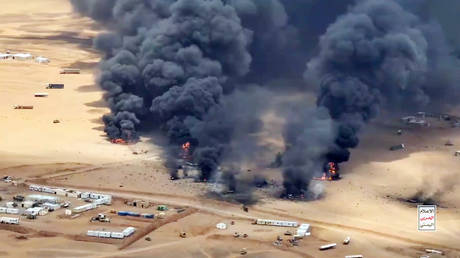
Йемений хууситууд АНУ-ыг Саудын Арабтай хийж буй зэвсэгт мөргөлдөөнд хөндлөнгөөс оролцохгүй байхыг хүссэн тухай АНУ-ын Ерөнхийлөгч Дональд Трамп мэдэгдлээ.
Хууситууд энэ долоо хоногт Йемений Улаан тэнгисийн эрэг дагуу томоохон ахиц гаргаж, Моха, Дхубаб боомт болон Баб-эль-Мандебын хоолойн орох хэсэгт байрлах Перим арлыг хяналтдаа авсан байна. Энэхүү газар зүйн стратегийн ач холбогдолтой бүс нутгийг хянаснаар тус бүлэглэл олон улсын тээврийн болон Саудын Арабын газрын тос экспортлох гол маршрутуудад нөлөөлөх боломжтой болжээ. Дональд Трамп Ирландад айлчлах үеэрээ хууситууд АНУ-тай дайтахыг хүсэхгүй байгаагаа илэрхийлсэн гэв.
Саудын Арабын угсаа залгамжлах хунтайж Мохаммед бин Салман пүрэв гарагт Дональд Трамптай хоёр удаа утсаар ярьж, хууситуудын довтолгоог зогсоохын тулд АНУ-ыг цэргийн цохилт өгөхийг уриалсан гэх мэдээлэл байна. Гэвч АНУ-ын албаны хүмүүсийн мэдээлснээр Вашингтон одоогоор шууд цэргийн ажиллагаанд оролцох төлөвлөгөөгүй байгаа аж. Үүний зэрэгцээ АНУ Саудын Арабт тагнуулын мэдээлэл болон бай онох өгөгдлөөр дэмжлэг үзүүлж, 200 орчим цэргийн албан хаагч туслах үүрэг гүйцэтгэж байна.
Хууситуудын төлөөлөгч Мохаммед аль-Бухайти тус бүлэглэл зөвхөн Саудын Арабыг онилж байгаа бөгөөд Улаан тэнгис дэх усан замын тээврийн эрх чөлөөг хамгаалах үүрэг хүлээсэн гэж мэдэгдэв. Гэсэн хэдий ч өнгөрсөн долоо хоногт Саудын Арабын F-15 болон Typhoon сөнөөгч онгоцууд Йемений долоон мужид 129 удаагийн агаараас цохилт өгсөн гэж хууситууд мэдээлсэн байна. Мөргөлдөөн хурцдаж, талууд пуужин, дрон болон хүнд зэвсэглэл ашиглан харилцан дайралт хийсээр байна.
Дэлгэрэнгүйг эх сурвалжаас харах
↓Эх сурвалжийг нээх ↓
The US president says the Yemeni group does not want Washington involved, as Riyadh reportedly presses him to order strikes
Yemen’s Houthis have asked the United States not to intervene in their escalating conflict with Saudi Arabia, President Donald Trump has said, as Washington seeks to avoid opening another front in the Middle East.
Houthi forces made major gains along Yemen’s Red Sea coast this week, pushing back Saudi-backed government troops and seizing the strategic ports of Mocha and Dhubab, as well as Perim (Mayun) Island at the entrance to the narrow Bab al-Mandeb Strait. The advance has tightened the group’s grip on one of the world’s most important shipping chokepoints while threatening another crucial route for Saudi oil exports.
“The Houthis called us, and they don’t want to fight with us,” Trump told reporters on Saturday during a visit to Ireland. “They don’t want us to go after them” and “would much prefer not having us involved,” he added.
Trump said the group was allowing most shipping to pass through the Red Sea, adding that “it’s just one country that they’re not too happy with, and we’ll get that straightened out.”
Saudi Crown Prince Mohammed bin Salman reportedly called Trump twice on Thursday and urged him to order US strikes against the Houthis to stop their advance. Trump declined the request, according to Axios, which cited US officials as saying Washington has no plans for direct military intervention for now.
The US is nevertheless providing Saudi Arabia with intelligence and targeting data, and roughly 200 American military personnel are providing non-combat support. CENTCOM chief Adm. Brad Cooper also traveled to the kingdom for urgent consultations.
Trump confirmed speaking with the Saudi crown prince but did not disclose details of their conversation. “He’s a good friend of mine,” Trump said. “I can just say everything’s going to work out fine and dandy.”

The Houthis have framed their campaign as a fight to drive Saudi-backed government forces out of Yemen and restore the country’s sovereignty.
“We do not target any country except the Saudi enemy,” Mohammed al-Bukhaiti, a spokesman for the group, told RT on Thursday. “In fact, we are committed to protecting the freedom of maritime navigation in the Bab al-Mandeb Strait and the Red Sea.”
Al-Bukhaiti also warned that Houthi forces are prepared for a broader confrontation if outside powers join Riyadh, saying Yemen was capable of fighting “up to three fronts” – against Saudi Arabia, Saudi-backed Yemeni forces and any foreign country that becomes involved.
The Houthis have launched missile and drone attacks on Saudi energy facilities in recent weeks, while Riyadh has blamed drones launched from Iraq for a separate attack that forced it to shut down its key East-West oil pipeline.
الناطق الرسمي للقوات المسلحة اليمنية : القوات الجوية اليمنية تستهدف عناصر وآليات الميليشيا الحوثية في صندوق القتل .
*المركز الاعلامي للقوات المسلحة* pic.twitter.com/0dL9fVW9he
— المركز الإعلامي للقوات المسلحة اليمنية (@Yem_army_media) September 12, 2026
Fighting has intensified sharply in recent days, with government forces releasing multiple videos of their counterattacks, including what they called “precision airstrikes on Houthi military vehicles and militants inside the designated Mocha kill box.”
Houthi spokesman Yahya Saree said on Saturday that Saudi aircraft had carried out 129 strikes across seven Yemeni provinces over the previous 48 hours using F-15 and Typhoon jets, warning that the bombardment “will not go unanswered.”
Footage released by Iran-backed Houthi rebels reportedly shows damaged and targeted Saudi-backed military vehicles.
Broadcast by Al-Masirah TV, a Houthi-controlled satellite news network, the video depicted burnt vehicles, the positioning of Houthi combatants, and the Bab… pic.twitter.com/d7ZKtNAD1x
— CGTN Europe (@CGTNEurope) September 12, 2026
The Houthis have also released extensive combat footage of their rapid advance, showing attacks on Saudi-backed forces using conventional weapons, ballistic missiles and drones, as well as abandoned and destroyed vehicles and the bodies of killed troops.

