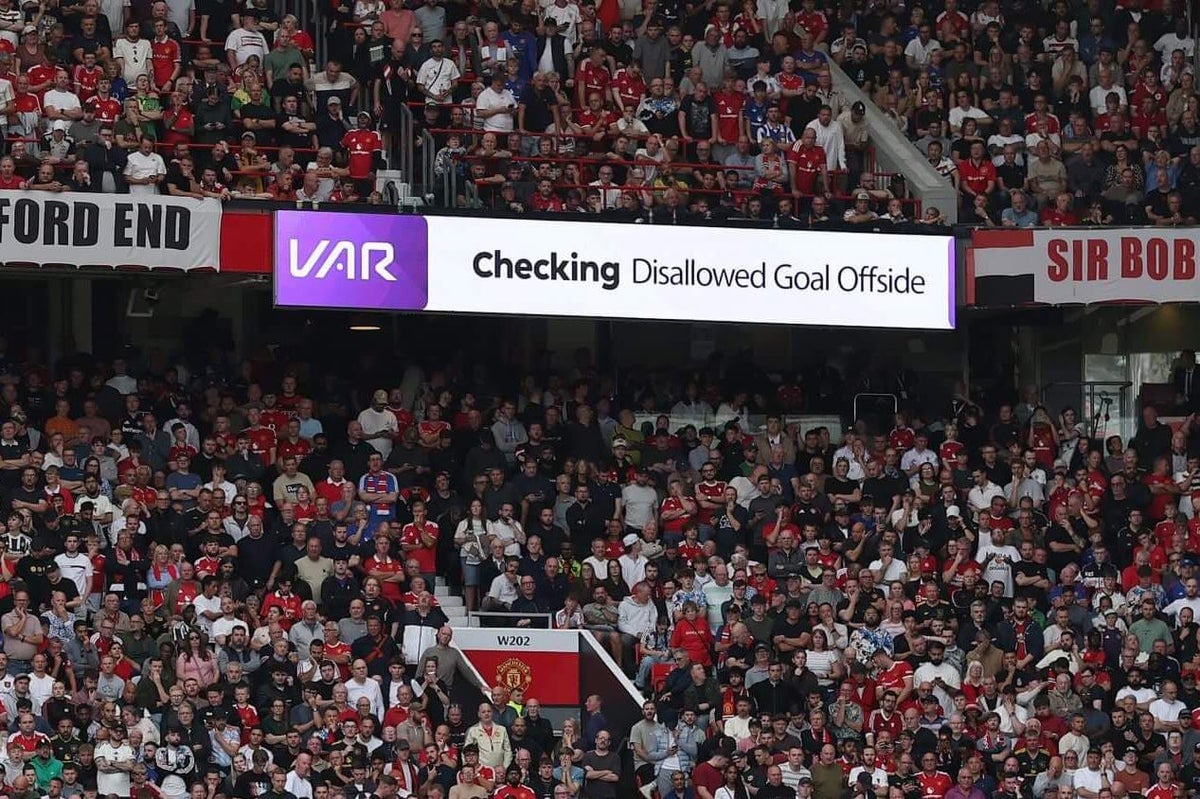
Шүүгчдийн баг Эрлинг Холандын гоолыг тооцохдоо Энцо Фернандесийн тоглолтод үзүүлсэн нөлөөллийг дутуу үнэлснээс ноцтой алдаа гаргажээ.
Премьер лигийн Манчестер дербигийн 60 дахь минутад Эрлинг Холандын оруулсан гоолыг талбайн шүүгч Майкл Оливер оффсайд гэж үзсэн ч ВАР-ын өрөөнд хяналт хийсэн Мэтт Донохью уг шийдвэрийг өөрчилсөн юм. ВАР-ын системээр хагас автомат оффсайд технологи (SAOT) ашиглан Холандыг дүрэм зөрчөөгүй гэж дүгнэсэн боловч энэ нь үйл явцын зөвхөн нэг хэсэг байв.
ВАР-ын ажилтнууд гоолын өмнөх нөхцөл байдлыг шалгахдаа Энцо Фернандес оффсайд байрлалаас бөмбөгөнд хүрэхийг оролдсон эсэх болон тэрээр хамгаалагч Лисандро Мартинез, хаалгачийн үйлдэлд хэрхэн нөлөөлснийг анхааралгүй орхижээ. “Pro Ref”-ээс гаргасан тайлбараар бол шүүгчид зөвхөн Холандын байрлалд төвлөрч, Фернандесийн оффсайд дүрмийн зөрчлийг бүрэн үнэлээгүй байна.
Энэхүү үйл явц 80 секунд үргэлжилсэн бөгөөд шүүгчдийн багт ажиллаж байсан туслах шүүгч болон хяналтын өрөөний ажилтнууд алдааг засах боломжтой байсан ч хөндлөнгөөс оролцоогүй нь тодорхой болжээ. Уг асуудал нь орчин үеийн хөлбөмбөгийн дүрэм журам хэт нарийн төвөгтэй болсныг харуулж байгаа бөгөөд алдаатай шийдвэр нь Манчестер Юнайтед-д сөрөг үр дагавар авчирлаа.
Дэлгэрэнгүйг эх сурвалжаас харах
↓Эх сурвалжийг нээх ↓
Graham Scott was a Premier League referee for a decade and also worked as a video assistant referee over 100 times. Here, he explains how the process would have worked, based on his experience, for Erling Haaland’s goal against Manchester United from the moment the ball hit the back of the net.
“The on-field decision is offside, Erling Haaland.”
These words by Michael Oliver in the 60th minute of the Manchester derby would have triggered video assistant referee (VAR) Matt Donohue to start checking whether City’s opening goal had correctly been chalked off.
“Checking the on-field decision of offside,” Donohue would have told Oliver before setting to work.
He would start by asking the replay operator sitting next to him to roll back the tape to the start of the attacking possession phase (APP), which would have been when Antoine Semenyo broke into the area. Until then, there had been no issue at the change of possession, no potential offside and no challenge for the ball.
When a goal is scored, whether it is given or not, VARs are expected to watch the incident through in its entirety and look for potential issues in the build-up.
In this case, Donohue would have asked the replay operator, employed by Hawk-Eye, to show him replays from side-on, in this case the cameras level with the 18-yard line and the goal line. There are no potential fouls or handballs, only offside to consider. He should have articulated any issues he would need to check, which in this case would be the actions of Enzo Fernandez and Haaland’s position.
Oliver was the referee on Sunday (Carl Recine/Getty Images)
Many observers in the stadium, TV studios and the nation’s sofas thought Haaland was indeed offside, but that’s because the television images become distorted. This optical illusion, known as a ‘parallax’, often leads to viewers drawing the wrong conclusion and amateur VARs on social media drawing the wrong lines.
Here, Donohue would have known immediately that the offside decision was close enough that he would need to use the semi-automated offside technology (SAOT) to check its veracity.
SAOT is operated by Genius Sports, which employs its own team of staff who sit in an adjacent space to the VAR hub at Stockley Park, west London.
For this part of the process, Donohue would have to refocus on a different screen on which there is a bewildering amount of information that can overwhelm even the trained eye.
The disembodied voice of a Genius employee would have told Donohue straightaway that, according to SAOT, the decision was close, but that Haaland was factually onside. However, a VAR cannot blindly follow this advice without interrogating the outcome, which is generated by an artificial intelligence-powered program that is incredibly accurate but cannot be trusted implicitly.
There are now multiple checks to carry out. These include determining the kick point, which is the moment that Gvardiol’s boot first touched the ball as he crossed it. This is established by dozens of cameras in the stadium that together capture 10,000 ‘surface data points’ per player, per second, throughout the game.
Donohue would have been shown a still image depicting the moment that SAOT had concluded Gvardiol first touched the ball and been told whether it would make any difference to the outcome if he thought the wrong kick point had been selected.
It rarely affects the decision, although Fabian Wirtz’s goal for Liverpool at Fulham last season was literally one frame away from being offside.

The parallax effect means it is hard to tell if Haaland was onside… (Sky Sports)

But semi-automated offside showed he was onside (Sky Sports)
For now, we do not know whether the choice of kick point affected the outcome, or whether Donohue decided to change it.
A graphic on the screen shows all the players, with tags against those who are relevant to the action. In this case, Gvardiol’s avatar would have a speech bubble with a ball above his head, to indicate he had touched the ball last.
A similar graphic pointing at Patrick Dorgu would have contained the code 2RD, which stands for second rearmost defender, as in this case Dorgu’s right boot was the offside line.
Above Haaland’s head would be another speech bubble with the letters ATT, as he was the attacker that SAOT concluded had next played the ball.
Lines on the pitch would show the relative positions of Dorgu and Haaland, and their names and that of Gvardiol would appear across the bottom of the screen.
Donohue would have been asked to check whether these were indeed the relevant parties, which in this case was straightforward. The check is considered essential because there have been glitches resulting in the wrong players being selected by AI, especially in a crowded area or if there is doubt as to who played the ball and when.
At the foot of the Genius screen, high on the wall above the bank of Hawk-Eye screens, the offside distance is shown in a box. If the player is onside, the box turns green, and the number shown is negative. For example, Ben White was eight centimetres onside during the build-up to an Arsenal goal against Coventry City on the opening night of the season.
To make matters more complicated, the Premier League has a tolerance level of five centimetres to give the attacking side the benefit of any doubt. At Fulham last season, Wirtz was exactly five centimetres offside, so the goal was allowed to stand. So the graphics can show that a player is offside, but not offside enough to be penalised.
By now, Donohue would have been confident that Haaland was factually onside, but there was still the final stage, which is to approve an image that would be sent to the broadcasters. For Genius, this involves a system known as mesh tracking, which can recreate every on-field event in a 3D render.
Once the SAOT process was complete, the factual element of the check was over, and it was clear from the TV coverage that Donohue told referee Oliver at this point — 80 seconds after the ball hit the net — that Haaland was in fact onside.
Broadcasters can hear anything a VAR says to the on-field officials, which is why they had the early heads-up that a change to the decision was in the offing. The TV pundit working for the Premier League’s international feed, Andy Townsend, said “Wow” on hearing the news, before commentator Conor McNamara explained what they had just heard down the line from Stockley Park.
Eighty seconds in the VAR chair feels like two or three times that long, and by now even seasoned video referees can start to feel the pressure of time. It becomes apparent through the headsets that the players and crowd are getting restless, and you can hear the referee having to bat back questions from both teams about what on Earth is taking so long.
The temptation to rush the final stage of the process can be irresistible — just ask Lee Mason, who lost his job as a VAR after hastily closing a check on a game between Arsenal and Brentford in 2023. However, while cutting corners at this stage is understandable, it’s also indefensible.
As we now know through a statement released by Pro Ref on Sunday night, Donohue focused only on whether Enzo Fernandez, who was comfortably offside when Gvardiol crossed, had got a touch on the ball before it reached Haaland. Any contact should have been detected by SAOT, but there is a slim chance that a very faint touch could be missed, so it was worth a look.
However, Donohue failed to consider whether Fernandez had committed an offside offence by having an impact on United defender Lisandro Martinez’s ability to play the ball.

Fernandez’s involvement was not given enough regard (Carl Recine/Getty Images)
Such is the complexity of the current offside law that this is open to interpretation, and I presumed wrongly that the video officials had taken an informed decision. They hadn’t, which meant they were wrong and so was I. Like Donohue, I rushed to judgement after becoming too focused on Haaland being judged onside, despite what the TV pictures appeared to show.
On watching the replays again, it’s clear that Fernandez attempted to play the ball, and obvious that he affected the goalkeeper and defender behind him. And I should know what ‘clear’ plus ‘obvious’ means by now.
Back at Stockley Park, there are safety nets in place that should still prevent this kind of error. Sitting next to Donohue yesterday was a Premier League assistant referee whose job includes challenging the VAR if they follow the wrong process. It is impossible to know this for sure unless audio is released from the incident, but we have to assume he did not.
Furthermore, just along the corridor there is an operations room where Pro Ref managers and other VAR hub staff follow every match in progress. This can be challenging if there are several being played at once, but on Sunday afternoon, there was only one.
Pro Ref have a hotline to the VAR and a mandate to intervene if they think he is making a palpably incorrect call in law or has not given due consideration to all the elements of the process. Again, while we don’t know this for certain, based on the outcome, we have to assume nothing happened there.
The fallout will be significant, and Manchester United have every right to be aggrieved. There will be calls for heads to roll in the name of ‘accountability’, but putting the fear of god in the minds of anyone sitting in the VAR chair would not be conducive to better outcomes.
Simplifying the laws and the processes would be the best place to start, as both have become so complicated that there are more cracks for officials to fall through.
In less than a decade, we have moved from having a man with a flag determine from distance whether a player has strayed offside and so gained an advantage, to a multi-million-pound process that requires an interface between five match officials and at least four staff from two tech companies.
For what? A few more goals are allowed to stand, and a few are disallowed, while money and time are wasted in the name of accuracy. Everyone in the game — not least paying spectators and TV subscribers — deserves better.

