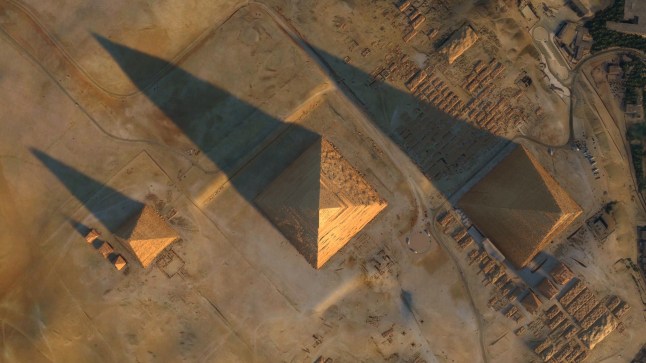
Израилын судлаач Сефи Леви Гизагийн пирамидын гадаад хэмжээсүүд нь эртний одон орны мөчлөгүүдийг хадгалсан мэдээллийн сан байж магадгүй хэмээн таамаглаж байна.
Судлаач Сефи Леви 2026 оны наймдугаар сарын 23-нд SSRN архивд байршуулсан судалгаандаа Хеопсын пирамидыг зөвхөн фараоны бунхан бус, харин одон орны мэдлэгийг чулуунд сийлсэн тэмдэглэл гэж үзжээ. Тэрээр эртний Египетийн “Рхинд” математикийн папирус дахь тооцооллын аргыг ашиглан пирамидын гадаад зургаан хэмжээсийг тодорхойлж, үүнийгээ одон орны болон хуанлийн 14 үнэ цэнтэй харьцуулсан байна. Эдгээр тооцооллын 10 нь сарны перигей, Сириус одны үзэгдэх байдал болон бусад гаригийн мөчлөгүүдтэй 0.2 хувийн нарийвчлалтайгаар таарч байгааг тэрээр онцолжээ.
Энэхүү таамаглалыг шалгахын тулд Сефи Леви 100,000 өөр хэмжээстэй пирамидын загвар дээр компьютерийн симуляци хийсэн байна. Үр дүнд нь 2.4 хувь нь л ижил төстэй одон орны утгуудыг гаргасан нь энэхүү тохиолдол нь санамсаргүй зүйл биш байх магадлалыг харуулж байна хэмээн тэрээр тайлбарлажээ. Гэвч энэхүү судалгаа нь хараахан хөндлөнгийн шинжлэх ухааны хяналтад ороогүй бөгөөд зөвхөн судлаачийн өөрийн боловсруулсан загвар юм.
Үндсэн урсгалын археологичид эртний Египетийн бичвэрүүдэд пирамидын хэмжээсүүд нь одон орны мэдээлэл агуулдаг гэсэн баримт байхгүйг сануулж байна. Мөн пирамидын доторх хоосон боржин чулуун авс болон түүнийг тойрсон оршуулгын цогцолбор нь уг байгууламжийг хааны бунхан байсан гэх уламжлалт онолыг илүүтэй дэмждэг. Сефи Левигийн судалгаа нь эртний Египетийн бүтээлийн тухай домог болон “Ногоон Сахар” бүс нутгийн түүхэн нүүдэлтэй холбоотой өргөн хүрээний таамаглалыг дэвшүүлж байгаа боловч үүнийг батлах хангалттай нотолгоо хараахан байхгүй байна.
Дэлгэрэнгүйг эх сурвалжаас харах
↓Эх сурвалжийг нээх ↓
The granite box inside the King’s Chamber at Giza is too wide to have passed through the finished corridors. It had to be put in place during construction. If the pharaoh’s body was ever laid inside, it left no trace. For 4,500 years, that empty room has kept a question alive, one mainstream Egyptology answers more or less with a shrug: the burial chamber of a royal tomb, robbed clean in antiquity.
Sefy Levy, an independent researcher based in Israel, thinks the emptiness is the point. In a preprint posted on SSRN on 23 August 2026, he argues that Khufu’s pyramid was built not to hold a body but to be a body of knowledge, with its outer dimensions serving as a permanent stone record of astronomical cycles known to its builders.
“The pyramid was not built to last forever because it contained something valuable,” he writes. “It was built to last forever because it was something valuable. The pyramid is not a container for knowledge. It is the knowledge, made stone.”
The claim slipped quietly into the preprint archive. It got loud on 11 September, when British and American tabloids began packaging it as a “Da Vinci Code” in stone. The paper underneath those headlines is narrower, and it has not been peer reviewed.
Researcher Found the Moon Inside Ancient Egyptian Math
Rather than starting with metres and a modern calculator, the hypothesis begins with design specifications the field already uses: a square base of 440 royal cubits and a seked of 5½, the Egyptian slope measure that gives the familiar face angle near 52 degrees. From those two inputs, Levy derives six exterior dimensions. He then applies the fractional operations recorded in the Rhind Mathematical Papyrus, a scribe’s handbook from the second millennium BC that preserves older methods.
Next comes the scoring. Levy checks the resulting calculations against fourteen astronomical and calendrical values documented in the Egyptian record. His deposited summary says ten of the fourteen land within 0.2 percent of their targets, while four miss, with the sizes of those misses listed. Four other targets were dropped because they could be reached only by operations the method does not permit, and each removal, he notes, lowered the reported count.
Two hits traveled furthest in secondary coverage. One calculation gives 27.5, set beside the 27.55-day interval between successive lunar perigees, the points at which the Moon comes closest to Earth; another gives 70, matching the roughly seventy days when Sirius disappears in the Sun’s glare, a span tied in Egyptian timekeeping to the star’s heliacal rising. Additional matches are said to line up with the repeating orbital cycles of Venus and Jupiter, along with the mathematical constants pi and the golden ratio.
Pi itself is hardly new to the argument. When the perimeter of Khufu’s base is divided by its height, the ratio comes out close to 2π, something John Taylor noticed in the nineteenth century.
A seked of 5½ also produces an approximation of 22/7 as a structural byproduct. So the old question remains: were the builders aiming at pi, or did they simply choose a clean Egyptian slope?
Levy treats the constant as one piece of a wider scoring exercise, not standalone proof.
A Simulation of 100,000 Pyramids Did Not Settle the Question
To see how often the matches might turn up by accident, Levy ran a computer simulation of 100,000 randomly dimensioned pyramids in the Old Kingdom style.
Approximately 2,419, about 2.4 percent, scored as many matches as the Great Pyramid or higher. He argues that the low percentage makes accidental alignment less likely, although the simulation is his own computational model, not independent scientific confirmation. The analysis scripts and raw output are deposited alongside the paper on Zenodo, which is more transparency than most viral pyramid papers provide.

The paper’s description on SSRN is tighter than the press framing: some write-ups called the work proof that the builders already knew the Earth’s size, but that is media language, not the test Levy reports in the deposited abstract, which scores Egyptian calendrical and astronomical values rather than a measured meridian or global circumference.
What Archaeologists Say the Empty Sarcophagus Actually Proves
Mainstream archaeologists still point to a basic problem. No recovered ancient text explicitly says the Great Pyramid’s dimensions were meant to encode astronomical data, remarkable as its precision is. The building also contains an empty granite sarcophagus and sits within a mortuary complex and surrounding royal cemetery, evidence that strongly supports its function as a royal tomb even though the King’s Chamber preserves no confirmed interment.
Britannica still lists three symbolic readings of the pyramid form: a stairway for the king’s ka, rays of the sun, or the primeval mound of creation. It does not treat the building as a data vault. That third reading is where Levy finds an opening. In the Heliopolitan creation account, the world begins as Nun, a dark primordial water, and from it rises a mound of dry land.
Egyptian religion already used the pyramid shape as an image of that creation mound. Levy’s move is different, and much larger: he treats Giza not as a late echo of the myth but as a full architectural restatement of it, with the proportions doing the work of text rather than the walls.

From there, he goes further than Egyptology does. Levy links the creation-mound reading to a longer hypothesis connecting early Egyptian culture to the Green Sahara, suggesting the builders were memorializing a landscape their ancestors left when the African Humid Period collapsed around 5500 BCE. No inscription says that.
The hypothesis instead depends on a chain of earlier Levy preprints on Saharan migration and minor step pyramids, also unreviewed. Critics of pyramid numerology have a familiar objection: give an analyst six dimensions, a menu of fractions and a list of astronomical periods, and matches will turn up because the menu is big. Levy tries to answer that with null models, a published miss list, a negative control showing stellar positions match at chance rates, and deposited code.
Those are the right moves. Whether they are enough is for specialists who work Giza for a living, and none appear to be on the record in the coverage this week; the paper lists nine falsifiable predictions in the deposit.
If the ten-of-fourteen score cannot be reproduced using only the operations Levy allows, without widening the method after the fact, the result deflates. If it survives independent replication, the argument shifts from whether the pyramid is a tomb to whether it is a tomb that also carries an encoded calendar, and those are not the same question. The stones do not yet answer either one.
Enjoyed this article? Subscribe to our free newsletter for engaging stories, exclusive content, and the latest news.

