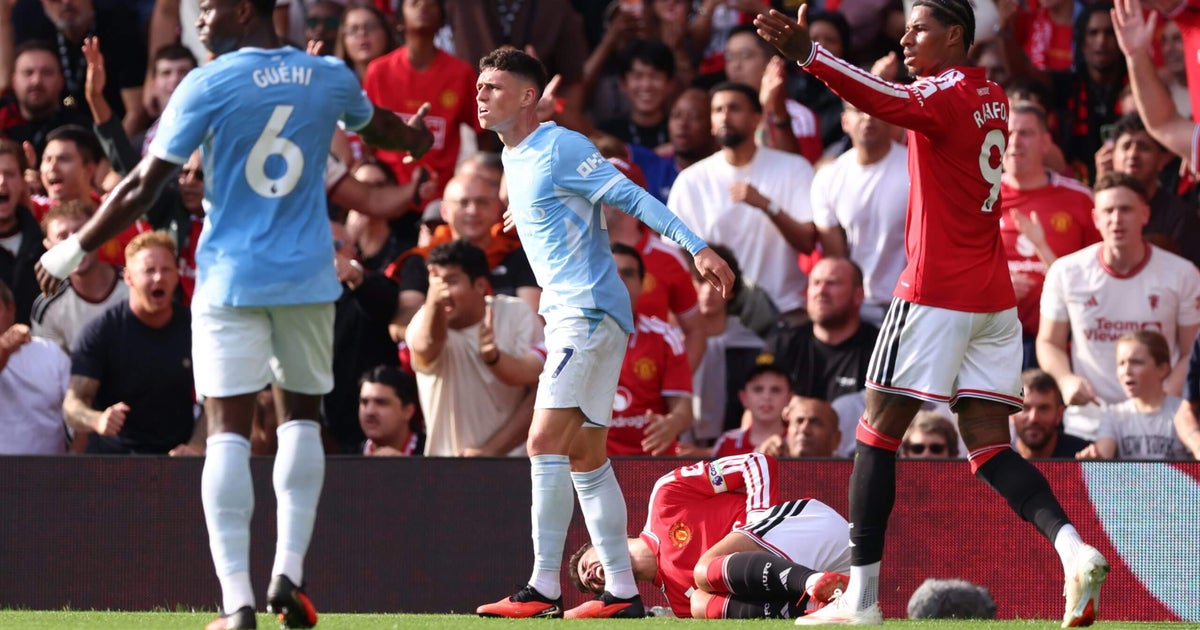
Манчестер дерби болон Премьер лигийн дөрөвдүгээр тойргийн тоглолтуудад гарсан маргаантай шийдвэрүүдийн талаар мэргэжилтнүүд тайлбар хийв.
Манчестер дерби тоглолтын үеэр Эрлинг Холандын оруулсан гоолыг VAR-аар шалгахдаа шүүгчид “алдаатай дүгнэлт” гаргасныг албаныхан хүлээн зөвшөөрлөө. Мөн тус тоглолтод Бруну Фернандештай мөргөлдсөн Фил Фоден улаан хуудас авч талбайг чөлөөлсөн юм. Шүүгчийн эксперт Грэм Скоттын тайлбарласнаар, Фоденыг талбайгаас хөөсөн шийдвэр нь дүрэм болон өмнөх жишгүүдийн дагуу зөв бөгөөд Бруну Фернандешийн хувьд улаан хуудас авах үндэслэл байхгүй гэж үзжээ.
Сандерленд багийн оролцоотой сүүлийн хоёр тоглолтод гарсан торгуулийн цохилтууд шүүмжлэл дагуулсаар байна. Брентфордтой хийсэн тоглолтод торгуулийн цохилт олгосон нь үндэслэлтэй байсан ч Арсеналын эсрэг тоглолтод шүүгч Жон Брукс нөхцөл байдлыг буруу уншсан байж болзошгүй гэж эксперт дүгнэжээ. Арсеналын дасгалжуулагч Микель Артетагийн шүүмжлэлийн тухайд, дасгалжуулагчид ийнхүү байр сууриа илэрхийлэх нь шүүгчдэд нөлөөлөх эрсдэлтэй ч мэргэжлийн шүүгчид сэтгэл зүйн хувьд үүнийг даван туулах чадвартай байх ёстой гэв.
Оффсайд байрлалыг тодорхойлоход ашигладаг технологийн хувьд Премьер лиг хуучин арга барилаас татгалзаж, хиймэл оюун ухаанд суурилсан системийг ашиглаж эхэлжээ. Энэхүү систем нь олон арван камерыг ашиглан тоглогчдын байрлалыг секунд тутамд хянаж, үнэн зөв мэдээллийг VAR-ын төв рүү илгээдэг байна. Мөн шүүгчид тоглолтын явцад гаргасан томоохон алдааныхаа дараа сэтгэл зүйн хувьд тайван байж, дараагийн шийдвэрүүддээ анхаарлаа төвлөрүүлэх шаардлагатай байдаг аж.
Дэлгэрэнгүйг эх сурвалжаас харах
↓Эх сурвалжийг нээх ↓
The fourth round of this season’s Premier League matches brought yet more controversy, with Erling Haaland’s winner in the Manchester derby being the main talking point after Pro Ref admitted officials made an “error of judgement” when applying VAR to the goal. But there was also a sending-off for his City team-mate Phil Foden in a clash with Bruno Fernandes of United in the same match.
Graham Scott refereed in the Premier League for a decade before retiring in 2025 to return to his previous career as a journalist. He was a video assistant referee (VAR) more than 100 times, so brings a unique insight into how match officials operate, both on the pitch and in the video suite.
As The Athletic’s resident refereeing expert, he answers your questions about the weekend’s big in-game decisions and VAR interventions…
Why didn’t VAR look at the whole Foden incident and recommend some discipline for Fernandes? — DB; Why wasn’t Fernandes at least booked for kicking Foden? — Leon G.
The VAR would have checked the whole incident based on the on-field decisions, as they affected both players, but was only allowed to assess whether either had been the victim of an obvious error.
The red card shown to Foden cannot be argued, given that only a few weeks ago there was a similar incident at Brighton & Hove Albion, in which the VAR recommended Joao Gomes of Aston Villa be sent off. The independent panel judged it a correct decision by a 5-0 margin.
Surely even United fans would likely think that Fernandes deserved some kind of sanction for his actions, but based on the laws of the game and precedents set by decisions in recent seasons, there is no case for a red card.
Michael Oliver sent off Foden for kicking out at Fernandes (Paul Ellis/AFP via Getty Images)
Were the two controversial penalties awarded to Sunderland in their past two Premier League matches (away to Brentford, and at home against Arsenal) the correct decisions? Or did they not reach the threshold required for VAR intervention? — Patrick D.
These calls demonstrate why referees are so reluctant to get involved in penalty decisions when players are wrestling in the area. Don’t be surprised if none are awarded for a while now, and there is a return to the all-in-wrestling bouts at every corner by Christmas.
The only way to be sure that only one player has committed an offence is for at least two officials to have watched the entire incident.
At Brentford, the assistant referee at that end of the pitch would have had a decent view throughout, as the defender was his point of reference for offside and was right in front of him.
The referee’s eyes would have swept across the area and landed on the challenge after it started, but early enough that he could form a view of what both players were doing.
Initially, the players are holding each other. But Sunderland’s Wilson Isidor lets go, while Keane Lewis-Potter of Brentford continues to grapple while facing away from the ball. The award of a penalty felt fair enough, and there’s a good chance the VAR would have intervened if not.
At the Stadium of Light on Saturday though, referee John Brooks was on his own, as his assistants were in no position to help. It would seem he only caught up with the actions of Dan Ballard and Ezri Konsa after they had started, and misread what he then saw.

Ezri Konsa was punished for a challenge on Dan Ballard (Michael Driver/MI News/NurPhoto via Getty Images)
There’s a good case for a VAR intervention, if only to allow Brooks the chance to watch the entire episode and take a more informed view. But that’s not how the VAR system works, because the Premier League fears that every key decision would end with the ref staring at the pitchside monitor. It only wants a review if any right-minded person would change the decision with the benefit of replays.
Arsenal manager Mikel Arteta clearly thought that threshold was met, and I’m inclined to agree, while acknowledging I may well have stayed out if it had been me in the VAR chair.
The independent panel that reviews decisions will doubtless mark this down as a referee error, but it’s less clear whether the VAR will be supported for keeping out of it.
As a former referee, do you agree with Arteta that the Sunderland penalty should not have been given? And looking beyond the individual decision, could strongly highlighting incidents like this also subtly influence how referees and VARs view similar situations involving Arsenal later in the season? — Justin L.
A straight ‘Yes’ to the first question, and I’ll try not to prevaricate and waffle in response to the second, but may struggle.
Arteta is doing what some managers have done for years: creating a siege mentality while trying to get into the officials’ heads that they owe their club a bid decision.
As hard as officials try to block out such noise, it would be hard to claim with conviction that these kinds of comments do not have a subtle influence, as Justin puts it. And there’s no point in me pretending that this is more likely if they’re from a higher-profile club or manager.
Officials are human, cannot avoid all media and are more likely to be aware of a post-match rant by Arteta than a manager lower down the league. Some are bound to carry some unconscious bias onto the field, however hard they try to suppress it.

Arteta was critical of the penalty decision against Sunderland (Getty Images)
But by the time officials reach the Premier League, most are resilient and resolute enough to set aside what has gone before and referee what is put in front of them. It’s just two teams trying to score more goals than each other. They’ve seen and heard it all.
Further, referees are heavily incentivised by professional pride and financial rewards to get the key decisions right or choose the best option if a call is highly subjective.
I tried consciously to clear my head as I entered the field so that the teams’ identities became irrelevant. I reckon I succeeded, but then I would think that.
Regarding Haaland’s goal, Michael Carrick commented that the lines drawn were dubious. It seems that we’re seeing less of the VAR process than in previous seasons (regarding the lines being drawn) — is this a decision made by Pro Ref, and if so, could you explain the reasoning? — Scott B.
Carrick is behind the times. There are no lines drawn any longer, and there haven’t been since long before he returned to United as interim head coach in January.
Since late in the 2024-25 season, determining the facts around an offside decision has been handed over to AI and involves dozens of cameras being fixed around every stadium. Their feeds are beamed straight into the VAR hub at Stockley Park, west London, and the 10,000 points of reference they record every second are used to plot the positions of the ball and every player.
If an offside decision is obvious, the VAR clears it immediately. If it’s tight, the VAR is shown all the relevant information on a screen split into quarters. This includes a definitive decision from AI, but the technology is not yet trusted implicitly, so the kick point, identity and position of the players involved are double-checked.
Why Do Some Onside Goals Look Offside?
I guess this screen could be shared with broadcasters in the interests of transparency, but its contents may not make much sense to viewers at home or in the pub. The independent panel that meets weekly to assess officials’ decisions in the Premier League is shown the full process, so there is a check after the event.
Earlier iterations did involve lines being drawn by the VAR’s replay operator, and TV viewers were sometimes shown this happening live. Now, they are shown ones that have been generated automatically.

Carrick questioned how the VAR calls were made (Carl Recine/Getty Images)
If a referee makes a big mistake during the game and then realises they have made an error that could cost a team three points, do they then referee the rest of the game differently, or try to accept the error? — apgoffin
Not since the advent of the VAR system. My career straddled the introduction of video reviews, and being able to move on from major errors was a crucial part of the job.
Psychologists would be employed to teach us to ‘Park it and move on’ or visualise releasing a balloon, which seemed like nice work if you could get it, although, in fairness, their roles were rather more involved than that.
Nowadays, the challenge can be the opposite, as you can be under the impression that a game has gone swimmingly because there have been no VAR interventions. But that doesn’t mean you’ve got everything right — only that, in one colleague’s view, you have not got anything definitively wrong. Sometimes, the world thinks you’re both wrong.
If a club feel they consistently receive incorrect/unfair decisions from a particular referee or official across multiple matches, can they request that the official not be selected to work their games in the future? — Sam C.
Kind of. Clubs can ask what they like, privately or publicly, and Pro Ref then gets to decide whether to comply.
Referees never officiate on the same team in successive weeks and rarely twice in a month, and time is a great healer. Occasionally, a club kick off so much that Pro Ref thinks it is better to keep the ref in question away for longer, partly to avoid having that fight and partly to protect their employee. None of us wanted to be the story before the game had kicked off.
The VAR on Sunday, Matt Donohue, won’t go anywhere near officiating a Manchester United match for months, maybe years, but in time will visit as fourth official on a midweek evening to start rebuilding bridges.
Should we start to use AI more to enforce consistency in refereeing, as we’re seeing in many professional fields? — Red R.
It will happen in relation to certain situations, but the referee’s role cannot be distilled into a series of discrete decisions that could be made by a computer.
AI is already used to help with factual offsides, as detailed above, but it still takes an experienced, professional eye to judge the subjective elements of the decision (assuming they remember to check it, of course).
Your question is predicated on the view that consistency is desirable, but referees often draw criticism for enforcing rules too strictly, in which case they are labelled robots who do not understand the game.
Maybe AI could create an empathetic robot who understands the nuances of mutual holding, the difference between aggression and violence, and whether Arteta has strayed unjustifiably outside his technical area.

