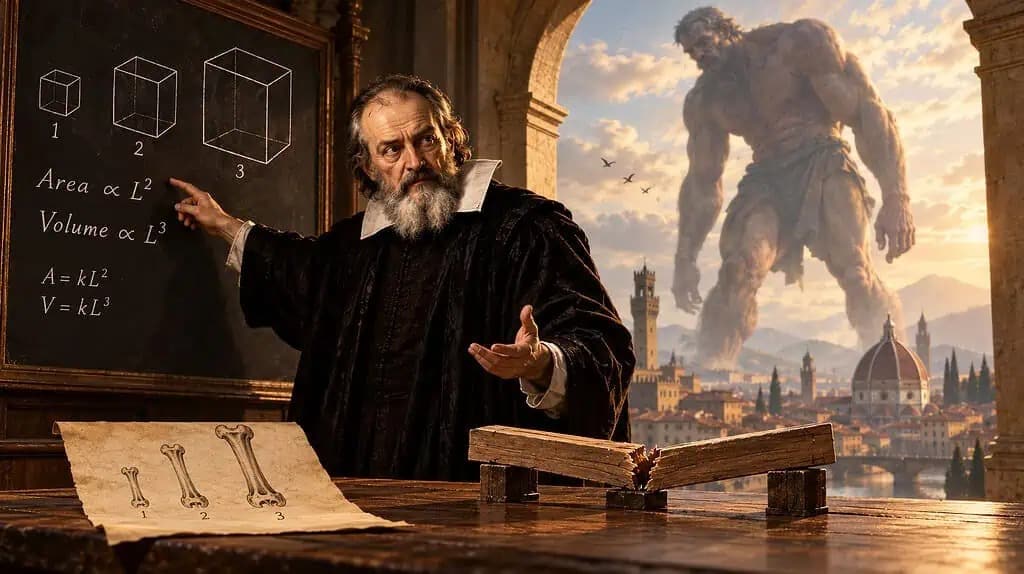
Физикийн хуулиар хүний биеийн хэмжээг зөвхөн томруулах замаар аварга биетэн үүсгэх боломжгүй бөгөөд энэ нь бүтцийн хувьд тэсвэргүй байдаг аж.
Италийн эрдэмтэн Галилео Галилей 1638 онд хэвлэгдсэн “Хоёр шинэ шинжлэх ухааны тухай харилцан яриа” бүтээлдээ биеийн хэмжээ нэмэгдэхэд жин болон хүч чадлын харьцаа хэрхэн өөрчлөгддөгийг тайлбарласан байна. Тэрээр модон дам нурууны жишээн дээр тайлбарлахдаа, хэмжээг нь томруулах тусам эзлэхүүн нь өсөхийн хэрээр жин нь хүч чадлаасаа хамаагүй хурдан нэмэгддэгийг тогтоожээ. Уг зарчмын дагуу, хүний биеийг ижил харьцаатайгаар томруулбал яс болон булчин нь өөрийн биеийн жинг даах чадваргүй болох юм.
Аварга биетнүүд нь домог үлгэрт түгээмэл байдаг ч бодит байдал дээр амьд организмын бүтэц нь биеийн хэмжээндээ зохицсон байхыг шаарддаг. Тухайлбал, заан эсвэл хирс зэрэг том амьтад жижиг амьтдыг зүгээр л томруулсан хувилбар биш, харин илүү бүдүүн яс, өөр бүтцийн онцлогтой байдаг нь Галилейн онолыг баталж байна. Эсрэгээрээ, шавьж зэрэг маш жижиг амьтад жин багатай тул нарийн мөчөөр ч чөлөөтэй хөдөлж, хана болон усны гадаргуу дээр явах боломжтой байдаг.
Энэхүү шинжлэх ухааны дүгнэлт нь домогт гардаг аварга биетнүүд шиг том хэмжээтэй хүн бодитой орших боломжгүйг харуулж байна. Хэрэв тийм аварга биетэн байлаа гэхэд түүний яс илүү бат бөх материалаар хийгдсэн байх эсвэл хүч чадлын хувьд хэвийн хэмжээтэй хүнээс ч сул байх шаардлагатай болно. Ийнхүү физикийн хязгаарлалт нь аливаа зүйлсийн бүтэц, хэлбэр хэмжээнээсээ хамааран өөрчлөгдөх ёстойг нотолж байна.
Дэлгэрэнгүйг эх сурвалжаас харах
↓Эх сурвалжийг нээх ↓
Giants have filled myths and legends for centuries, from the Cyclops in ancient Greek stories to the famous giant of Jack and the Beanstalk. But according to Galileo Galilei, creatures with a human shape but enormous proportions could never actually survive under the laws of physics.
Nearly 400 years ago, the Italian scientist explained that simply making a human body bigger would not work. As size increases, weight grows much faster than strength, meaning a giant with the same proportions as a normal person would eventually be unable to support its own body.
The idea of giants appears in cultures around the world. In Homer’s Odyssey, Odysseus faces the Cyclops, a huge one-eyed creature that behaves much like a human but possesses extraordinary size and strength. Medieval stories also imagined giants as beings capable of walking, fighting, building, and using objects just like humans, only on a much larger scale.
But these stories overlook one major problem: bodies and structures do not simply scale up. A bigger version of a human would not automatically be stronger. Bones, muscles, and other parts of the body would have to deal with forces that increase much faster than their ability to resist them.
Galileo Revealed Why Bigger Is Not Always Stronger
In his 1638 book Dialogues Concerning Two New Sciences, Galileo explored this problem by imagining a wooden beam made from strong oak. He asked what would happen if that same beam was enlarged while keeping exactly the same shape and proportions.
At first, a larger beam seems like it should be much stronger. Its cross-sectional area increases as its size grows, meaning it can resist more pressure. A beam that is ten times larger in every direction would have a cross-sectional area 100 times greater, making it much stronger than the original.
However, the weight of the beam does not increase in the same way. Because weight depends on volume, a ten-times larger beam would become 1,000 times heavier. Its strength would increase, but its mass would increase much faster.
According to Galileo’s explanation in Dialogues Concerning Two New Sciences, this difference eventually creates a serious problem. At a certain size, a structure would become too heavy for its own strength and would no longer be able to support itself.
A Human-Sized Body Cannot Simply Become A Giant Body
Galileo then applied the same idea to living creatures. Human bones act like support beams, carrying the weight of the body and helping muscles create movement. If those bones were enlarged without changing their proportions or materials, they would not become strong enough to handle the extra weight.
“Clearly then if one wishes to maintain in a great giant the same proportion of limb as that found in an ordinary man he must either find a harder and stronger material for making the bones, or he must admit a diminution of strength in comparison with men of medium stature,” Galileo wrote.
This means that a giant could not simply have longer arms, bigger legs, and thicker muscles while keeping the same human design. Its entire structure would need to change.
The same problem would affect everything around such a creature. A giant sword would be extremely heavy, a larger wooden chair could break under its own weight, and oversized buildings or tools would face the same physical limits. The world imagined in giant legends does not match how materials behave in reality.
Why Big Animals Need Different Bodies?
The animal world shows how size affects bodies in practice. Large animals such as elephants, rhinoceroses, and hippopotamuses do not look like scaled-up versions of smaller creatures. Their bodies have evolved with thicker bones and stronger structures to support their greater weight.
As explained by Galileo’s principles, as an animal becomes larger, its mass increases faster than the strength of its supporting structures. This is why elephants have much thicker legs compared with smaller animals like cats or dogs.
The opposite effect can be seen in very small creatures. Insects can have extremely thin limbs and still move effectively because their weight is so low. Some insects can even walk on walls or water because forces that are insignificant for larger animals become much more important at their scale.
Enjoyed this article? Subscribe to our free newsletter for engaging stories, exclusive content, and the latest news.

