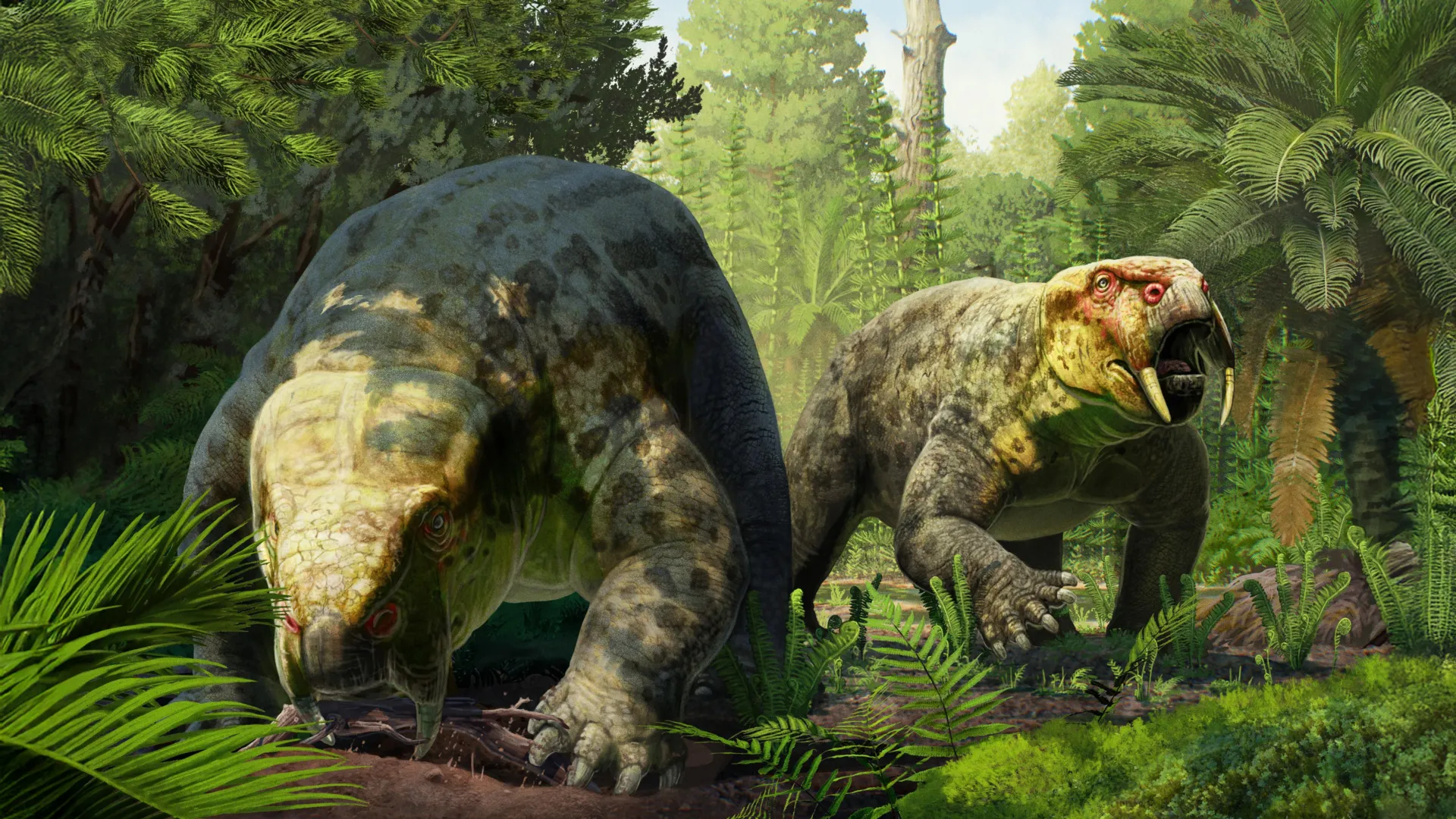
Эрдэмтэд Танзани улсын нутаг дэвсгэрээс илрүүлсэн өмнө нь бүртгэгдээгүй байсан эртний амьтны олдвор нь динозаврын хувьслын үе шатыг шинэчлэн тогтооход тусалж байна.
Бристолийн их сургуулийн судлаачид Танзаниас олдсон, ургамал идэшт дицинодонт (dicynodont) бүлэгт хамаарах эртний амьтныг Dinodontosaurus isiyavamanda хэмээн нэрлэжээ. Энэхүү олдвор нь 1963 онд Британийн экспедицийн цуглуулсан, олон арван жил Лондонгийн Байгалийн түүхийн музейд хадгалагдаж байсан чулуужсан яснуудын дунд байсан аж. Өмнө нь зөвхөн Өмнөд Америкаас илэрч байсан Dinodontosaurus төрөл зүйл Африк тивээс анх удаа олдсон нь эрдэмтдийн анхаарлыг татаж байна.
Journal of Vertebrate Palaeontology сэтгүүлд есдүгээр сарын 15-нд нийтлэгдсэн энэхүү судалгаа нь Танзанийн чулуулаг дахь олдворуудын насны талаарх ойлголтыг өөрчлөв. Урьд нь эдгээр чулуужсан олдворыг динозаврын хамгийн эртний төлөөлөгчдийн нэг гэж таамаглаж байсан ч, шинэ олдвор нь Өмнөд Америкийн чулуулагтай ижил насны давхарга болохыг харуулж байна. Радиометрийн шинжилгээгээр Өмнөд Америкийн эдгээр давхарга нь Өмнөд Африкийн олдворуудаас 10 сая жилээр залуу байж болзошгүйг харуулсан нь динозаврын үүслийн цаг хугацаа, газар зүйн байршлыг дахин авч үзэх шаардлагатайг сануулж байна.
Судлаачид музейн сан хөмрөгт хадгалагдаж буй үлдэгдлүүдийг орчин үеийн микро-CT сканнер зэрэг дэвшилтэт техникээр нарийвчлан судлахаар төлөвлөж байна. Ирээдүйн судалгаагаар үлдсэн яснуудыг шинжилж, эдгээр аварга ургамал идэштэн амьтад динозаврууд ноёрхохоос өмнөх үеийн экосистемд хэрхэн зэрэгцэн оршиж байсныг тодруулах юм. Энэхүү ажил нь музейн цуглуулга дахь өмнө нь бүрэн судлагдаагүй материалууд шинжлэх ухааны ойлголтыг хэрхэн өөрчилж болохыг харуулж байна.
Дэлгэрэнгүйг эх сурвалжаас харах
↓Эх сурвалжийг нээх ↓
An international research team has identified a previously unknown prehistoric animal that lived in what is now Tanzania roughly 240 million years ago during the Triassic period.
The species, named Dinodontosaurus isiyavamanda, could do more than add a new animal to the fossil record. According to researchers led by the University of Bristol, the discovery may help scientists more accurately date one of the world’s most important fossil regions and refine the timeline for the earliest stages of dinosaur evolution.
The findings were published September 15 in the Journal of Vertebrate Palaeontology. They suggest that some fossils from Tanzania once considered candidates for the earliest dinosaurs may actually be younger than scientists had thought.
A Fossil Mystery More Than 60 Years Old
The story began in 1963, when a British expedition collected a large number of synapsid fossils from what is now Tanzania. Synapsids are mammal-lineage vertebrates that were widespread and diverse long before dinosaurs came to dominate terrestrial ecosystems.
The fossils were eventually placed in the collections of the Natural History Museum, London. Many were studied, but others remained only partially examined, leaving unanswered questions about what animals they belonged to and what they could reveal about ecosystems that existed approximately 240 million years ago.
Among the material was an undescribed associated skeleton from a plant-eating group of synapsids known as dicynodonts. Researchers examined that specimen along with a fragmentary skull discovered more recently.
Their analysis showed that both belonged to the genus Dinodontosaurus. That was a surprise because, until now, Dinodontosaurus had only been confirmed in South America.
A closer anatomical comparison showed that the Tanzanian fossils represented a species unknown to science. The researchers named it Dinodontosaurus isiyavamanda. The species name refers to the land of the Wamanda people, who live in the region of Tanzania where the fossils were discovered.
A New Link Between Africa and South America
The identification has broader importance because the rocks containing Dinodontosaurus isiyavamanda are the same geological deposits that have also produced fossils proposed to be among the oldest possible dinosaurs.
Scientists had previously linked those Tanzanian rocks with deposits in South Africa because the two regions were thought to contain some of the same fossil genera. Those South African rocks were considered Middle Triassic in age.
The new Dinodontosaurus discovery changes that comparison.
Because the same genus is now known from both Tanzania and South America, researchers have a new way to correlate the fossil-bearing rock sequences in those regions. The presence of Dinodontosaurus in both places indicates that the deposits are likely equivalent in age.
Recent radiometric dating of South American rocks suggests that these early dinosaur-bearing sequences are as much as 10 million years younger than comparable rocks in South Africa.
That strengthens the case that the Tanzanian deposits should no longer be considered evidence for the oldest potential dinosaurs. Instead, scientists may need to reconsider both the timing and geography of the earliest stages of dinosaur evolution.
Revising the Dinosaur Origin Timeline
Hady George, PhD student in the School of Earth Sciences at the University of Bristol, and lead author, said: “Our discovery marks the first confirmed record of the genus Dinodontosaurus outside South America. The finding links the Tanzanian and South American fossil-bearing rocks, showing they are of equivalent age.
“This helps confirm that the oldest dinosaur candidates from Tanzania are probably no older than those from South America, refining the timeline of dinosaur origins. Forthcoming research projects will examine the remaining fossil material and explore the biomechanics and ecology of Triassic dicynodonts.”
The discovery also has an unusually long scientific history.
Paleontologist Nigel Larkin, Visiting Research Fellow in the School of Biological Sciences at the University of Reading, and a co-author, studied the dicynodont skeleton decades ago and already suspected that it represented a species new to science.
He added: “I studied this dicynodont skeleton for my MSc thesis at University College London back in 1994 and judged it to be a species new to science, but it took me nearly 30 years to start the process of writing it up for publication. I’m glad I waited, as the international team we put together, headed by Hady George, has done an amazing job of fleshing-out this story in much more detail and depth than I could have achieved on my own.
“Techniques have improved vastly over the last 30 years too – we can do so much more with micro-CT scanning, etc. to examine such specimens than we ever could have imagined in the 1990s, and international collaboration is so much easier. And what’s 30 years? It’s the blink of an eye compared to the age of this prehistoric specimen.”
Old Museum Fossils Can Still Transform Science
The work highlights the scientific value of returning to fossils that have been stored in museum collections for decades.
Dr. Mike Day, Curator of Non-Mammalian Tetrapods at the Natural History Museum, London, explained: “This fossil specimen from Tanzania has been in our care for over 60 years, and it’s wonderful that its identity has now been brought to light. By revealing that Dinodontosaurus lived in South America and eastern Africa, it offers a glimpse of our planet 240 million years ago.
“It goes to show how revisiting museum collections can change our understanding of the past just as much as finding new fossils in the field, showing the importance of looking after these invaluable records of life on Earth.”
Scientists still have much more material to investigate. A substantial portion of the Tanzanian Dinodontosaurus remains has yet to be fully studied, especially the postcranial skeleton, which includes bones from the body other than the skull.
Future research will examine those remains in greater detail and compare them with Dinodontosaurus fossils from South America.
The team also plans to study the biomechanics of Dinodontosaurus and related dicynodonts. That work could help explain how several species of large plant-eating animals were able to live alongside one another in Triassic ecosystems millions of years before dinosaurs rose to dominance.

