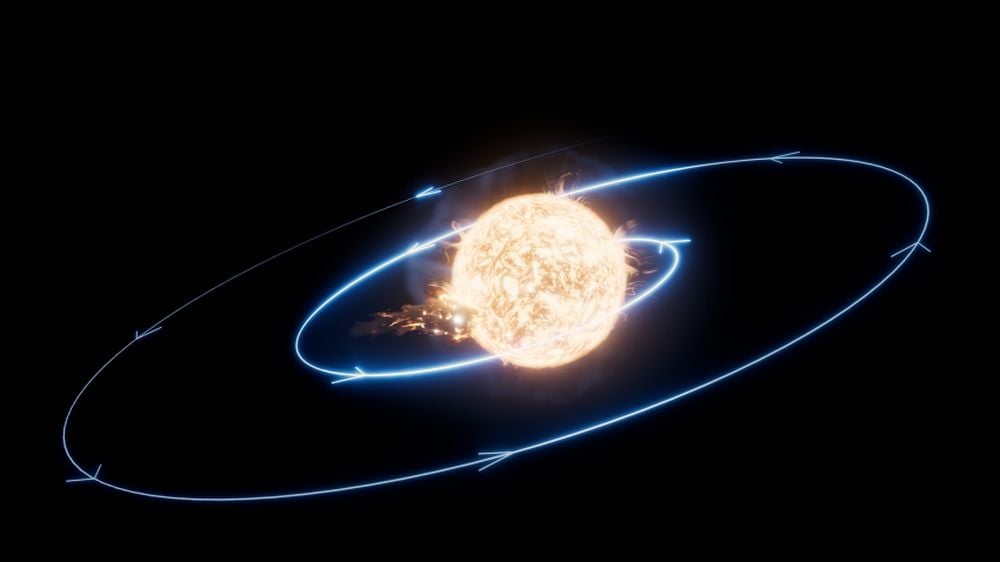
Олон улсын судлаачдын баг бэриллюм элементийн агууламжийг ашиглан одод өөрт ойр байсан чулуурхаг гаригуудыг залгисан эсэхийг тодорхойлох шинэ аргыг боловсруулжээ.
Бразилийн Одон орон, геофизик, агаар мандлын шинжлэх ухааны хүрээлэнгийн судлаач Анне Ратсман болон түүний баг 180 гэрлийн жилийн зайд орших HD 129171 ба HD 129209 хэмээх хос одны системд судалгаа хийжээ. Эдгээр од нь Нартай ижил төстэй шинж чанартай боловч металлын агууламжаараа ялгаатай байв. VLT дуран болон UVES спектрографийн тусламжтайгаар хийсэн нарийвчилсан хэмжилтээр HD 129171 од нь ойролцоогоор 11 Дэлхийн масстай чулуурхаг материалыг залгисан байж болзошгүй гэж үзсэн байна.
Судлаачид энэхүү дүгнэлтийг гаргахдаа бэриллюм элементийг ашигласан нь онцлог юм. Лити элементээс ялгаатай нь бэриллюм нь илүү тэсвэртэй химийн шинж чанартай тул одны хувьслын явцад гаригийн ул мөрийг удаан хугацаанд хадгалах чадвартай байдаг. Одод өөрсдөө бэриллюм үүсгэдэггүй тул одны гадаргуу дээр илэрсэн бэриллюмийн өндөр агууламж нь гадны чулуурхаг матери шингээснийг илтгэж байна.
Энэхүү судалгаа нь манай Нарны аймаг шиг тогтвортой гаригийн систем ховор байж болохыг харуулж байна. Хэрэв гаригуудыг одод залгих үзэгдэл түгээмэл байдаг бол энэ нь олон одны системүүд хүчирхийлэлтэй динамик үеийг туулдаг гэсэн үг юм. Гэсэн хэдий ч энэ нь прото-одны үүлний химийн ижил бус байдлаас үүдэлтэй эсэх, эсвэл үнэхээр гариг залгиснаас үүдэлтэй эсэх нь цаашдын судалгаагаар тодруулах шаардлагатай асуудал хэвээр байна.
Дэлгэрэнгүйг эх сурвалжаас харах
Эх сурвалжийг нээх ↓
Binary stars are born in the same cloud of molecular gas, and should share the same chemical composition. But sometimes they don’t. Is this because of minor differences in the protostellar clouds? Or is it because some stars have eaten, or engulfed, rocky planets? If rocky planets are regularly consumed by their stars that’s a bad sign for habitability.
An international team of researchers have found a way to determine if stars have eaten rocky worlds that strayed too close. It’s based on Beryllium, a rare element that makes up a tiny amount of the Earth’s crust—only about 0.0004 %—and is even rarer than that in the Universe.
Their work is titled “Planet engulfment in the chemically anomalous HD 129171/HD 129209 pair,” and it’s published in Astronomy and Astrophysics. The first author is Anne Rathsman, a doctoral student at the Institute of Astronomy, Geophysics, and Atmospheric Sciences in Brazil.
This work is focused on two stars that are very similar to the Sun in their magnetic activity, chemistry, and physical attributes. They’re named HD 129171 and HD 129209 and they make up a binary star system about 180 light years away. Despite their many similarities, their metalllicity abundances are different from one another.
HD 129209/HD 129171 is a binary pair of Sun-like stars about 180 light years away. The differences in their Beryllium abundances suggest that HD 129171 engulfed a rocky planet in its past. The research shows it absorbed about 11 Earth masses of rocky material. Image Credit: Digital Sky Survey/Aladin/Anne Rathsam.
Astronomers have hypothesized that one of the stars has engulfed a rocky planet, which could explain their differences.
“It is still unclear whether these anomalies originate from inhomogeneities of protostellar clouds, with important implications for chemical tagging and theories of star formation, or if they are caused by a planet engulfment event suffered by one binary component,” the researchers write.
To find out, the researchers measured “precise differential abundances” in the pair. Their work is based on spectra obtained with the VLT and its Ultraviolet and Visual Echelle Spectrograph (UVES).
The researchers zeroed in on Beryllium, one of the refractory elements. “The star HD 129171 is enriched in refractory elements – that is, elements that typically condense in the solid state and make up rocky planets,” the authors write. Those include iron, magnesium, silicon, calcium, and titanium. It also has more lithium and beryllium. “That strongly suggests that it has engulfed planetary material throughout its evolution,” first author Rathsman said in a press release.
This is where Beryllium (Be) comes in. Be is different from other elements in an important way. Stellar nucleosynthesis can’t produce any stable Be isotopes. Some small amount of it was created in the Big Bang, and the rest comes from cosmic ray spallation. There are multiple chemical differences between HD 129171 and HD 129209, but Be was their focus.
“Lithium had already been used as a possible indicator of planetary engulfment, but it’s destroyed relatively easily. Beryllium is more resistant, and its chemical signature can last longer,” Rathsam explains.
Lithium isn’t a reliable indicator of rocky planet engulfment, even though Lithium 7 is a common isotope. But it’s depleted during the main sequence phase of Sun-like stars, making its abundance difficult to interpret. Li 6 is completely destroyed during the pre-main sequence phase of a star’s life, so it’s tempting to use its presence as an engulfment indicator. But it’s destroyed at low temperatures like those found in convective Sun-like stars, so it’s likewise unreliable.
“We focused on the Be abundance in particular, showing that this element can serve as a diagnostic of engulfment events for solar-type stars,” the authors write. By measuring the Be abundance, the researchers were able to show how much rocky material HD 129171 has engulfed.
“The abundance pattern of the pair is reasonably reproduced by an engulfment model of 11.2 M⊕ of rocky material,” the researchers explain.
“That material may have come from a single large planet or from several smaller bodies” Rathsam said. “However, in the case of Sun-like stars, internal mixing is so efficient that the final chemical signature doesn’t allow us to distinguish between those scenarios.”
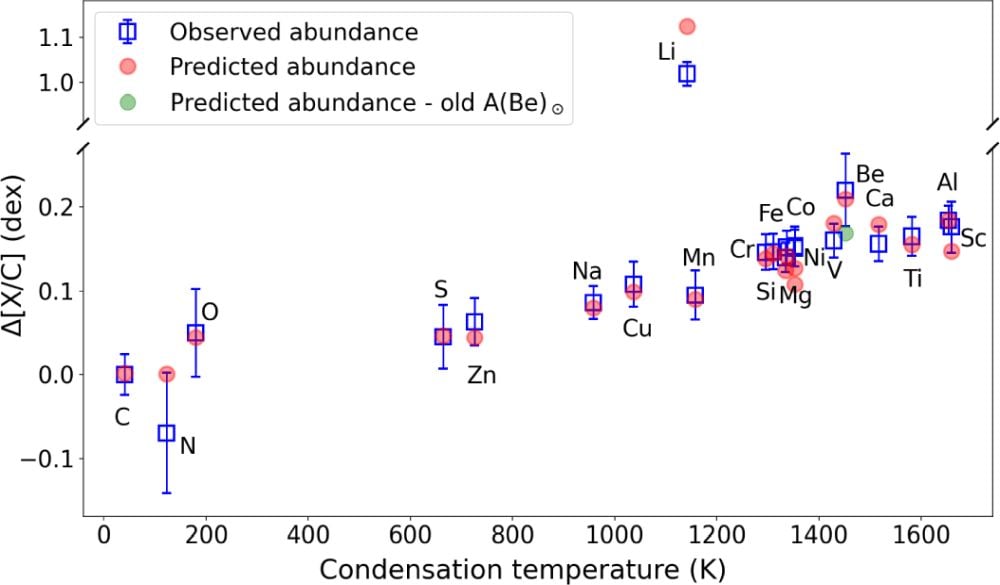 This is a comparison of the observed differential abundances of HD 129209 relative to its binary partner HD 129171 (open squares). The filled circles show the predicted abundances estimated from the model of an engulfment of 11.2 M⊕ of rocky material. The green circle under Be is an older prediction of the Be abundance. Image Credit: Rathsam et al. 2026. A&A.
This work shows that Be is a good diagnostic for planet engulfment, at least by Sun-like stars. It’s presence in the cool photospheres is hard to explain any other way.
It also shows that our Solar System might be kind of rare. Simulations struggle to create systems like ours, where massive planets in the outer Solar System follow more circular orbits, and rocky planets in the inner system follow stable orbits. Observations agree with that in some ways. Astronomers have found very few gas giant exoplanets like Jupiter that follow orbits similar to Jupiter’s.
It’s possible that in more systems, inner rocky planets are perturbed from stable orbits and driven into their stars.
“In our planetary system, the planets have relatively stable, low-eccentricity orbits. However, if planetary engulfment is common, it suggests that many systems undergo violent dynamic phases,” Rathsam said. “Life wouldn’t just need billions of years to emerge and evolve. The planet would also have to remain in a sufficiently stable orbit to survive significant gravitational perturbations.”
“When we bring together evidence from dynamical simulations, exoplanet observations, and chemical studies of binary stars, a consistent picture emerges, indicating that systems similar to the Solar System may be less common than we imagined,” explained co-author Jorge Luis Melendez Moreno.

