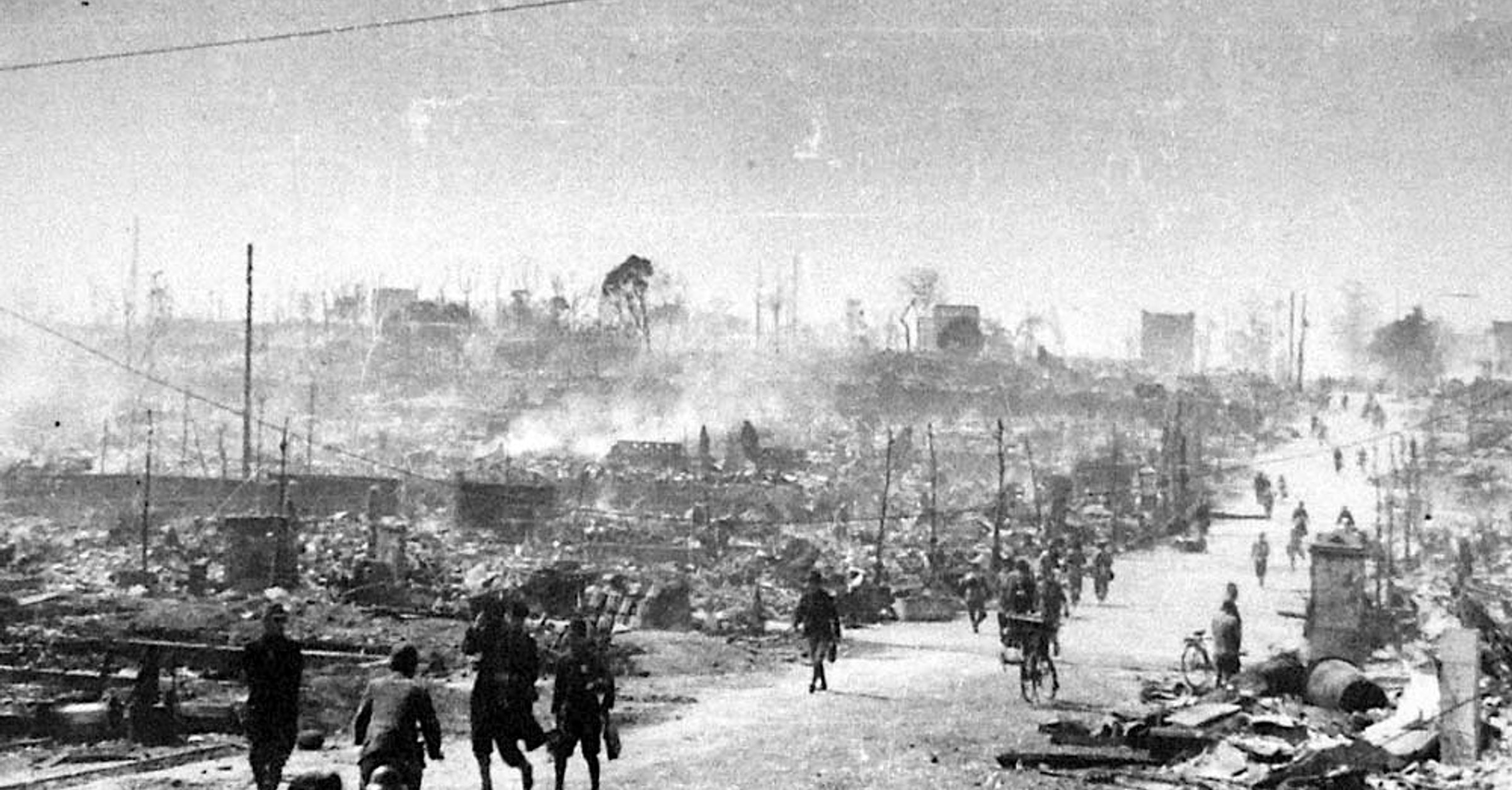
АНУ-ын агаарын цэргийн хүчин Дэлхийн хоёрдугаар дайны үеэр Японы нийслэл Токио хотыг удаа дараа бөмбөгдсөн нь тус улсыг бууж өгөхөд хүргэх стратегийн гол алхам байв.
Дэлхийн хоёрдугаар дайны (1939-1945) үеэр АНУ-ын агаарын цэргийн хүчин Японыг бууж өгөхөд хүргэх зорилгоор Токио хотыг системтэйгээр бөмбөгдсөн юм. 1945 оны гуравдугаар сард хаясан олон мянган галт бөмбөгийн улмаас үүссэн гал түймэр 87,000 гаруй хүний амийг авч оджээ. Аж үйлдвэрийн томоохон төвүүд байрладаг Токио хот төдийгүй Японы бусад хотууд ч дараагийн саруудад агаарын хүчтэй довтолгоонд өртөв. Энэхүү асар их сүйрэл, хүний амь насны хохирлын дараа далайн бүслэлт болон атомын бөмбөгийн хүчтэй нөлөөгөөр Япон улс эцэст нь бууж өгөх шийдвэр гаргасан юм.
Анхны довтолгоо
Японы нийслэл нь хүнд үйлдвэрүүд болон дайны зориулалттай материал үйлдвэрлэдэг олон арван мянган жижиг үйлдвэрүүдтэй тул АНУ-ын бөмбөгдөгч онгоцнуудын гол бай болсон. 1942 оны дөрөвдүгээр сарын 18-нд АНУ-ын B-25 бөмбөгдөгч онгоцнууд “Дулитлын дайралт”-ыг хэрэгжүүлж, Токио хотыг анх удаа бөмбөгдсөн. Хавайн Перл-Харбор дахь АНУ-ын тэнгисийн цэргийн баазад хийсэн халдлагын хариу болгон нисэх онгоц тээгч хөлөг онгоцноос хөөргөсөн энэхүү ажиллагаа нь цар хүрээний хувьд хязгаарлагдмал байлаа. Үүнээс хойш 31 сарын турш АНУ-ын бөмбөгдөгч онгоцнууд Японы нийслэлийн тэнгэрт үзэгдээгүй ч, дараагийн довтолгоонууд нь Герман, Британи болон бусад оронд хийгдсэн агаарын дайралтуудаас илүү их сүйрлийг авчирсан юм.
B-29 бөмбөгдөгч онгоц ба Марианы арлууд
Японы эсрэг шууд бөгөөд тасралтгүй довтолгоо хийх боломж 1944 оны дундуур АНУ-ын зэвсэгт хүчин Марианы арлуудыг эзэлснээр бүрджээ. Сайпан, Гуам болон Тиниан арлуудыг эзлэн авснаар АНУ-ын Boeing B-29 Superfortress бөмбөгдөгч онгоцнууд Японы аль ч хотод цохилт өгөх баазтай болсон юм. Хэдийгээр Хятад дахь баазуудыг ашиглан стратегийн бөмбөгдөлт хийж эхэлсэн байсан ч Марианы арлууд нь хамгаалалт, хангамжийн хувьд илүү давуу талтай байв. Ингэснээр олон зуун онгоцыг оролцуулсан, хэдэн шөнийн турш үргэлжлэх хүчтэй довтолгоонуудыг зохион байгуулах боломжтой болжээ.
Марианы арлуудаас хөөрсөн B-29 онгоцнуудын анхны дайралт 1944 оны арваннэгдүгээр сарын 24-нд болж, Токио дахь нисэх онгоцны үйлдвэрийг бөмбөгдсөн. Өндөр түвшний нарийвчлалтай бөмбөгдөлтөд зориулагдсан хэдий ч хүчтэй салхи болон бусад нөлөөллөөс болж бөмбөгдөгчдийн дөнгөж дөрөвний нэг нь л байндаа тусгаж чадав. Иймд АНУ-ын Агаарын цэргийн хүчин Германы Хамбург хотод хэрэгжүүлсэн “Гоморра” ажиллагааны жишгээр Японы хотуудыг шөнийн цагаар, нам өндрөөс галт бөмбөгөөр бөмбөгдөх тактикт шилжсэн байна. Энэ нь цэргийн болон үйлдвэрийн байгууламжуудыг устгахын тулд энгийн иргэдийн амь насыг үл хайхарсан, илүү харгис арга байв.
Агаарын ажиллагааг удирдаж байсан хошууч генерал Кёртис Лемэй Японы модон барилга байгууламжийн онцлогт тохируулан галт бөмбөг ашиглах шийдвэр гаргасан гэж тайлбарлажээ. Японы тал нам өндрийн хамгаалалт сул байсныг ашиглан нам өндрөөс илүү их ачаатай бөмбөг хаях нь үр дүнтэй байсан тул тэрээр энэ аргыг сонгосон байна.
1945 оны гуравдугаар сарын “Галт шуурга”
1945 оны хоёрдугаар сарын 25-нд болсон томоохон дайралтаар 450 тонн галт бөмбөг хаяж, 30,000 орчим байшин устгагджээ. Үүний араас 1945 оны гуравдугаар сарын 9-ний шөнө “Уулзалтын байшин” (Operation Meetinghouse) нэртэй хамгийн аймшигт дайралт болсон юм. Марианы арлуудаас хөөрсөн 334 онгоц 1,830 метрийн нам өндрөөс 1,700 тонн галт бөмбөг хаяжээ. Напалм бүхий M-69 бөмбөгүүд нь Японы хотуудын модон архитектурыг тэр дор нь галдан шатааж, улмаар асар их халуунаас болж “галт шуурга” үүсгэсэн байна. Энэхүү түймэр 16 хавтгай дөрвөлжин миль талбайг хамарч, 87,000 гаруй хүний амийг авч одсон нь тухайн үедээ нэг шөнийн дотор гарсан энгийн иргэдийн хамгийн их хохирол байв.
Дараагийн довтолгоонууд
Генерал Лемэй гуравдугаар сарын дайралтын дараа Японы яаралтай тусламжийн үйлчилгээг сөхрүүлэхийн тулд дараалан олон довтолгоог зохион байгуулсан. Японы агаарын довтолгооноос хамгаалах хүчин сул байсан тул B-29 бөмбөгдөгч онгоцнууд бараг саадгүй нисэж байв. Мөн бөмбөгдөгч онгоцнуудын сумчин багийнхныг цөөлж, нэмэлт зургаан тонн бөмбөг ачих боломж бүрдүүлсэн нь сүйрлийг улам нэмэгдүүлжээ. Токио хот гурав, дөрөвдүгээр сард дахин олон удаагийн агаарын дайралтад өртөж, нийслэлийн хүн ам 6.6 саяас 2.3 сая болж буурч, 1
Дэлгэрэнгүйг эх сурвалжаас харах
↓Эх сурвалжийг нээх ↓
The systematic bombing of Tokyo by US aircraft in repeated raids during the Second World War (1939-45) was intended to force Japan‘s surrender. The dropping of thousands of incendiary bombs in March 1945 created a firestorm that killed at least 87,000 people. Tokyo, with its myriad of industrial sites, was hit again and again over the following months, as were many other Japanese cities. Despite the tremendous destruction and loss of life, only when these raids were combined with a naval blockade and the shocking use of the new atomic bomb did Japan finally surrender.
Tokyo After the Firestorm of March 1945
The First Raid
The Japanese capital was an obvious target for US bombers with its huge factories of heavy industry and tens of thousands of micro-factories all producing materials essential for the war effort. Tokyo was first hit by US B-25 bombers in the Doolittle Raid of 18 April 1942. The raid, launched from an aircraft carrier in retaliation for the attack on Pearl Harbor, the US naval base at Hawaii, was very limited in scale and consequences. US bombers would not darken the skies of the Japanese capital again for another 31 months, but when they did, they would cause more destruction than any comparable air raid in Germany, Britain, or elsewhere.
Most B-29s were used to drop incendiary bombs at night and from a low altitude.
B-29s & the Marianas
Direct and sustained attacks on Japan had only become possible once the US armed forces had captured the Mariana Islands in mid-1944. Victory in the Battle of Saipan and in the Battle of Guam in June, July, and August ensured the US forces could use these two islands, and neighbouring Tinian, as permanent air bases. Long-range Boeing B-29 Superfortress bombers could now strike at any Japanese city. The US had already begun its strategic bombing campaign against Japan using bases in China, but the Marianas were a much easier base to defend and resupply. The bombing raids could now be scaled up to include hundreds of aircraft, and raids could be carried out across several consecutive nights to increase their devastating effect.
The first B-29 raid from the Marianas took place on 24 November 1944, when 80 Superfortresses bombed an aircraft factory in Tokyo. Despite being specifically designed for high-altitude precision bombing, the reality was that only one quarter of the bombers hit their target area, and those that did were not as effective as hoped in destroying factories and industrial sites. High-altitude bombing proved problematic due to very high winds from the jet stream affecting accuracy, and daylight was required for the bomb-sighters, which exposed the aircraft to Japanese fighter attacks. Seeing the consequences of such incendiary bombing raids on German cities as Operation Gomorrah against Hamburg in August 1943 during the Allied bombing of Germany, the US Air Force decided to apply the same tactics on Japan. Consequently, most B-29s would be used to drop tons of incendiary bombs on Tokyo and other Japanese cities at night and from a low altitude. It meant thousands of civilians would be killed in a crude attempt to knock out industrial targets.
Map of the Allied Pacific Counteroffensive, 1942–1945 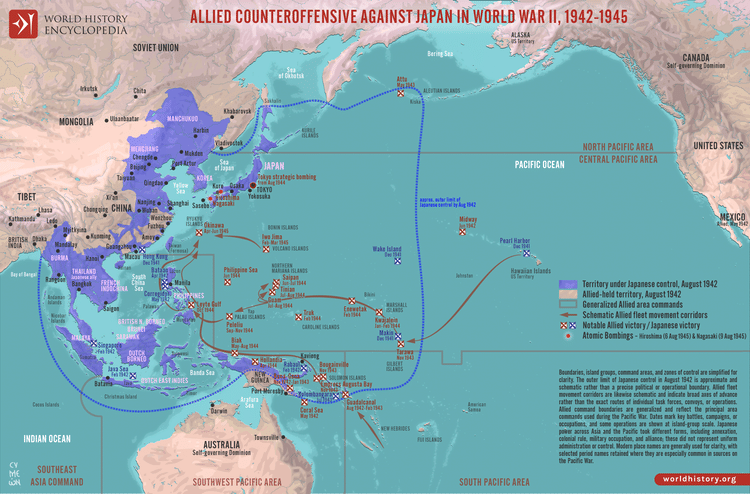
Major General Curtis LeMay (1906-1990) was in charge of US bombing operations over Japan from January 1945, and here he describes the reason incendiary bombs were used:
We’d always planned on using incendiaries in the campaign against Japan because the construction used in their cities made them very effective. But in order to use them properly you have to have a minimum concentration of incendiaries to get a good fire started – a minimum of aeroplanes…The Japanese seemed to be lacking in low-altitude defences and for that reason I decided to come down low, because we could carry a bigger load…and the bombing would be more effective…seventeen square miles of the industrial area of Tokyo was burned…
(Holmes, 566)
March 1945 ‘Firestorm’ Raid
The first major B-29 raid carried out on Tokyo came on 25 February 1945 when 450 tons of incendiary bombs were dropped by around 150 B-29 bombers. Almost 30,000 homes were destroyed in the attack.
B-29 Superfortress in Flight 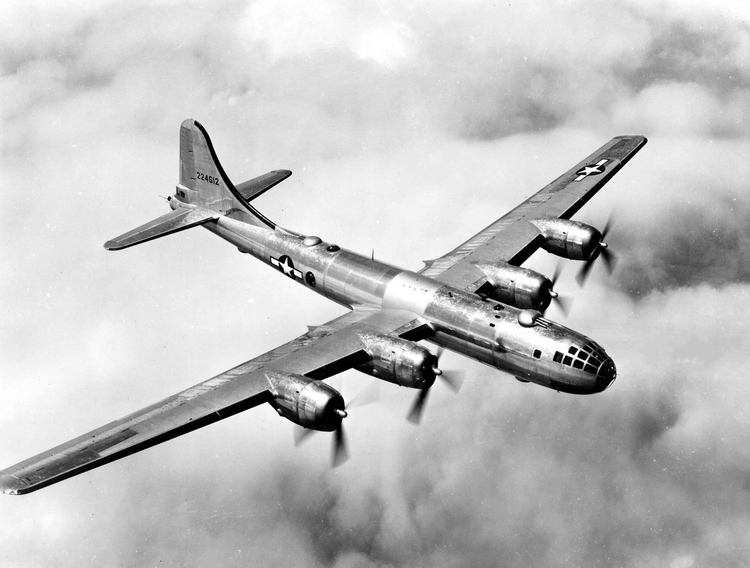
The raid described above by LeMay, Operation Meetinghouse, came on the night of 9 March 1945. 334 aircraft (200 bombers and their fighter escorts) set out from the Marianas. All but 14 of the aircraft would return from the mission, as the Japanese anti-aircraft guns were not very effective and only 40 night fighters actually engaged the attackers. The bombs were dropped at a relatively low altitude of 6,000 feet (1,830 m), and they included the M-69 napalm-filled incendiary devices that spread fire as they exploded. The historian J. Vader describes this new weapon:
The M-69 fire bombs weighed 6 pounds each and were dropped in a cluster of 38 within a container. A time fuse was set to release the small bombs from the cluster at 5,000 feet and they exploded on contact, spreading a jelly-gasoline compound. The B-29s usually carried 37 of the 500-pound cluster.
(Liddell Hart, 434)
The bombs began to fall around midnight and did not stop until 3:45 a.m. In total, 1,700 tons of incendiary bombs were dropped that night. As predicted by LeMay, the incendiary bombing caused devastation amongst the highly combustible wooden architecture that predominated in Japanese cities. Even reinforced concrete buildings designed to withstand fires were destroyed. The clouds of black smoke rose so high they blackened the undersides of the later waves of bombers.
B-29 Incendiary Cluster Bombs 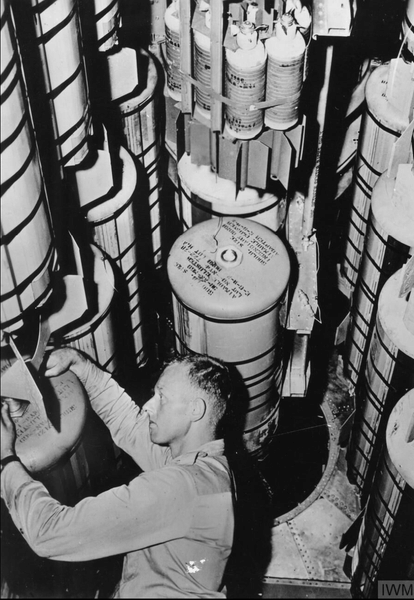
As strong winds that day spread the fires, the tremendous concentration of heat then generated its own microclimate where thermal winds of around 50 mph (80 k/h) sucked in surrounding air, further spreading the fires. It was, in a literal sense, a firestorm that only ended when there was nothing else to burn.
16 square miles (41.5 km²) of Tokyo were destroyed, most of that being commercial and industrial areas but including many residential zones. 20 major industrial targets were destroyed. Over one million people became homeless overnight. The city’s fire department suffered, too, losing 15 stations, 95 fire engines, and 125 firefighters. At least 87,000 people were killed, and nearly 41,000 were injured in the attack and the consequent firestorm (Neillands, 378). This was the single greatest loss of civilian life in one night so far in history.
The effects of this raid on the ground are here described by a Tokyo housewife, Tsuyako Kii:
On 9th March I felt somewhat severe atmosphere that night and the alarm came, a man came shouting through a megaphone we must shelter in the school but I disobeyed because I thought that school was very dangerous, there were many houses standing around that school, so I ran to the big bridge over the Sumida river and I stayed all night around that bridge. There was no fire at first on my side but the other side was burning and early morning of 10th March the fire started on my side so I crossed over the other side of the bridge and there it was already burned up so I kept myself rather safely at that place. I thought I could jump into the river at last chance as people had done in the middle of the earthquake of 1923.
(Holmes, 566-7)
Tokyo Bomb Damage, March 1945 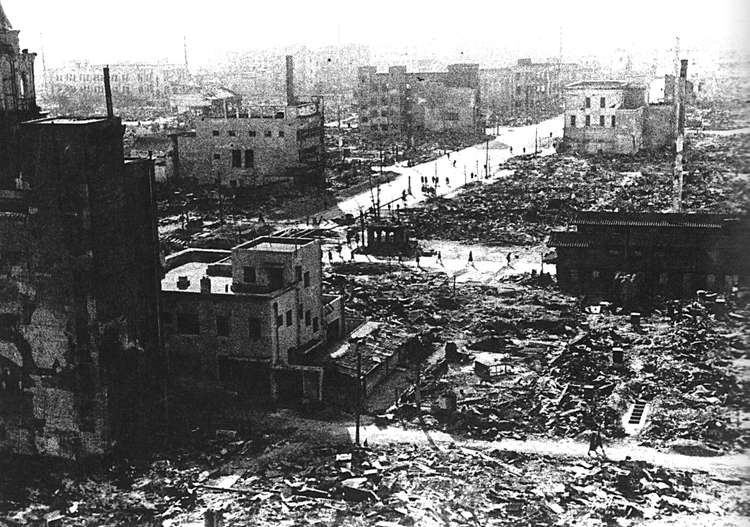
The firebombing of Tokyo remained relatively unknown, overshadowed at the time by the bombing of Dresden in 1945. This latter raid, again involving US aircraft (but also a number of RAF Lancaster bombers), had occurred just a few weeks before. The Dresden raid killed around 30,000 people and flattened the city. Controversy surrounded the Dresden bombing as it seemed to some that Germany had already lost the war and so it was strategically unnecessary. The same was true of Japan, but the feeling was somehow different amongst many Americans. A commonly held opinion was that the Japanese people deserved retribution for the sneak attack on Pearl Harbor, for the tremendous Allied casualties suffered so far in the Pacific War, and for the stories of the torture and execution of Allied prisoners of war by the Japanese military.
Raids destroyed 56 square miles of the capital & there was a civilian exodus to the countryside.
Subsequent Raids
LeMay immediately followed up the March raid with a second one so that the Japanese authorities and emergency services would struggle to respond. Many more raids followed, both on Tokyo and other major cities. Japan’s ability to defend itself in the air became very limited as aircraft had to be husbanded for a possible future invasion. LeMay noted: “the B-29s were flying at will over Japan and they couldn’t do anything about it” (Holmes, 567).
Not only did the lower altitude mean the B-29s could carry a greater bomb load, but their capacity was further increased when it was decided not to take the gun crews on these missions (with the exception of the tail gunners). These weight savings allowed each bomber to carry another six tons of bombs. The gunners were not required since Japan did not then possess effective nightfighter aircraft. Indeed, the US aircraft suffered losses of just 1.5 to 2% (as opposed to 5 to 7% in the daylight raids), a statistic that led commanders to think that Japan could be pounded into submission. There were additional motivations to demonstrate air power could win wars since the US Air Force was still officially part of the US Army, and such a demonstration would go a long way to achieving an entirely independent air force.
B-29 on a Bombing Mission 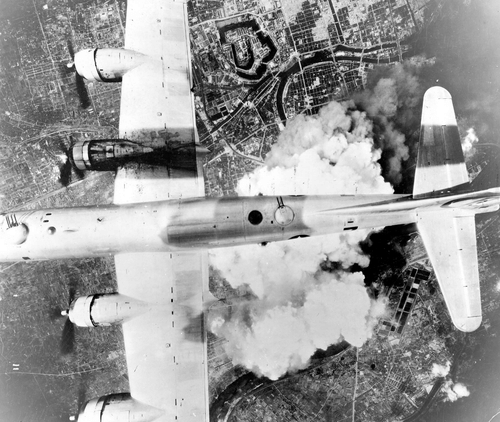
The B-29s did mix precision bombing, which aimed at specific industrial or military targets, with indiscriminate incendiary bombing, although the latter, given the technology of the period, remained much more difficult and more often than not unsuccessful in hitting the desired targets. The widespread destruction of oil refineries was more successful and achieved to such a degree that the Japanese military struggled to fuel their remaining planes and tanks. A wide range of cities continued to be targeted, notably Yokohama, Kawasaki, Nagoya, Osaka, and Kobe.
Tokyo suffered many more attacks through March and April, in all 20 raids of B-29s and five from aircraft carrier bombers. In April, three separate attacks across five nights (12 to 16) involved over 700 bombers, which created yet more devastating fires. In the last week of May, two more raids were made on Tokyo involving 562 and 464 B-29s respectively. These raids and others collectively destroyed 56 square miles (145 km²) of the capital and caused a civilian exodus to the countryside. Tokyo’s population had plummeted from a pre-raid 6.6 million to 2.3 million. Over 100,000 people had been killed and 2.8 million made homeless. Bombing raids continued across Japan through May, June, and July.
Japan’s Surrender
The bombing of Tokyo and other Japanese cities, just as had been the case with cities in Britain and Germany, did not on its own bring any form of surrender or even demonstrably dent civilian morale. Nevertheless, the impact was dramatic. Over half of 64 different Japanese cities were destroyed. 8 million people lost their homes. The B-29 bombers had almost run out of targets. But it was the blockade of Japan – enforced using naval ships, submarines, and attack aircraft – which proved most effective in depriving Japan of the essential resources it needed to conduct warfare. This and the long list of military defeats in the Pacific War and destruction of its navy were significant factors which, combined with the bombing raids, brought Japan to the brink of surrender.
Enola Gay B-29 Superfortress 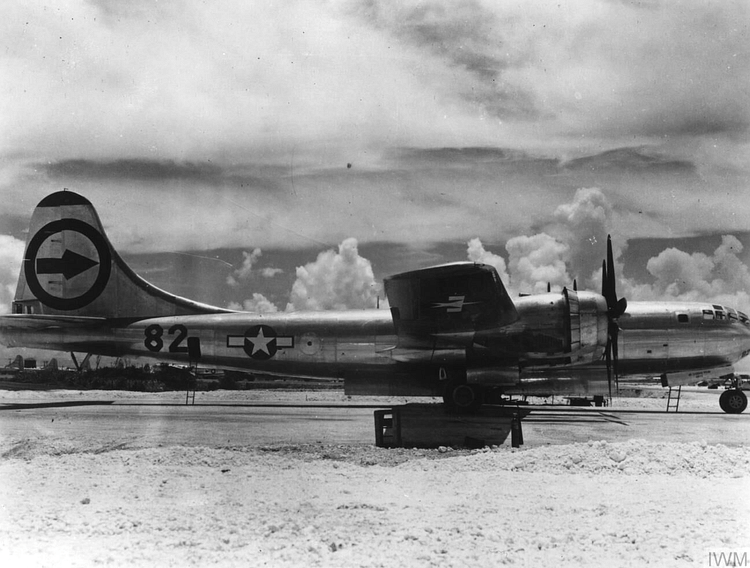
The final decisive chapter in the story of the Pacific War was the fruition of the Manhattan Project and the dropping of an atomic bomb on Hiroshima and another on Nagasaki in August. These two cities were chosen precisely because they had been relatively untouched by the conventional bombing campaigns. Tokyo might have seemed an obvious choice to hit, but the city had been so badly destroyed already that the bombing of it once again would not have had any great impact. The psychological impact of destroying a relatively untouched city with a single bomb was tremendous. The dreadful tragedy of nuclear weapons in action did finally bring the desired response: Japan’s surrender and Allied victory in WWII.

