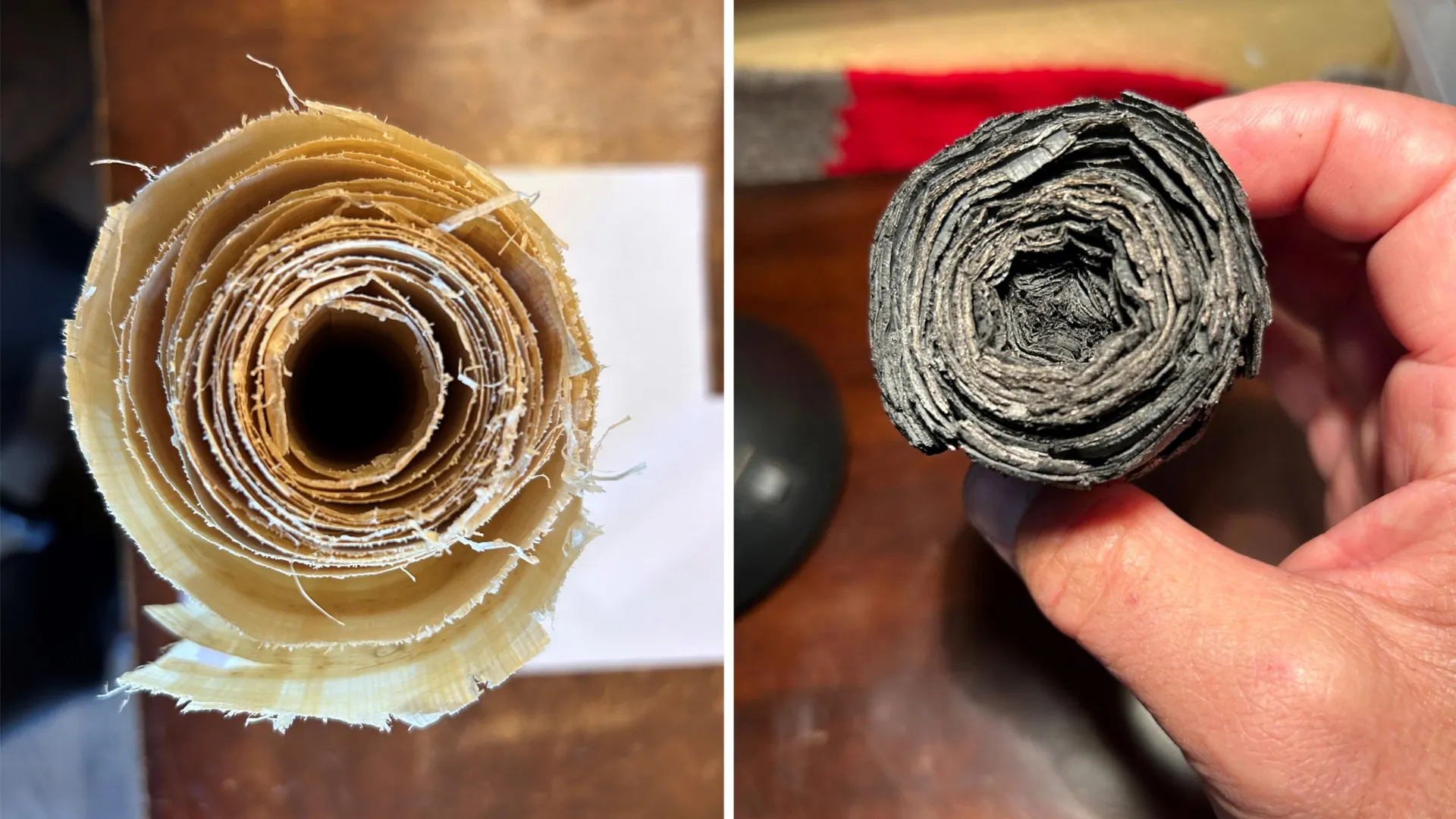
Судлаачид харлаж гэмтсэн эртний судруудын бичвэрийг гэмтээлгүйгээр сэргээх боломжийг рентген туяаны тусламжтайгаар судалжээ.
Беркли дэх SETI-ийн судлаач Дуглас Сейлер тэргүүтэй баг 79 онд Везувий галт уулын дэлбэрэлтийн улмаас шатаж, нүүрсжсэн эртний Херкуланум хотын судруудыг унших шинэ аргыг боловсрууллаа. Тэд эртний судруудын бэхэнд агуулагдах хар тугалга нь рентген туяаг шингээх чадвартай болохыг тогтоосон байна. Энэхүү шинж чанар нь нүүрсжсэн папирус дээрх бичвэрийг тодотгож, биетээр нь дэлгэх шаардлагагүйгээр дижитал хэлбэрээр унших боломж олгодог ажээ.
Судлаачид уг таамаглалаа батлахын тулд орчин үеийн папирус дээр хар тугалга агуулсан бэхээр бичиж, тэдгээрийг өндөр температурт шатаан нүүрсжүүлжээ. Ингэж бэлтгэсэн загваруудыг рентген томографи (X-ray CT) болон рентген флюресценцийн сканераар шинжлэхэд хар тугалга агуулсан үсгүүд нь судруудын нүүрсжсэн хэсгээс 25 дахин илүү тод харагдсан байна. Энэхүү үр дүнг PLOS ONE сэтгүүлд нийтлүүлсэн бөгөөд уг арга нь эртний бичвэрүүдийг сэргээх ажилд чухал ахиц авчирна гэж үзэж байна.
Херкуланумын судруудын цуглуулга нь эртний Ромын оюуны соёлыг хадгалсан цорын ганц бүрэн бүтэн номын сан гэдгээрээ түүхэн ач холбогдолтой юм. Өмнө нь эдгээр судруудыг биетээр нь дэлгэж унших гэсэн оролдлогууд нь папирусыг үйрүүлж гэмтээх эрсдэлтэй байсан тул уг дижитал арга нь түүхийн ховор өвийг хамгаалах шийдэл болж байна. Цаашид судлаачид энэхүү технологийг ашиглан олон тооны судруудыг дараалалд оруулан, илүү нарийвчлалтай шинжлэхээр төлөвлөж байна.
Дэлгэрэнгүйг эх сурвалжаас харах
↓Эх сурвалжийг нээх ↓
Douglas Seiler went to unusual lengths to recreate an ancient mystery.
He obtained papyrus and reed pens from Egypt, along with traditional lampblack ink from Japan. Then he paid high school students to write on the papyrus using passages from “Star Wars,” the Bible, and a quote from the 1960s science fiction television show “The Outer Limits.”
Once the writing was finished, Seiler, an affiliate of Berkeley SETI, rolled up the papyrus, sealed it inside a container, placed it in a high-temperature furnace, and burned it until it was thoroughly carbonized.
The experiment was designed to mimic a catastrophe that occurred nearly 2,000 years ago in Herculaneum, an ancient Roman city in Italy. When Mount Vesuvius erupted in 79 C.E., volcanic ash overwhelmed the city and transformed more than a thousand papyrus scrolls in a local library into fragile, charred remains. The same eruption famously buried nearby Pompeii.
Yet the destruction also produced an extraordinary form of preservation. The Herculaneum collection is the only known intact library to survive from antiquity, potentially preserving works that have otherwise vanished from history.
Reading Ancient Scrolls Without Opening Them
Seiler wanted to know whether researchers could recover writing from these carbonized scrolls without physically unrolling them, an action that could cause the brittle papyrus to crumble into black dust.
His idea focused on the chemistry of the ink. If some ancient inks contained lead, he reasoned, that metal might absorb X rays far more strongly than the surrounding carbonized papyrus. A computer could then use the resulting scans to virtually flatten the tightly rolled sheets and expose the hidden writing.
In a paper published on Sept. 16 in the journal PLOS ONE, Seiler and his collaborators, including several Berkeley experts, report that the strategy works in their experimental scrolls. Even extremely small amounts of lead made written characters detectable with X-ray tomography, also called X-ray CT.
Lead absorbed as much as 25 times more X rays than the burned papyrus around it, causing the writing to stand out dramatically.
“With lead in the ink, you would get a huge friggin’ signature, so you really need to be looking for scrolls with lead in them,” Seiler said. “They’re having problems reading a lot of them because of the low contrast of carbon ink on carbon paper. We’re relatively certain that if they start searching for lead, or they let us search for lead, it will help this whole process. This is the Holy Grail.”
The researchers also found that a relatively inexpensive handheld X-ray fluorescence scanner could readily detect lead based ink in a burned scroll. That could provide a straightforward way to screen ancient scrolls first and identify which ones are the most promising candidates for more detailed X-ray CT imaging.
A Library Frozen in Time
Only a small number of the charred scrolls from Herculaneum’s Villa of the Papyri have so far been virtually opened and deciphered. None of those had first been tested to determine whether their ink contained lead.
Researchers have not yet carried out a systematic search for lead based ink across the collection. However, at least one previous researcher detected lead in the ink of a fragment left over from early attempts to physically open the scrolls.
Many of those attempts began after the scrolls were discovered in 1752. The results were often disastrous. Trying to unwind the carbonized rolls frequently reduced them to piles of ash, eventually prompting Italian authorities to stop the practice.
Every scroll that was successfully opened physically contained writing previously unknown to scholars. Many of those texts were works by Philodemus, an Epicurean philosopher who lived in Herculaneum roughly a century before Vesuvius erupted.
Today, the surviving library consists of about 1,800 scrolls and scroll fragments held in collections in Italy, France and England.
“Almost everything from antiquity has been destroyed,” Seiler said. “There’s very little left except papyrus that was in a dry climate or some works that were copied by scribes and transferred down. But some of the Herculaneum scrolls aren’t copies. These are books directly from the ancient world frozen in time. They’re actually from Roman intellectual circles.”
For scholars who study ancient writing, the potential importance is difficult to overstate.
“The value in this project is practically unquantifiable,” said Berkeley archaeology graduate student Leah Packard-Grams, who consulted on the project as a papyrologist. “The stakes are the largest in the history of Greek literature.”
Lost Voices From the Ancient World
Packard-Grams has long been fascinated by the civilizations of ancient Greece and Rome, and by the countless works of literature, philosophy, and science that disappeared before scribes could make surviving copies.
She currently translates Greek and Egyptian writing preserved on ancient papyri at UC Berkeley’s Center for the Tebtunis Papyri in the Bancroft Library. Unlike the scrolls from Herculaneum, those documents survived because they were buried in Egypt’s dry sands.
Among the collection are fragments written by a man named Dionysios, who worked as a school teacher and scribe-for-hire. His surviving notes capture ordinary moments from daily life, including records of how much he spent on food for his children along the canal.
“This is what drew me to papyrology — that I could read the words of ancient people not through a library book or through a Renaissance copy but actually sit down and know that someone wrote this letter to whomever, his father or something,” she said. “It’s autograph history — not just from a book, but from what they were actually writing.”
Packard-Grams’ expertise proved particularly useful for Seiler’s project because she has studied the chemical composition of inks on Egyptian papyri in Berkeley’s collection.
Traditional ink was generally made from soot, water, and a binder such as gum Arabic. Packard-Grams hopes that subtle differences in ink chemistry could act like signatures, potentially helping researchers distinguish individual writers. Metals mixed into the ink, whether intentionally or accidentally, could make that chemical fingerprint even more useful.
Ancient Ink Offers an Encouraging Clue
The Tebtunis papyri include fragments dating from 300 B.C.E. to 300 C.E. They were excavated for UC Berkeley 126 years ago at the site of the ancient city of Tebtunis.
Using a hand-held X-ray fluorescence scanner, Packard-Grams found that some of those documents contain ink with lead and/or copper. The examples containing these metals were generally written after the first century C.E.
That finding raises the possibility that at least some Herculaneum scrolls could also contain detectable metals in their ink.
“If we know that the Herculaneum papyri have lead in them — some of them do, some of them don’t — then when they take the CT scan, they can scan it with a sensitivity for the element lead and we can see where the ink is,” she said. “As you unroll it, you can map the letters a lot more clearly.”
To test the idea under controlled conditions, Seiler enlisted retired Berkeley chemists David Kreimer and Elena Kreimer, a retired manager of the College of Chemistry’s Microanalytical Facility.
With their help, he mixed carefully measured quantities of lead nitrate into lampblack ink, creating inks with several different lead concentrations.
Seiler then had the children of friends write passages on fresh papyrus using traditional reed pens and the prepared inks. Packard-Grams and Jesse Obert of the Archaeological Research Facility scanned the newly written scrolls to verify the amount of lead present.
Burning the Replicas
The next step was to make the modern scrolls resemble the ancient carbonized ones.
Seiler placed them in a semi-sealed steel container with very little oxygen and heated them in a high-temperature furnace in his home laboratory.
Through contacts at the Space Sciences Laboratory, he connected with Jake LaManna, a physicist at the Center for Neutron Research at the National Institute of Standards and Technology in Gaithersburg, Maryland.
LaManna used the center’s laboratory X-ray source to produce a three-dimensional CT scan of the burned scroll.
“It’s the first scroll I’ve ever done,” he said. “I don’t tend to say no to interesting projects.”
LaManna improvised a stand to hold the fragile scroll while rotating it through an X-ray beam. Thousands of individual image slices were recorded and combined by computer into a three dimensional reconstruction.
The difference between the lead-bearing ink and the surrounding papyrus was striking. Because lead absorbs far more X rays, letters appeared as bright marks against the darker carbonized material, similar to brighter regions on an underexposed black and white negative.
The scans successfully detected ink containing as little as 25 micrograms of lead per square centimeter using both X-ray CT and X-ray fluorescence.
“If you look at the images, the letters lit up like a Christmas tree,” Seiler said.
A Battery Algorithm Finds a New Purpose
Another piece of the puzzle came from an unexpected source.
Michael Cyrus Daugherty, then a postdoctoral fellow at NIST, had developed software for digitally unrolling CT scans of the “jelly rolls” found inside lithium-ion batteries.
LaManna wondered whether the same approach could be adapted to a papyrus scroll.
“He got excited and ran off with the data and within a couple of days and after just a couple little tweaks to his program, he came back with examples of the scroll unrolled,” LaManna said. “He just had to tweak his code to follow the uneven and changing thickness along the length of the scroll.”
The Vesuvius Challenge
The effort to digitally recover writing from Herculaneum’s scrolls has been advancing for years.
In 2009, Brent Seales at the University of Kentucky became the first researcher to make micro-CT scans of a Herculaneum scroll, one belonging to the Institut de France. In 2015, he demonstrated the successful digital unrolling of a charred scroll recovered from a synagogue that burned around 600 C.E.
Building on those advances, Seales and a group of venture capitalists, with Italy’s permission, launched the Vesuvius Challenge in 2023.
The competition offered a $700,000 Grand Prize to the first person who could decipher four passages containing at least 140 characters each from two Herculaneum scrolls imaged with X-ray CT.
Only five months later, two researchers working independently managed to identify the first word: πορφύραc, the Greek word for purple. Artificial intelligence played a central role in the discovery.
In 2024, the same team used AI to recover 15 complete columns from a scroll owned by the Institut de France, amounting to less than one tenth of the entire document. The newly readable text proved to be an Epicurean philosophical work dealing with perception and pleasure.
AI delivered another advance in 2026. Seales’ team decoded surviving portions of a Herculaneum scroll known as PHerc. 1667, which had nearly been destroyed during an earlier attempt to physically open it.
The text appears to discuss the philosophy of the ancient Greek Stoics. It may date from the second or third century B.C.E., potentially making it one of the oldest scrolls in the Herculaneum collection.
Making Faint Ancient Ink Easier to See
Those successes have depended on digitally unrolling CT scans and then using machine learning to detect extremely subtle changes in texture or shape associated with ancient ink.
The signal can be exceptionally faint because conventional carbon ink and carbonized papyrus can look very similar to X rays.
Lead could change that equation.
LaManna estimates that lead based ink can appear up to 25 times brighter than the papyrus in X-ray CT images.
Seiler hopes researchers will use X-ray fluorescence to screen more of the surviving Herculaneum collection. Scrolls found to contain lead could then be prioritized for CT scanning, potentially allowing many more texts to be recovered and building on the work of Seales and his collaborators.
“What I would like to see and what I’d like to do is a much more rigorous study into the ink concentrations or what’s in the ink, not just lead,” LaManna said. “And see how far we could push this into making training data sets to actually make more robust algorithms for reading the real ones.”
The replicas offer another major advantage. Researchers can refine scanning methods and computer algorithms on expendable models rather than experimenting directly on irreplaceable ancient artifacts.
“Doug had a really great idea scientifically with creating a model,” Packard-Grams said. “Why? Because if you hurt a model, it’s fine. If you hurt a 2,300-year-old ancient artifact, you’ll have a bunch of archeologists ready to jump you. Not to mention me jump you!”
An Unusual Path to Ancient History
Seiler does not yet know where the research will lead.
He began investigating the scrolls largely on a whim after learning about them while working with Berkeley SETI on Panoseti, a new telescope designed to search the galaxy for laser signals that could indicate intelligent life.
Now retired, Seiler previously worked in real estate and banking and also spent time as an inventor.
“Honestly, getting here is, for me, just as unique as our research,” he said. “I mean, inorganic chemistry, papyrus, X-ray tomography, AI — it’s really quite an eclectic group of scientists and methodology to get to the point that yes, if there’s lead in those scrolls, you guys will be able to read the images much better. I’ll give you 10 to 1 odds. We’d like it to be our team, but if some other team is going to take this idea — which is okay — we don’t care.”
Karl van Bibber, a Berkeley professor of nuclear engineering, served as Seiler’s informal adviser on subjects ranging from X-ray imaging to scientific publishing.
“Following Douglas’ progress on the scroll project has been fascinating,” said Karl van Bibber, a Berkeley professor of nuclear engineering who served as Seiler’s informal advisor on everything from X-ray imaging to the ins and outs of scientific publishing. “One might be tempted to imagine the ‘gentleman scientist’ as a bygone era, but it’s alive and well here in Berkeley.”
Seiler funded the research himself and is the paper’s first author. The other authors are LaManna, Daugherty, David Kreimer, Michael McOsker of University College London and Jens Dopke of the Rutherford Appleton Laboratory in the United Kingdom.

