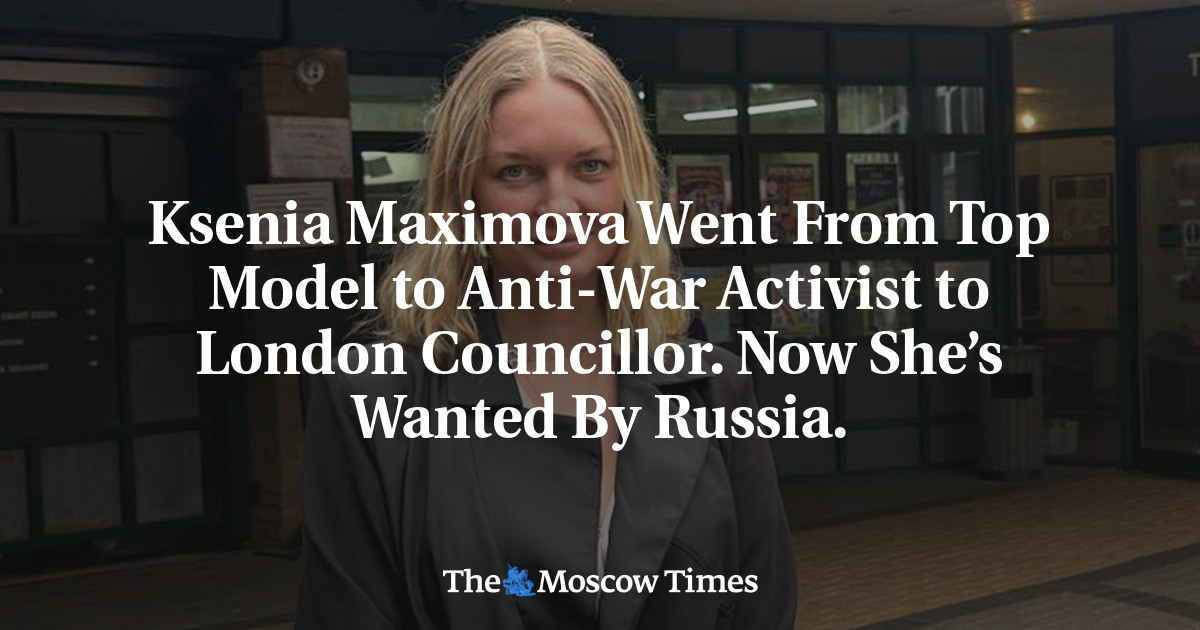
ОХУ-ын Аюулгүй байдлын холбооны алба ОХУ-ын эсрэг дайныг эсэргүүцэгч, Лондон хотын зөвлөлийн гишүүн Ксения Максимоваг террорист байгууллагад оролцсон хэргээр эрүүгийн хэрэг үүсгэн эрэн сурвалжилж эхэллээ.
2000-аад онд дэлхийн шилдэг 50 загвар өмсөгчийн нэгд тооцогдож байсан Ксения Максимова 2022 оноос хойш Украйныг дэмжих, ОХУ-ын дайныг эсэргүүцэгч цагаачдад туслах үйл ажиллагаа явуулж ирсэн юм. Тэрээр саяхан Их Британийн Либерал ардчилсан намаас нэр дэвшиж, Лондон хотын зөвлөлийн гишүүнээр сонгогдсон байна. ОХУ-ын эрх баригчид түүнийг үүсгэн байгуулсан “Оросын ардчилсан нийгэмлэг” байгууллагаараа дамжуулан Киевт санхүүгийн болон бусад тусламж үзүүлсэн хэмээн буруутгажээ.
Ксения Максимова өөрийг нь “террорист болон экстремист” хэмээн зарласныг улс төрийн үйл ажиллагаанд нь томоохон саад учруулахгүй гэж үзэж байна. Тэрээр Их Британийн улс төрд орсноор ОХУ-тай холбоотой асуудлуудыг олон улсын түвшинд илүү үр дүнтэй шийдвэрлэх боломж бүрдэнэ хэмээн мэдэгдлээ. Түүний хувьд орон нутгийн зөвлөлийн гишүүнээр ажиллах нь Британийн Парламентад нэр дэвших бэлтгэл үе шат гэж харж байгаа аж.
Одоогоор тэрээр Украйн улсад тогтмол очиж, дайны нөхцөл байдалтай биечлэн танилцан, олон улсын бодлогод нөлөөлөх судалгаа, шинжилгээний ажил хийж байна. Максимова ОХУ-д үлдсэн гэр бүлийнхнийхээ аюулгүй байдалд санаа зовниж байгаа ч, барууны улс орнууд ОХУ-ын эсрэг илүү шийдэмгий арга хэмжээ авах ёстой гэсэн байр суурьтай байна.
Дэлгэрэнгүйг эх сурвалжаас харах
↓Эх сурвалжийг нээх ↓
Ksenia Maximova was ranked among the world’s 50 most successful models in the 2000s, but today is better known as a prominent figure in Russia’s anti-war movement in London.
Since 2022, Maximova has worked to support Ukraine, help anti-war Russian emigres and refugees in Britain and collaborated with the Russian Anti-War Committee. More recently, she became a rare Russian-born figure to enter British politics after she was elected as a Liberal Democrat councillor in London.
On Monday, Russia’s Federal Security Service (FSB) opened a criminal case against her, accusing her of participating in a “terrorist organization” and claiming that the Russian Democratic Society, which she co-founded, collected money and other assistance “in the interests of the Kyiv regime.”
Maximova, 40, was also placed on Russia’s wanted list and added to its register of “terrorists and extremists.”
In an interview with The Moscow Times, Maximova discussed entering British politics as a Russian immigrant, her work supporting Ukraine and why she is considering running for Parliament.
This interview has been edited for length and clarity.
The Moscow Times: Does being added to the list of ‘terrorists and extremists’ affect your political career?
Ksenia Maximova: I’d say it’s more no than yes. Everyone in the U.K. has been incredibly supportive. Sometimes it even feels like a bit too much, to be honest, given how many messages my colleagues have been sending me. There’s an expression: ‘Wear it as a badge of honor,’ but I’d rather have a different kind of badge of honor.
First, I was put on a wanted list, then I was designated a ‘terrorist and extremist.’ Technically, it should have happened in the opposite order: first the charges, then the designation and then the wanted list. It’s also possible that at some point I’ll end up on an Interpol list and that could cause some problems when crossing borders. The biggest problem is that I still have family in Russia, and that’s what worries me.
MT: How much did you expect to be directly targeted?
KM: Honestly, I expected it. There’s even a joke that if you’re still not designated as a ‘foreign agent,’ an ‘undesirable organization’ or an ‘extremist,’ maybe you’re actually working for the FSB and someone is protecting you.
MT: When you became a municipal councillor, it was seen in exiled media as a success story — an example of someone from Russia getting involved in Western politics and integrating into society. How did it feel from your perspective?
KM: For me, it was a logical next step. At some point, I realized that if I wanted to work on Russia-related issues, it made sense to do it from within British politics. Constantly trying to push things from the outside wasn’t very effective. I also wanted firsthand experience of Western politics — to understand how it works and what it’s like to be part of a Western political party.
It’s actually been a real eye-opener. My first experience was with the Russian anti-war opposition, but so much of it seemed to be about undermining each other and fighting among themselves — this constant territorial behavior, arguing over who has the right to what and who controls what.
Then I joined the Liberal Democrats, and I don’t know if every party is like this, but people immediately started helping me. They explained how everything worked, supported me and kept checking in to make sure I understood what I was doing. It was a real shock to the system. I thought: ’This is what political participation can actually look like.’ I’ve been trying to bring some of that back into the Russian opposition movement — to foster more of a culture of mutual support. [The Russian Democratic Society] has always worked that way, thankfully, and it still does. But I’d like to see more of that across the Russian anti-war movement as a whole.
Also, there are already quite a few municipal councillors with Russian roots. I’m definitely not the first. Sometimes I even felt a little awkward about how much attention it got: ‘Oh, a Russian municipal councillor!’ There have been others before me, there are some now and there will be more.
Ksenia Maximova at her swearing-in ceremony for Ealing Borough Council, London.
ksenia_maximova__ / Instagram
MT: How do you balance your work as a municipal councillor with your work in the Russian anti-war movement?
KM: I clearly need to find a way to streamline things — that’s what I’m thinking about now, as I don’t have enough time.
As for my work as a municipal councillor, you could say we inherited our district at the worst possible time. We were elected in May and then we had an absolutely brutal drought all summer. I was visiting Kyiv and my constituents were messaging me saying: ‘All our parks are on fire.’ And I had to deal with it. Then we were told that the local council didn’t budget any money for firefighters or for maintaining water levels in the ponds. Everything dried up and the animals were dying.
An enormous number of requests keep coming in. The economy is doing badly across the country, people are struggling financially and a lot of people are losing their homes, so I also have to deal with social housing cases. Those are considered some of the most difficult cases. I was actually used to this from my human rights work, because every now and then random people would somehow get hold of my contact details —both Russians and Ukrainians. Imagine, a completely random person you’ve never met or even heard of lands in your inbox and says: ‘I’m a refugee,’ or ‘I’m about to be deported,’ or ‘I’m having problems with my visa.’ And you just try to figure it out and help however you can. It’s basically the same thing here, except now the British have been added to the mix.
I originally decided to run for the municipal council because it seemed like the natural path toward eventually running for Parliament. I’m still figuring things out, but I’ve now submitted an application to become a parliamentary candidate. The next step is to sit down, learn our policies and take the tests I need to qualify.
As for my anti-war work, I suppose you could say it’s broader in scope. There’s a diaspora organization, a committee in the British Parliament and an interparliamentary alliance on Russia that I’m currently putting together. Much of this is really about [shaping] Western policy toward Russia. I also work as a Russia expert — we produce reports and analysis and then use them for advocacy, whether that means pushing for sanctions or finding ways to support Ukraine.
MT: Speaking of supporting Ukraine, could you tell more about your trips there?
KM: I’ve been spending a lot of time there lately. I stayed for about a month and a half on my last trip. I’m a British citizen, so I can travel there freely, although there are obviously limits on how long I can stay.
It’s simply easier for me to do my work from there because so many experts, journalists, politicians, decisionmakers, stakeholders, foundations and NGOs are concentrated in Kyiv. When you’re working on Russia- and Ukraine-related issues from the West, you have to chase people around and seek out the relatively small number of people who are actually working on these issues.
I also wrote a post saying that Ukrainians don’t necessarily hate Russians who are anti-war and doing something useful for Ukraine — and I got absolutely slaughtered on social media for it. A lot of people assume that Ukrainians simply hate all Russians, full stop. But that’s not what I’ve experienced. I’ve had no problems staying there, and I can continue my advocacy work on Russia from Kyiv without any issues.
Obviously, there are airstrikes, and lately they’ve become even more intense. It’s hard to get used to. Everyone is chronically sleep-deprived. Nobody goes to shelters anymore, because otherwise you’d basically be living there.
I feel a little strange in Europe after coming back from Ukraine. You return and realize that, broadly speaking, people are preparing for war, but at the same time, there’s still very little readiness to take concrete action or, for that matter, allocate a budget for it. People who haven’t experienced this firsthand still seem to operate at a much slower pace. You want to do something, but you don’t know where to start. The Russian anti-war community has been sounding the alarm in the West for years. I’ve realized that there’s a particular nuance here. Even though I grew up in the West from my teenage years onward, I did grow up in Russia before that. When you spend part of your life in Russia, you’re left with this feeling that you always need to be prepared, ‘just in case.’ It’s this underlying state of alertness that you carry with you and the West simply doesn’t have that. Several generations of people in the West have grown up completely at ease and now getting them to see things differently is incredibly difficult.
As for our reports on Russia, it’s not that the [West] doesn’t want to listen, we actually get commissioned to produce them. But the whole system and institutional structure simply isn’t set up to respond quickly to changes.
MT: You said you’re considering running for Parliament. Could you tell us more about your plans and what it’s like building a political career as an immigrant, starting at the local level?
KM: I had absolutely no problems. I joined the party and about six months later decided to run for office. People actually encouraged me to do it and explained how the process worked. Not once did anyone suggest that the fact that I’m Russian might be an issue.
I found that voters actually really wanted to talk about international politics. People are anxious and don’t understand what’s going on. During the campaign, I had a few doorstep conversations where I asked people about their concerns and they said things like: ‘Can you get rid of Trump?’ or ‘Can you bring down petrol prices?’
There was one time when someone asked me how I felt about the war in Ukraine. It was January and I had just come back from Kyiv, so I replied: ‘I’ve just been freezing in Ukraine along with everyone else, so I hope that answers your question.’ That was basically it. I was actually surprised. I had expected that at some point someone might make an issue of [my nationality]. I even told our team that maybe we should make it clear that I work with Ukraine and support it. But in the end, nothing happened at all.
As for the Parliament, I think I need to weigh the pros and cons and consider how much I’d actually be able to do, and how effective I could be, particularly in continuing my human rights work and work on Russia. MPs are being pulled in so many different directions right now —they have international issues, national issues and then all the local issues in the constituencies they represent.
On the other hand, if you’re an MP, you’re a British politician and you have a certain level of influence. I think our party, the Liberal Democrats, could do quite well at the next election because Labour and the Conservatives are unpopular, while the Greens haven’t really managed to push their agenda through. [Nigel] Farage has also weakened, although he could still regain some strength. So we’re basically the centrists, with a relatively conservative economic position but liberal values. People are tired of all the extremes, and I think we certainly have a chance.
So, I’m also interested to see what happens at the next election.
A Message from The Moscow Times:
Dear readers,
We are facing unprecedented challenges. Russia’s Prosecutor General’s Office has designated The Moscow Times as an “undesirable” organization, criminalizing our work and putting our staff at risk of prosecution. This follows our earlier unjust labeling as a “foreign agent.”
These actions are direct attempts to silence independent journalism in Russia. The authorities claim our work “discredits the decisions of the Russian leadership.” We see things differently: we strive to provide accurate, unbiased reporting on Russia.
We, the journalists of The Moscow Times, refuse to be silenced. But to continue our work, we need your help.
Your support, no matter how small, makes a world of difference. If you can, please support us monthly starting from just $2. It’s quick to set up, and every contribution makes a significant impact.
By supporting The Moscow Times, you’re defending open, independent journalism in the face of repression. Thank you for standing with us.
Continue

Not ready to support today?
Remind me later.
×
Remind me next month
Thank you! Your reminder is set.
We will send you one reminder email a month from now. For details on the personal data we collect and how it is used, please see our Privacy Policy.

