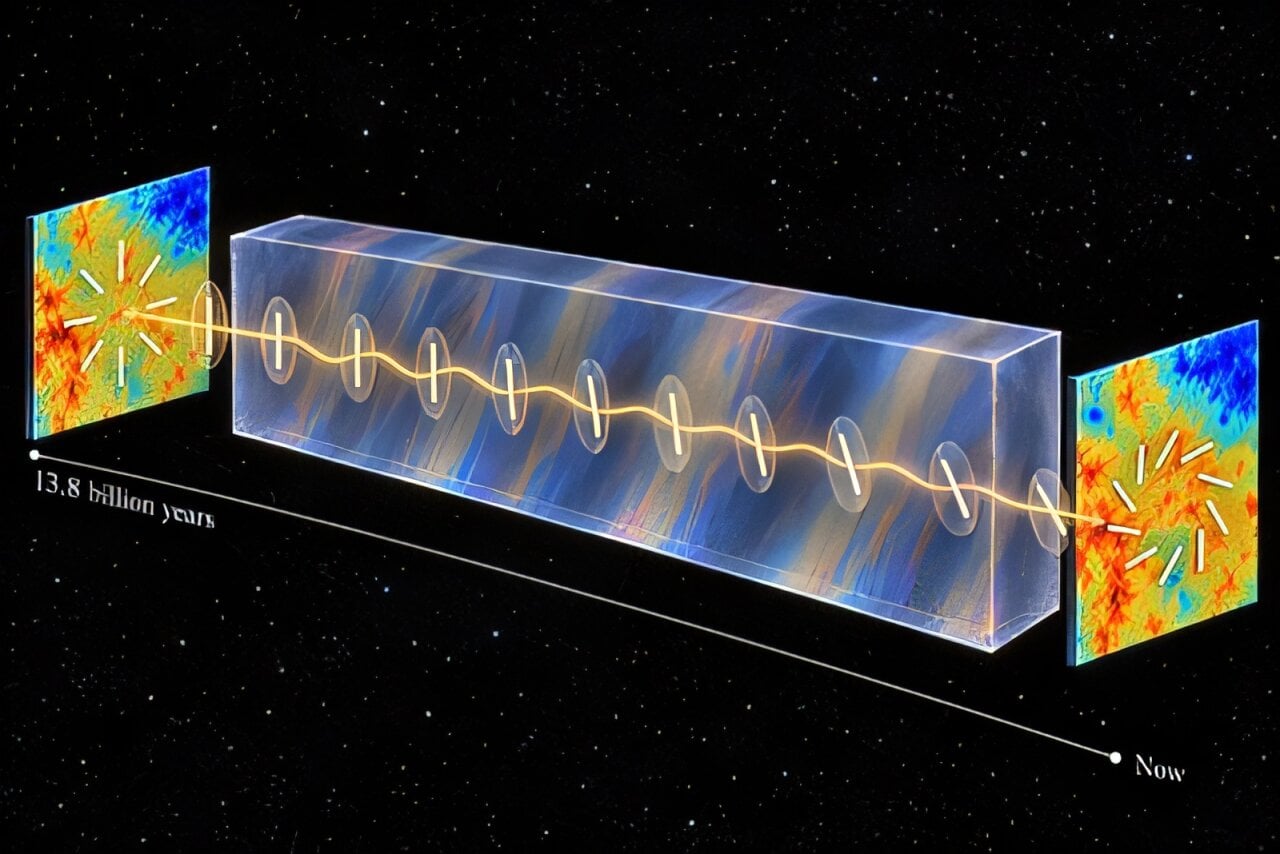
Эрдэмтэд сансрын бичил долгионы дэвсгэр цацрагийн туйлшралд дүн шинжилгээ хийж, орчлон ертөнцийн хувьслын талаарх үндсэн ойлголтуудыг сорьсон шинэ нээлт хийв.
Сансрын бичил долгионы дэвсгэр цацраг (CMB) нь их тэсрэлтээс хойш 380,000 жилийн дараа орчлон ертөнц тунгалаг болсноор үүссэн 13 тэрбум гаруй жилийн настай гэрэл юм. Энэхүү гэрлийн туйлшралын төлөв нь E-mode (цацраг мэт чиглэл) болон B-mode (ойр орчмын бүсүүдтэй харьцуулсан шилжилт) гэсэн хоёр хэлбэртэй байдаг. Одон орон судлаачид эдгээр туйлшралын хэв шинжийг ажиглах замаар орчлон ертөнцийн үүсэл болон физикийн процессыг судалдаг.
Космологийн стандарт загварын дагуу том хэмжээст орон зайд туйлшралын хэв шинжүүд нь тэнцвэржиж, ямар нэгэн хазайлт үүсгэх ёсгүй. Гэвч “сансрын хоёр хугарал” буюу сансрын гэрлийн глобал шилжилт нь уг загвараас зөрүүтэй үр дүн үзүүлдэг. 2020 онд хийсэн судалгаагаар энэхүү хазайлт тэгээс ялгаатай болохыг тогтоосон нь стандарт загвар бүрэн бус байж болзошгүйг харуулсан юм.
Судлаачид ажиглалтын багажийн алдаа болон жинхэнэ сансрын хугарлыг ялгахын тулд Planck сансрын хөлгийн найман өөр туйлшралын зураглалд статистик дүн шинжилгээ хийжээ. Уг аргачлалаар 2020 онд илэрсэн туйлшралын бага зэргийн шилжилт нь ажиглалтын алдаа бус, сансрын гаралтай болохыг баталсан байна.
Энэхүү ололт нь орчлон ертөнц бүрэн жигд бус байх эсвэл харанхуй материйн бөөмс сансрын гэрлийг мушгих нөлөө үзүүлдэг байж болзошгүй гэсэн таамаглалыг дэвшүүлж байна. Гэсэн хэдий ч энэ үр дүн нь эцсийн дүгнэлт гаргахад хангалттай нотолгоо биш тул цаашид илүү нарийвчилсан ажиглалт хийх шаардлагатай байгаа юм.
Дэлгэрэнгүйг эх сурвалжаас харах
Эх сурвалжийг нээх ↓
We are bathed in light from the ancient cosmos. It began its journey when the Universe finally cooled enough to be transparent, and it has traveled for more than 13 billion years to reach us. We call it the cosmic microwave background (CMB), and it has much to tell us.
One of the more subtle bits encoded in the cosmic background is polarization. When the Universe became optically transparent around 380,000 years after the Big Bang, those old photons had one last scatter off a hydrogen atom before undertaking their great journey. This “last scattering” polarized the photon. Initially the CMB photons were polarized randomly and had no large-scale orientation. But much can happen over 13 billion years.
E-mode and B-mode polarizations. Credit: Baumann, et al (2009)
There are two basic ways that cosmological photons can shift at observable scales. The first is called E-mode polarization, where the orientations can seem to radiate outward from a region. The second is called B-mode polarization, where the polarization appears shift relative to other nearby regions. Astronomers look for these polarization modes because they have unique cosmological causes.
E-mode polarization is caused by temperature variations in the CMB. It was first observed in 2002 by the DASI interferometer. The variations of E-modes within the CMB matches the temperature fluctations seen by the Planck spacecraft, which further confirms the Big Bang.
B-mode polarization was first observed in 2014, but not without some controversy. You might remember the stir caused by the results of BICEP2. The reason is that B-modes have multiple causes. The most common is the effect of gravitational lensing. As E-mode polarized light passed near a galaxy, the gravitational interaction can rotate the polarization slightly, shifting it from E-mode to B-mode. Another way B-mode could occur is through early cosmic inflation. That first rapid expansion rang the Universe like a bell, creating primordial gravitational waves. This is the B-mode that BICEP2 initially claimed to detect.
According to the standard model of cosmology, these polarizations should average out at large scales. In other words, there should be no overall bias to the polarization. It’s similar to galaxy clusters. Although we see galaxies clumped together into clusters, we still see about the same number of galaxies no matter which direction we look. The Universe is homogeneous.
Such a polarization bias is known as cosmic birefringence, a global shifting of cosmic light. The standard model predicts that cosmic birefringence should be zero, but back in 2020 there was a study that found a non-zero value. If confirmed it would prove that the standard model is either wrong or incomplete.
The problem is that it’s difficult to distinguish true birefringence from observational bias. To overcome this challenge a new study presents a way to test for observational bias. Rather than looking at a complete data result, the team looked at observational sets, then compared them statistically. The idea is that a true cosmic birefringence would have the same shift in all sets, while any bias of a set would vary.
Applying this method to eight polarization maps captured by the Planck spacecraft, they found that small polarization shift observed in 2020 appears to be cosmic in origin. This result supports the idea that cosmic birefringence is real.
As with the earlier study, this result isn’t strong enough to be conclusive. But it does support the possibility that some of our basic assumptions about the cosmos are wrong. Perhaps the Universe isn’t quite homogeneous, or perhaps there is some dark matter particle that gives a twist to the cosmos. As is often the case, we’ll need more observations to solve this mystery.
Reference: Minami, Yuto, and Eiichiro Komatsu. “New Extraction of the Cosmic Birefringence from the Planck 2018 Polarization Data.” Physical Review Letters 125.22 (2020): 221301.
Reference: Lonappan, Anto I., Brian Keating, and Kam Arnold. “Differential Polarization Calibration: A Consistency Test for Cosmic Birefringence.” The Astrophysical Journal Letters 1009.1 (2026): L12.

