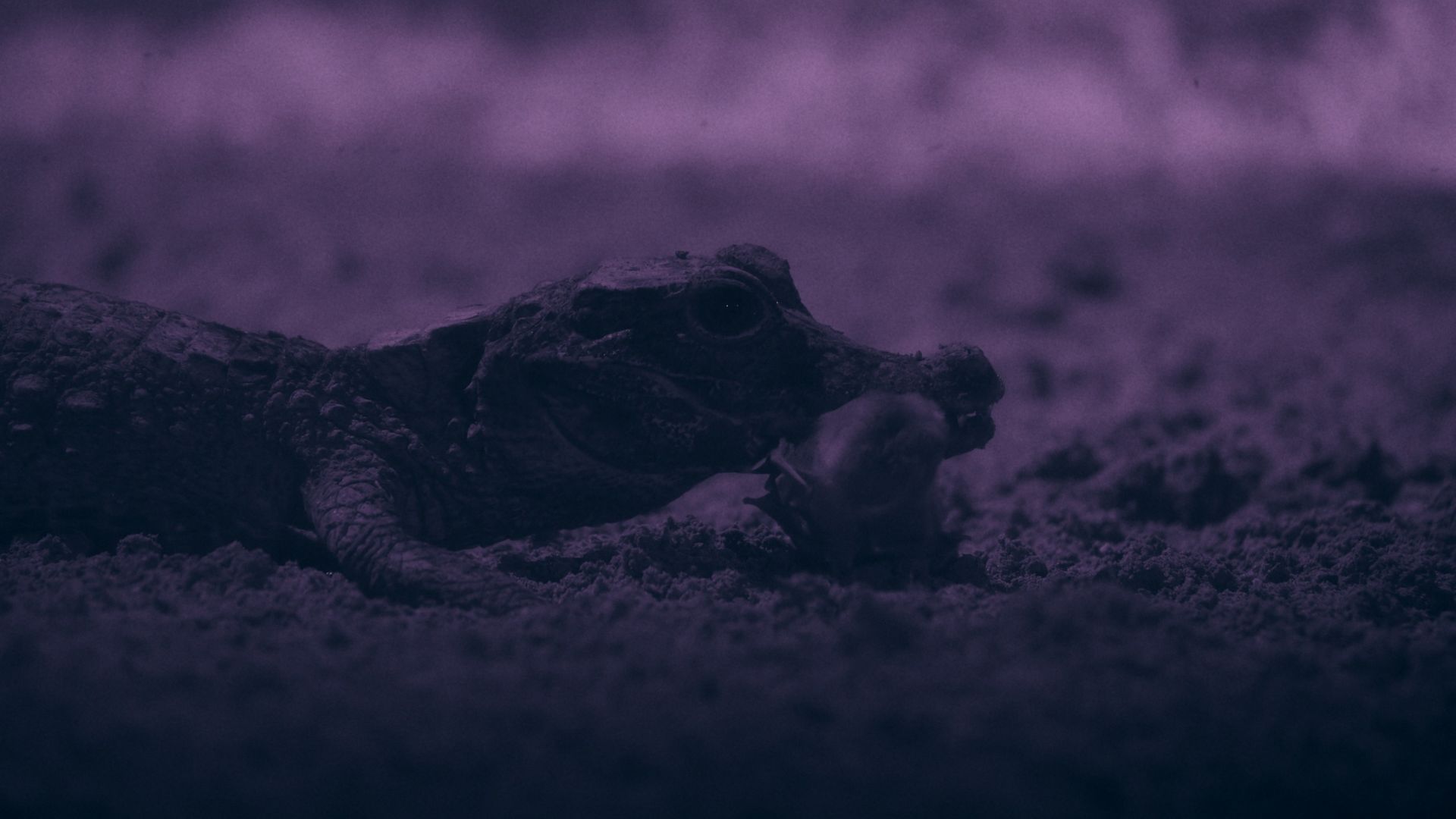
Судлаачид Габоны алслагдсан агуйд амьдардаг одой матрууд сарьсан багваахайг отож барьдаг өвөрмөц зан төлөвийг анх удаа дүрс бичлэгээр баримтжууллаа.
Африк тивийн баруун болон төв хэсгийн ой тайга, намагт амьдардаг Osteolaemus tetraspis буюу одой матрын энэ бүлэг 2008 онд Габоны Абанда агуйгаас олдсон юм. Байгаль хамгаалагч, судлаач Мэтт Ширли болон түүний багийнхан алсын удирдлагатай тусгай камер ашиглан тэднийг агуйн харанхуйд сарьсан багваахайн ялгадас дунд нуугдан идэш тэжээлээ барьж буйг илрүүлжээ. Энэхүү ажиглалт нь 15 гаруй жил үргэлжилсэн судалгааны явцад анх удаа бүртгэгдсэн чухал ач холбогдолтой үйл явдал болсон байна.
Агуйн матрууд гаднах орчны матруудаас ялгаатай нь сарьсан багваахайн ялгадас ихтэй, харанхуй орчинд дасан зохицсон байна. Агуйн хүчиллэг ялгадас нь тэдний арьсыг өнгөө алдаж, улбар шар өнгөтэй болгодог болохыг эрдэмтэд тогтоожээ. Мөн тэд агуйд идэш тэжээл элбэг, махчин амьтан цөөн байдгийн улмаас гаднах төрөл нэгтнүүдээсээ илүү сайн тэжээгддэг болох нь харагдаж байна.
Одоогийн байдлаар эдгээр матрууд нь генетикийн хувьд тусгаарлагдсан бүлэг болон хувьслын явцад дасан зохицож байна. Мэтт Ширлигийн үзэж буйгаар, тэд өөрсдийн амьдрах орчныг сонгосноор генетикийн ялгаатай шинж чанаруудыг хуримтлуулж, хувьслын үйл явцыг бодитоор харуулж байна. Одоогоор Габоны засгийн газар Абанда агуйг тусгай хамгаалалттай бүс болгохоор ажиллаж байгаа бөгөөд энэ нь нэн ховордож болзошгүй матрын энэ бүлгийг хамгаалахад чухал алхам болох юм.
Дэлгэрэнгүйг эх сурвалжаас харах
↓Эх сурвалжийг нээх ↓
The world’s smallest crocodiles use a sneak attack to hunt bats in hellish underground caves filled with poop, a new video reveals.
The footage of the never-before-seen behavior was captured for the upcoming National Geographic series “Africa: Earth’s Wild Home” and offers a rare glimpse into the lives of Gabon’s mysterious cave-dwelling dwarf crocodiles.
Dwarf crocodiles (Osteolaemus tetraspis), which grow to only around 5 feet (1.5 meters) long, live across West and Central Africa and are typically found in forests, rivers, swamps and similar surface habitats. However, the cave population filmed in the new series is unique.
Discovered in 2008, these subterranean explorers spend their days in total darkness, stalking mounds of bat excrement (guano) in the remote Abanda Caves of Gabon on the west coast of Central Africa. Researchers knew the crocs were feeding on bats and insects, but they weren’t sure how because the crocs wouldn’t hunt with humans in their lair.
Now, thanks to a team of brave scientists and filmmakers — and special, remote camera equipment — we can watch the crocs catch their prey for the first time.
“I’ve been working with this population for almost 15 or 16 years now, and that’s something we’ve never been able to see,” Matt Shirley, a conservation ecologist and Rolex National Geographic Perpetual Planet Explorer, told Live Science. “No matter how deeply in the bat guano I’ve been, or how long I’ve spent in the caves, whenever I’m in there, the crocodiles just aren’t doing what they want to be doing.”
Gabon’s cave crocodiles will be featured in the “Jungle” episode of “Africa: Earth’s Wild Home.” This seven-part series spans the African continent, covering a variety of wildlife and landscapes, with narration from actress Wunmi Mosaku.
Shirley said the crocodile footage can be used to reconstruct the cave population’s behavior patterns and trends.
Researchers aren’t sure when the dwarf crocodiles adopted their subterranean lifestyle, but they might have been living in the caves for thousands of years. The cave system is remote and difficult to access, so it’s no surprise that the crocs went unnoticed until comparatively recently. Shirley described conditions within the system as intense, with very enclosed spaces, bats and copious amounts of guano to navigate.
“If it’s the dry season, you’re just kind of standing on this like fluffy mattress cloud of bat guano, but if there’s any rain, you’re in a bat guano slurry,” Shirley said. “Sometimes, to catch the crocodiles, I’m either literally standing with up to my neck in bat guano, or I’m having to lay down to crawl through tunnels and basically move through bat guano slurry, head to toe.”
Shirley was part of the team that first documented the crocodiles in 2010. That work led to a 2016 study, published in the African Journal of Ecology, comparing the dwarf crocodiles in the cave to those living aboveground in the forests.
Living in acidic bat guano effectively tans the crocs’ grayish skin, eroding it over time to give them a distinct orange color. However, Shirley and his colleagues have found that the cave crocodiles are often better fed than their forest-dwelling counterparts, which the team thinks is likely due to the abundance of prey and lack of predators in the caves.
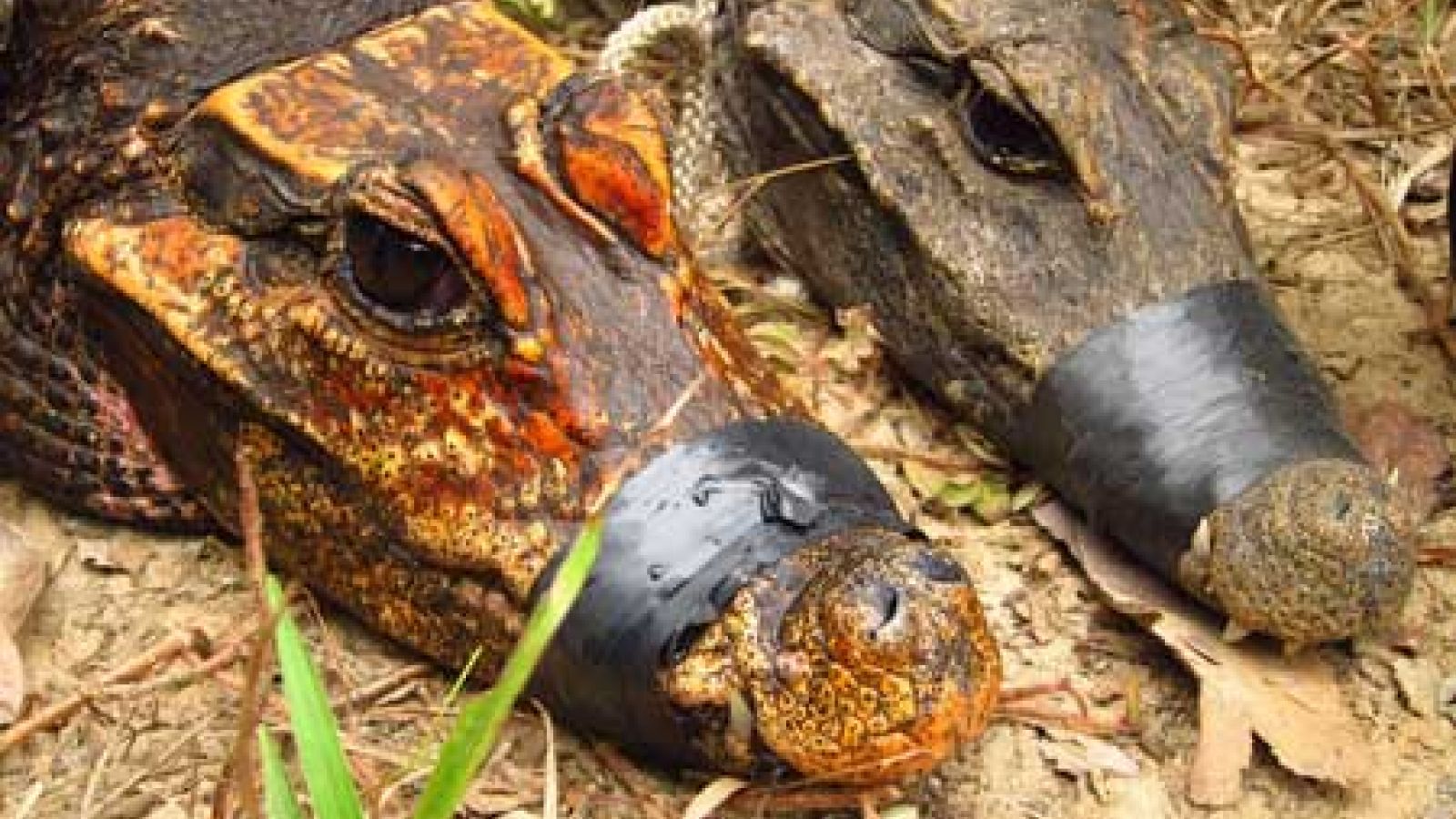
Currently, the cave population is part of the broader dwarf crocodile species, but it stands out as a genetically isolated group. Shirley noted that the animals have clearly made a choice to occupy the extreme cave environment, despite the potential health risks and noisy neighbors, and are therefore quite possibly dictating their own evolution.
By staying in the cave and mating only with each other, they are accumulating genetic differences that should help them better adapt to their environment, he explained.
“It’s very ‘Jurassic Park,’ you know — life-finds-a-way sort of a scenario,” Shirley said. “This is evolution in action.”
Dwarf crocodiles are classified as vulnerable to extinction on the International Union for Conservation of Nature’s (IUCN) Red List of Threatened Species. However, the IUCN hasn’t assessed these crocodiles in decades, so their current conservation status is uncertain.
As a common source of protein for people in parts of West and Central Africa, the species is threatened by overharvesting, as well as by habitat loss, National Geographic reported. However, the dwarf crocodiles also have a very wide range and are particularly abundant in Gabon.
The Abanda Caves, where the subterranean population lives, sit outside Gabon’s protected areas, making the cave crocs more vulnerable to any human activities in the area. Shirley noted that the Gabonese government is undergoing a process to protect the caves as a specific reserve.
“I don’t think we’re worried about extinction of the species, but until that classification of a protected area comes to fruition, the cave population is definitely at risk,” he said.
“Africa: Earth’s Wild Home” premieres on National Geographic Friday (Oct. 2) at 8 p.m. EDT and will be available to stream on Disney+ and Hulu the following day.

