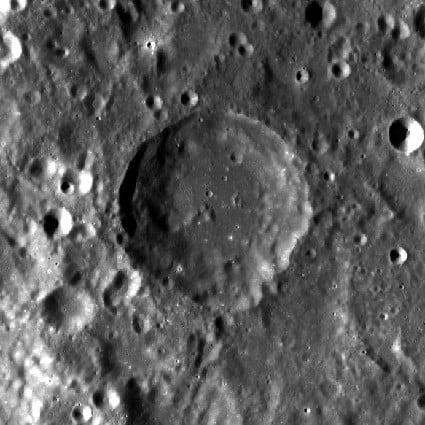
Сарны алс талын Dewar хэмээх бүсэд илэрсэн эртний галт уулын үлдэгдэл нь манай дагуул дэлхий эрт цагт соронзон динамтай байсныг нотолж байна.
ETH Zurich, DLR болон Хэрэглээний геошинжлэх ухааны хүрээлэнгийн судлаачид Сарны соронзон орны түүхийг Dewar хэмээх гадаргын содон тогтоц дээр үндэслэн судалжээ. Сарны алс талд, Өмнөд туйл-Айткений сав газрын баруун хойд хэсэгт байрлах энэхүү бүс нь соронзон болон таталцлын хүчний гажгууд зэрэг илэрдэг онцлогтой. Судлаачид GRAIL, Lunar Prospector, Kaguya зэрэг сансрын аппаратуудын цуглуулсан өгөгдлийг “Variation of Information” (VI) аргачлалаар шинжилж, тус газар 60 км өргөн, 5-9 км гүн, нягтрал ихтэй булшлагдсан галт уул байгааг тогтоосон байна.
Dewar бүс дэх “Сарны эргүүлэг” буюу цайвар өнгийн тэмдэглэгээ нь төмрийн оксидоор баялаг хөрсөн дээр үүсжээ. Төмрийн оксид нь нарны салхинд амархан элэгддэг ч тус бүсэд тод хэвээр байгаа нь доор нь орших базальт чулуулгийн үүсгэсэн хэвтээ чиглэлийн соронзон орон нарны салхинаас хамгаалсантай холбоотой юм. Хэрэв соронзон орон босоо чиглэлтэй байсан бол нарны салхи хөрсийг шууд мөргөж, бараан өнгөтэй болгох байв.
Энэхүү соронзон гажиг нь ердөө хэдхэн хоног үргэлжилдэг солирын мөргөлдөөнөөс үүсэх боломжгүй бөгөөд олон зуун мянгаас сая жилийн турш үргэлжилсэн соронзон орон л ийм нөлөө үзүүлэх боломжтой. Судалгаагаар Dewar галт уулын тогтоц нь ойролцоогоор 4.22 тэрбум жилийн өмнө соронзон орны нөлөөнд автсан болохыг тогтоожээ.
Тухайн үеийн Сарны соронзон орон нь өнөөгийн Дэлхийн соронзон орны хүчнээс сул буюу ойролцоогоор 11 микротесла байсан байна. Энэхүү нээлт нь Сарны соронзон орон байсан эсэх талаарх олон арван жилийн маргааныг эцэслэж, цаашид энэхүү динамын үйл ажиллагаа хэрхэн явагдаж байсныг судлах шинэ боломжийг нээж байна. Ирээдүйн Lunar Vertex болон бусад судалгааны ажил нь энэ чиглэлээр илүү нарийвчилсан мэдээллийг өгөх төлөвтэй байна.
Дэлгэрэнгүйг эх сурвалжаас харах
Эх сурвалжийг нээх ↓
Scientists know for certain the moon doesn’t currently have a magnetosphere. But they’ve been debating for decades about whether it ever did. Data from both Apollo samples and orbital scientific instruments have proven divisive, and so the debate still rages. But a new paper from researchers at ETH Zurich, DLR, and the Institute of Applied Geosciences hopes to resolve the debate once and for all – by definitively proving that the Moon did, indeed, once have a magnetic dynamo.
To prove this point, they turn to a feature on the lunar surface that can’t be seen from Earth – the Dewar Swirl. Located on the lunar far side northwest of the South Pole Aitken (SPA) basin that is so famous for its potential water resources, this area showed promise because it appeared to harbor two different “anomalies”, one magnetic and one gravitational.
Planetary geologists have known about the Dewar swirl for a long time, eventually classifying it as a “cryptomare” – a type of ancient basalt deposit hidden under layers of impact debris. It also features a “lunar swirl”, a type of marking that shows up on the lunar surface like brush strokes, and almost always coincide with a magnetic anomaly.
Fraser talks about giving the Moon an atmosphere
Typically, these swirls show up in clusters, but Dewar is unique as it is relatively isolated as well as sitting directly overtop of a geochemical hotspot that contains a lot of iron oxide, titanium dioxide, thorium, and pyroxene. The geological body that sits directly underneath the Dewar swirl is approximately 60 kilometers wide and runs between 5 and 9 km deep. Critically, it also has a higher density than the surrounding area, creating a “gravitational anomaly” in orbital readings, which is also paired with a strong magnetization level.
Studying what is actually hidden between the Dewar swirl required the researchers to use orbital data from a variety of gravitational and magnetic sensors, including those on GRAIL, Lunar Prospector, and Kaguya. Collecting that data together allowed them to then use an information theory technique known as variation of information (VI) to calculate the “inversion” of the data to try to determine what object was making them. After figuring out its general dimensions and density, the image became clearer – the Dewar swirl was sitting directly on top of a buried volcano.
Granted that volcano likely hadn’t erupted in billions of years. And that was a good thing, as its explosion would have likely wiped out layers of fine regolith that had been lying on top of it for almost as long. Which would have been a tragedy as the regolith there appeared much brighter than would otherwise be expected.
Fraser talks about how the ridges on the Moon give a clue to its geology.
That higher albedo, which is what the swirl is made out of, is caused by two things. First, the regolith must be rich in iron oxide, which is highly reflective. Iron oxide also weathers quickly in the solar wind, so the material making up the Dewar swirl must be shielded in some way. The researchers determined that shield was coming from the underlying basalt, which provided a horizontal magnetic anomaly that pushed the solar wind away from the regolith directly on top of it, allowing it to stay brighter for longer, and contrasting it to the darker, weathered basalt surrounding.
Which then begs the question, if the swirl is in fact caused by a magnetic anomaly, why don’t all magnetic anomalies have swirls? The simple answer appears to be the orientation of the anomaly itself. Dewar’s anomaly was horizontal, meaning it pushed solar wind particles away from the regolith underneath, whereas some other magnetic anomalies are vertical, funneling the solar wind particles directly into the regolith and causing it to dark significantly and wiping out any trace of a swirl.
A key feature of this magnetic anomaly was that it appeared to be created over hundreds of thousands to millions of years while under the influence of a magnetic field. That is simply not possible in the event it was created by an asteroid impact, as those fields only last for a few days at most, leaving a long-term magnetic field, caused by a dynamo, as the only potential source for the Dewar magnetic anomaly.
Map of lunar magnetic anomalies near the South Pole. Credit – Li Long
Dating when the Dewar rock was formed also helps narrow down when the magnetic field was present. The cryptomare itself lies on top of the South Pole-Aitken basin ejecta, which was created about 4.32 billion years ago. But it is also covered up by ejecta from the Freundlich-Sharonov basin, which was created around 4.14 billion years ago. So somewhere around 4.22 billion years ago, the lunar surface was affected by a magnetic field that pushed the Dewar volcano to develop into an anomaly that we can still see today.
Admittedly, even back then the magnetic field on the Moon wasn’t as strong as it is on Earth today (~11 microteslas as compared to ~50 microteslas for Earth). So now the question shifts from whether the Moon ever had a “dynamo” driving a magnetic field to “how did the dynamo work?” Answers to that might come from a series of future missions collecting yet more data about the Moon’s geological history.
The Lunar Vertex lander will soon visit another famous swirl known as Reiner Gamma, monitoring its magnetic anomaly closely and tying it back to albedo differences. Other sample return missions, such as Chang’e-7/8 or Artemis surface missions could also bring back more rocks with a more definitive geological history than the Apollo samples. But for now, this paper represents another step forward in our understanding of the Moon’s evolution, and how different our closest neighbor was in its early years from what we see today.
Learn More:
ETH Zurich – The far side of the Moon provides clues to a previous magnetic field
X. Yang et al – Magmatic origin of the Dewar magnetic anomaly: Implications for an early lunar dynamo
UT – Mysterious Swirls on the Moon Could Be Explained by Underground
UT – Did a Large Impact on the Moon Make its Rocks Magnetic?


Энэ судалгаа үнэхээр сонирхолтой санагдаж байна, Сарны соронзон орон байсан гэдэг түүхийг баталж байгаагаас харахад илүү нухацтай судалгаа хийх шаардлагатай мэт. Тэгвэл та эртний сарны соронзон динамыг ямар илүү сонирхолтой нээлт гэж үзэж байна вэ?