Францын хаан XIV Людвигийн хаанчлалын жилүүдэд хөгжим нь зөвхөн цэнгээний хэрэгсэл бус, харин хааны эрх мэдэл, улс төрийн ноёрхлыг олон нийтэд сурталчлах, хаант засаглалын сүр хүчийг илтгэх соёлын нэгдсэн тогтолцооны салшгүй хэсэг байв.
Францын хаан XIV Людвиг (1643-1715) хаанчлах хугацаандаа хөгжмийг хааны ордон, дипломат хүлээн авалт, шашны зан үйл, балет болон “хөгжимт эмгэнэлт жүжиг” (tragédie en musique)-ийн салшгүй хэсэг болгон ашиглажээ. Гэвч үүнийг зөвхөн хааны хөгжимд дурлах сэтгэл эсвэл суртал ухуулгаар тайлбарлах нь хангалтгүй юм. Хөгжим нь домог зүй, бүжиг, яруу найраг, хувцас загвар, уран барилга, зураг болон зан үйл зэрэг хааныг ялалт, энх тайван, сүр жавхлантай холбон дүрсэлдэг өргөн хүрээний соёлын илэрхийллийн нэг хэсэг байв. Хаант засаглал нь урлагийн энэхүү тогтолцоог ашиглан өөрийн нийгэм дэх байр сууриа бэхжүүлж, олон нийтэд харилцаа тогтоодог байжээ.
XIV Людвиг нь өмнөх үеийн Францын хаадын уламжлалыг өвлөн авч, тэдгээрийг илүү боловсронгуй болгосон юм. Эрт үед хааны эрх мэдлийг хааны өөрийн бүжиглэж буй биеэр илэрхийлдэг байсан бол цаг хугацаа өнгөрөх тусам хөгжим нь төр засгийн бүтцэд гүн гүнзгий нэвтэрчээ.
Эрх мэдлийн өвлөгдсөн хэл
Францын хаад Людвигээс ч өмнө улс төрийн дэг журмыг олон нийтэд харуулахын тулд хөгжмийн үзүүлбэрийг ашигладаг байв. IX Чарльз хааны (1560-1574) үед хатан хаан Екатерина де Медичигийн нөлөөгөөр энэхүү уламжлал улам бүр бэхэжжээ. Тэрээр Италийн Медичигийн удмын хүний хувьд хааны ордонд сүрлэг ёслол, багт наадам, балет зэргийг хөгжим, яруу найраг, уран барилгатай хослуулан хэрэгжүүлэх уламжлалыг авчирсан юм. Сонгодог домог зүйг ашиглан хаадыг бурхан эсвэл баатар мэтээр дүрсэлж, улс төрийн зөрчлийг эмх замбараагүй байдлыг ялж буй дэг журам мэтээр харуулдаг байв.
Үүний тод жишээ бол 1570 онд IX Чарльз болон Австрийн Элизабет нарын хуримын үеэр зохион байгуулсан “Кадм ба Хармони” хэмээх домог юм. Кадмыг хөгжимчин хаан, соёл иргэншлийг үндэслэгч хэмээн дүрсэлсэн нь Францын шашны дайны үеийн эмх замбараагүй байдлыг даван туулж, энх тайвныг тогтоож буй хааны дүртэй дүйцүүлж байв. 1570 онд байгуулагдсан “Яруу найраг, хөгжмийн академи” (Académie de poésie et de musique) нь эртний Грекийн жишгээр яруу найраг, хөгжмийн нэгдлийг сэргээхийг зорьж байсан нь нийгмийн дэг журам, ёс суртахуунд нөлөөлөх зорилготой байв.
XVII зууны эхэн үед XIII Людвиг хаан болон Кардинал Ришелье нар балетын урлагаар дамжуулан цэргийн ялалт, засгийн газрын үйл ажиллагааг ёгтлон харуулдаг байв. Гэвч үзэгчдийн хүлээж авах хандлага үргэлж хааны хүссэнээр байдаггүй байсан нь Кардинал Мазариний үед Италийн дуурийг Парист нэвтрүүлэх оролдлогоос харагддаг. Луижи Россигийн “Орфей” дуурийн өндөр зардал нь иргэдийн дургүйцлийг төрүүлж, улмаар “Фронда” (1648-1653) хэмээх иргэний бослогын үеэр Италийн хөгжимчид халдлагад өртөхөд хүргэжээ. Энэхүү бүтэлгүйтэл нь эсрэгээрээ Францын үндэсний дуурийн урлаг хөгжихөд түлхэц болсон юм.
Бүжиглэдэг хаан ба Фронда
Фрондагийн бослогыг дарж, 1653 онд тавьсан “Шөнийн балет” (Ballet de la nuit)-д 14 настай Людвиг хаан өөрөө бүжиглэж, наран бурхан Аполлоны дүрд хувирсан нь улс төрийн хүчтэй бэлгэдэл болсон юм. Хаан өөрөө бүжиглэснээрээ зөвхөн захиалагч төдийгүй эрх мэдлээ биеэрээ үзүүлэгч болж байв. Энэ нь хааныг “Нарны хаан” хэмээн алдаршуулах эхлэлийг тавьж, эмх замбараагүй байдлыг төгсгөж буй гэрэлт хүч хэмээн сурталчилсан билээ.
Ивээн тэтгэлгээс засаг захиргааны тогтолцоо руу
1661 онд Мазаринийг таалал төгссөний дараа Людвиг хаан төр засгийг бие даан удирдаж эхэлснээр соёлын амьдралыг удирдах тогтолцоо өөрчлөгджээ. 1672 онд Жан-Батист Люллид “Хааны хөгжмийн академи”-ийг удирдах онцгой эрх олгож, Парист дуурь тоглуулах монополь эрхийг өгсөн нь соёлыг төрийн хяналтад бүрэн авсны баталгаа байв. Энэ нь зөвхөн суртал ухуулга төдийгүй дуурийн тасалбарын орлогоор зардлаа нөхөх эдийн засгийн ач холбогдолтой байлаа.
Люлли болон жүжгийн зохиолч Филипп Кино нарын хамтын ажиллагаагаар “хөгжимт эмгэнэлт жүжиг” төрөл хөгжсөн. Тэд Италийн дуурийн хэв маягийг Францын яруу найраг, бүжиг, хөгжмийн онцлогтой хослуулан, Франц хэлний хэмнэлд тохирсон дахин давтагдашгүй хэв маягийг бүтээжээ. Жүжгийн оршил хэсэгт улс төрийн гол санааг домог зүйн аргаар илэрхийлж, хааны цэргийн ялалт, энх тайвныг сурталчилдаг байв. 1677 онд тавьсан “Исида” дуурийн үеэр хааны нууц амрагуудын хоорондох зөрчлийг үзэгчид жүжигтэй холбон тайлбарлаж, улмаар зохиолч Кино ажлаасаа халагдсан нь урлаг улс төри
Дэлгэрэнгүйг эх сурвалжаас харах
↓Эх сурвалжийг нээх ↓
During the reign of Louis XIV of France (1643-1715), music accompanied some of the most visible occasions of royal life: entrances, diplomatic receptions, religious services, court festivals, ballets, and eventually tragédie en musique. To explain this phenomenon simply through the king’s enthusiasm for music, patronage, or propaganda, however, would be insufficient. Music belonged to a broader culture of royal representation in which myth, dance, poetry, costume, architecture, painting, ritual, and sound associated Louis with victory, peace, splendour, concord, and order. Music was therefore one element within a much broader artistic system through which the monarchy constructed and communicated its public image.
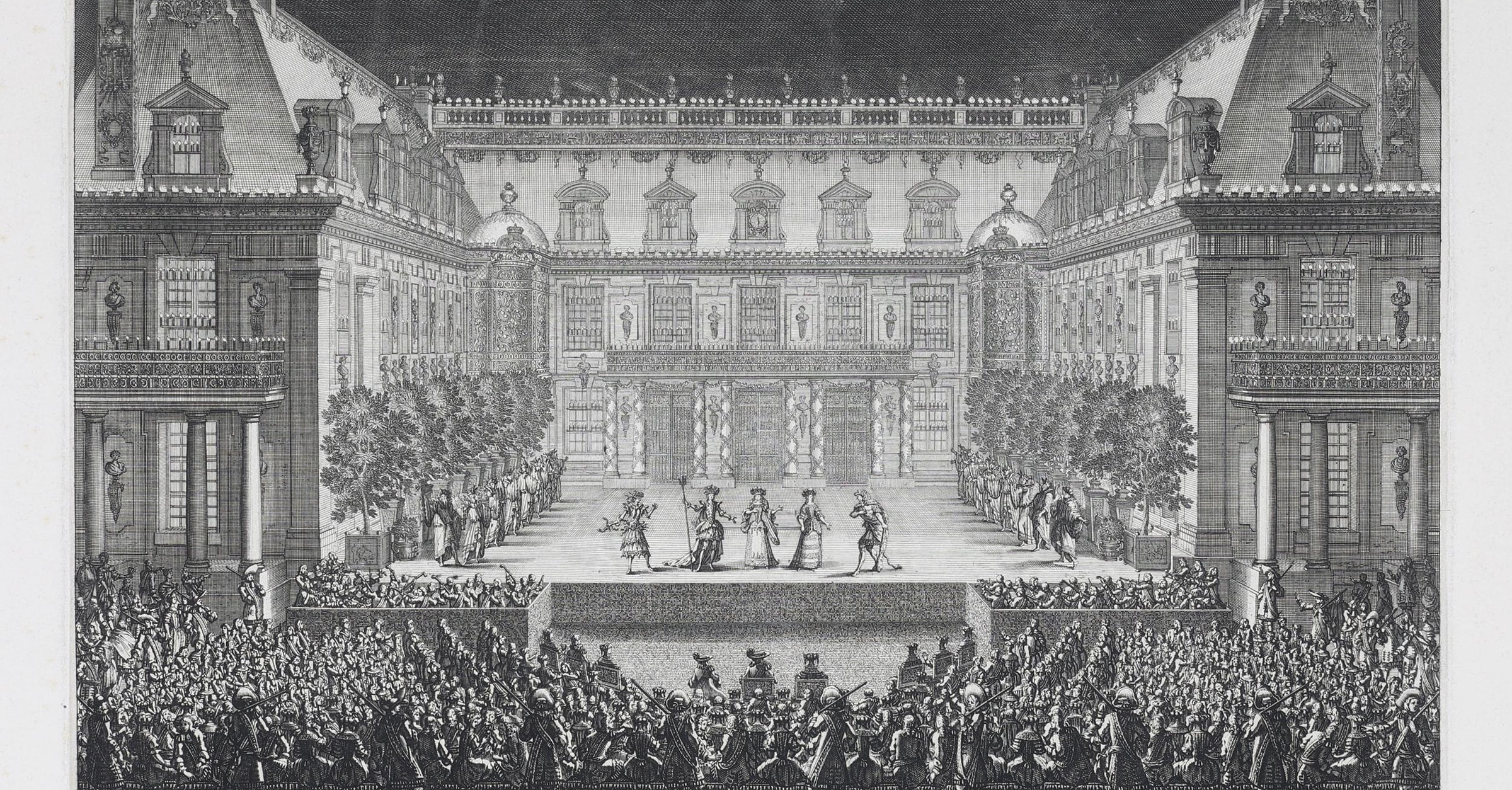
Performance at the Palace of Versailles, 1676
Louis XIV inherited practices developed at earlier French courts, some of which were shaped by Platonic and Neoplatonic ideas about music, and saw to it that these practices were extended and more closely coordinated. At first, royal representation could centre quite literally on the young king’s own body as a dancer. Over time, however, music became more deeply embedded in the structures of royal power. The monarchy’s control over production, the responses of audiences, and the development of a recognisably French musical style all influenced the place music came to occupy in its public image.
An Inherited Language of Power
Long before Louis, French rulers had used musical spectacle to make political order visible. During the reign of Charles IX of France (reign 1560-1574) and under the influence of the queen mother and regent, Catherine de’ Medici, these practices were already well established. Catherine, a great-granddaughter of Lorenzo de’ Medici (“the Magnificent”), brought a strong tradition of elaborate dynastic spectacle to the French court. Royal entrances, fêtes, tournaments, mascarades (masked court entertainments), and ballets combined music with architecture, poetry, painting, costume, and choreographed movement. Classical mythology, too, offered flexible ways of expressing political ideas, allowing rulers to be represented as gods or heroes and political conflict as a struggle in which order ultimately triumphs over disorder.
Music, poetry, classical mythology, & other arts & spectacle represented a cumulative ideal for promoting stability, order, & peace.
The celebrations surrounding the 1570 marriage of Charles IX to Elizabeth of Austria, a Habsburg archduchess, exemplified this. Court writers settled on the myth of Cadmus and Harmonia. Cadmus, imagined as a musician-king and civilising figure, defeats destructive forces before marrying Harmonia, whose very name evokes concord. The contemporary implications were difficult to miss. Cadmus could be read as Charles, while his union with Harmonia suggested the restoration of peace. As the country was still fractured by the French Wars of Religion (1562-1598), this marriage represented more than a dynastic alliance; it became an image of the king overcoming disorder and restoring stability.
Jean-Antoine de Baïf, co-founder of the Académie de poésie et de musique, wrote poems for the occasion that made the connection between marriage, peace, and the effects of music explicit. The Académie de poésie et de musique was founded in 1570 with Charles IX’s support and brought poets and musicians together in an attempt to recover what its members understood as the close union of poetry and music in ancient Greece. Baïf and his circle believed that well-ordered verse and music could influence morals and encourage social concord. During the decades of religious wars, the ideal of consonance within and between the arts, morals and social order would be read as a model for concord within the kingdom. Seen from Louis XIV’s time, music, poetry, classical mythology, and other arts and spectacle represented a cumulative ideal for promoting stability, order, and peace.
The same symbolic language remained active in the early 17th century. Under Louis XIII of France (reign 1610-1643) and his chief minister Cardinal Richelieu, court ballets celebrated military success and transformed government into allegory. In the Ballet de la prospérité des armes de France (1641), Harmony declares that rulers must follow her, while Victory, Mars, Fame, and other mythological figures recast recent warfare in a theatrical narrative of royal achievement.
Choreography for a Ballet, 1617 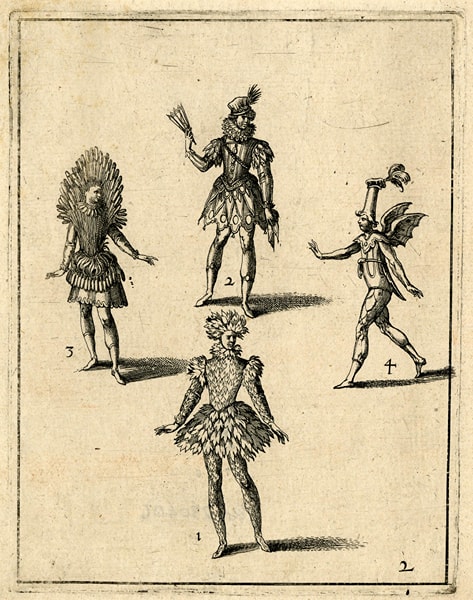
Audience reception, however, could not be controlled, and the political use of musical spectacle did not guarantee that audiences would interpret it as its patrons intended. This became particularly clear under Cardinal Jules Mazarin, the Italian-born minister who directed the royal government during Louis XIV’s minority. Mazarin tried to establish Italian opera in Paris, but Luigi Rossi’s Orfeo (1647), produced with elaborate stage machinery and expensive Italian performers, arrived at a moment of fiscal pressure and growing hostility toward the minister. Critics seized on the cost of the production as evidence of ministerial extravagance. Once the Fronde (the civil revolts against royal authority from 1648 to 1653) began, Italian musicians themselves became targets. Opera, “introduced for political reasons,” collapsed “for political reasons” (Isherwood, 125-26).
Contentious and damaging as this episode was, it proved to be just right for French music’s development. Italian opera encountered French-spoken theatre, pastoral drama, and ballet de cour, and some of those conventions would later be adapted within French opera, also known as tragédies en musique.
The Dancing King & the Fronde
In the Fronde’s aftermath, Louis XIV’s use of performance acquired particular force. In the Ballet de la nuit, first performed in February 1653 after the defeat of the rebels, the 14-year-old king danced several roles and finally appeared as the rising sun. Isaac de Benserade, the court poet responsible for the libretto, connected the darkness of night with defeated disorder and the return of light with Louis himself. Aurora announces that the lesser lights flee before “the Sun who follows me,” making the identification of the young monarch with the power that brings darkness to an end abundantly clear (Isherwood, 136-38).
Louis XIV as Apollo in the Ballet de la Nuit 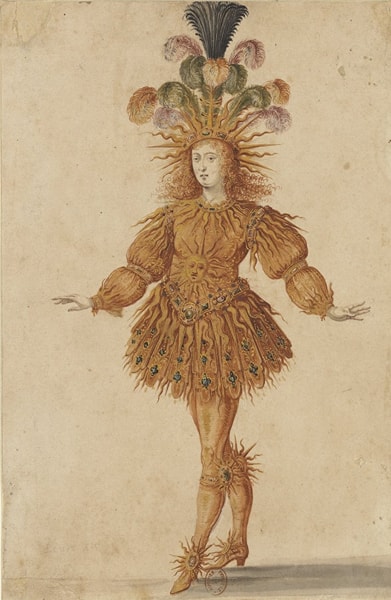
The political effect depended partly on the fact that Louis himself danced the role. He was not simply commissioning an image; in his own anointed body, he enacted it. The gloom and obscurity of the nighttime scenes were dispelled by the effulgence of the young king’s entrance, allegorically enacting the painful aftermath of social conflict and the restoration of royal order. Dance and theatrical divertissements, therefore, were integral to the political dramaturgy of the ballet rather than mere additions. In time, the image of Louis as Sun King would become a familiar trope, but in 1653, it was novel and majestic, promising relief and a hoped-for centering of power in the young monarch.
Court ballet continued to adapt the royal image to changing circumstances. Louis appeared at different times as Apollo, Neptune, lover, warrior, peacemaker, or heroic ruler. In Les amants magnifiques (1670), his final appearance in a court ballet, he again danced as Apollo. Performances of this kind offered courtiers, Parisians, and foreign visitors repeated images of monarchical heroism, benevolence, and brilliance. By 1671, however, the king’s dancing body was no longer the principal presentation of his public image and the expanding culture of Versailles increasingly reinforced one another.
From Patronage to Administration
Mazarin died in 1661, and Louis’s resultant assumption of personal rule marked, among other things, an important change in the organisation of cultural life. Earlier princes’ patronage involved employing musicians and commissioning spectacles; under Louis, the crown increasingly shaped the conditions under which artistic production could take place. The Académie royale de musique provides the clearest example.
Pierre Perrin, poet and librettist, received royal authorisation in 1669 to establish an academy for French opera. In 1672, a new privilege transferred this institution to Jean-Baptiste Lully, the Italian-born composer, dancer, and royal music official whose position at court had become exceptionally powerful. Royal letters allowed Lully to direct the Académie, charge admission, and present works to paying audiences after or alongside their production for the king. They also prohibited the staging of complete musical works without the monarch’s written permission, under threat of heavy fines and the confiscation of theatrical property. Colbert, Louis’s minister and a central figure in cultural administration, pressed the Parlement of Paris to register the privilege, and royal officers closed a rival theatre.
La Barre and Other Musicians 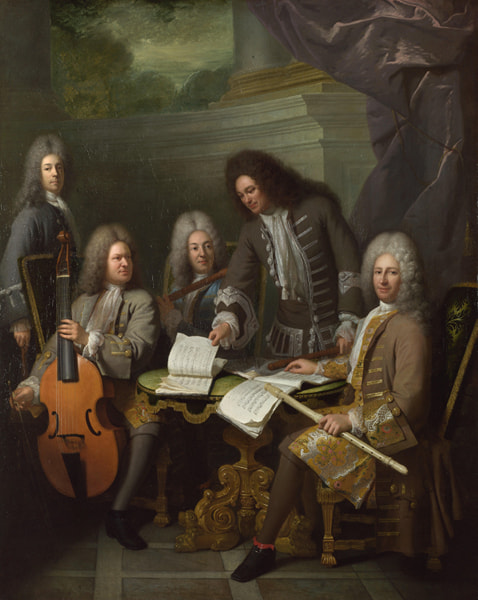
Lully’s dominance, thus, rested on legal powers that gave him something close to monopoly control over Parisian musical theatre. In a deployment of soft power, the performance of operas associated with royal magnificence was no longer confined to spaces such as Versailles or Fontainebleau. Advantageous to the court, too, was that paid performances recouped some of the production expenses.
Lully, Quinault, & the Politics of Opera
Lully’s collaboration with the dramatist and librettist Philippe Quinault gave this system its most distinctive theatrical form. Rather than simply adapting Italian opera to the French language, tragédie en musique emerged from a combination of traditions already present in France, including spoken theatre, ballet de cour, and pastoral drama, together with elements drawn from imported opera. Lully’s Italian background contributed to this synthesis, but those influences were substantially reshaped to meet French theatrical expectations. A typical work combined five acts with recitative, dance, chorus, orchestral music, and stage machinery. Lully’s approach to the French language was particularly important. His recitative followed the rhythms and inflections of speech closely enough to preserve the intelligibility of the text, rather than making vocal display the principal aim, presenting a specifically French alternative to Italian opera.
The most direct political statements usually appeared in the prologue, which often had only a loose connection with the plot.
The most direct political statements usually appeared in the prologue. These allegorical opening scenes preceded the mythological drama and often had only a loose connection with the plot that followed. Cadmus, Atys, Alceste, or Armide might dominate the main drama, while a prologue could transform a current war, peace settlement, conquest, or royal policy into mythological action. Louis no longer needed to appear on stage in person to guide an audience’s interpretation. In Cadmus et Hermione‘s (1673) prologue, for example, Apollo defeats the serpent or dragon Python. This opera appeared during the Franco-Dutch War (1672-1678), and the prologue invited comparison with the king’s military power. Other prologues used similar strategies. Thésée (1675) brings war, pleasure, abundance, and peace into symbolic relation around Louis, while Atys (1676) associates the approaching military season with the king’s continuing pursuit of glory. Such works repeatedly juxtapose warfare with the prosperity and peace that royal victory was supposed to secure.
Current political events could be authored and staged in ways that facilitated audiences’ understanding. Military campaigns and sieges were represented through the defeat of monsters, while royal victories might appear as the triumphs of Jupiter or Apollo. Peace, in turn, could be presented as the result of heroic action. Beyond warfare, in dedications and prologues, Quinault could also draw attention to rest, love, and pleasure that would follow from victory and a resultant peace.
Royal Oversight & Coordinated Image-Making
Quinault proposed subjects, Louis chose from among them, and Lully shaped the order of scenes and divertissements. At the king’s request, completed passages might also be submitted to the petite Académie, later the Académie des Inscriptions. This small body of writers and scholars was concerned with inscriptions and the vocabulary of royal glory. Despite this scrutiny of the production flow, Lully still exercised significant authorial control.
Similar figures and symbols of royalty were repeated across genres: architecture, opera, painting, sculpture, and other forms. Artists were not expected to produce uniform political messaging. Apollo, Glory, Victory, Peace, and defeated monsters reappeared often enough to make the language of royal power familiar across art forms. In this coordinated fashion, the audience’s reading of a performance could be shaped, but political allegory was always vulnerable to interpretations the court had not anticipated.
Final Act of Isis, the Opera 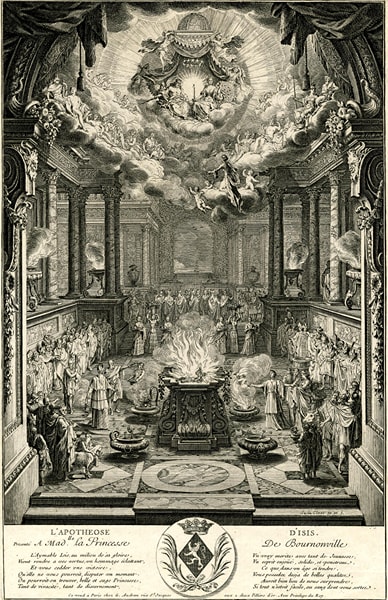
The controversy surrounding Lully and Quinault’s Isis (1677) is the clearest example. Court gossip centred on Madame de Ludres, with whom Louis had become involved, and Madame de Montespan, his long-standing mistress. Spectators began to map the opera’s characters onto this situation: Jupiter became Louis, Io or Isis was associated with Ludres, and the jealous Juno with Montespan. Because Io was treated sympathetically while Juno appeared vindictive, Montespan understood the opera as an attack on her. She complained to the king, demanding Quinault’s removal. In vain, Quinault denied having intended this reading, and Louis dismissed him from court service. Isis did not return to the Paris stage until 1704.
French Musical Style as Political Prestige
Politics also shaped the style of French opera, which drew on a theatrical tradition that valued intelligible text, dance, and chorus. Lully increasingly distanced his music from Italian improvisatory practices, demanding precision from his ensemble. His recitative followed the cadences of French speech with unusual care. The French style of opera that emerged in this period reworked the essentials of Italian opera into a distinctly French offering that spoke to its audiences.
As Louis’s monarchy competed for cultural and military pre-eminence, so a successful national opera offered evidence that France had no need to depend on imported Italian models. Dance and divertissement, French-language recitative, and the formal organisation of tragédie en musique became defining features of the genre, supported by the institutional continuity of the Académie royale de musique. Royal festivals, ballets, and operas were also presented with foreign ambassadors and visiting courts in mind. Just as flattering portraits of notables circulated within France and abroad, so the glory of French music enhanced the king’s standing across Europe.

