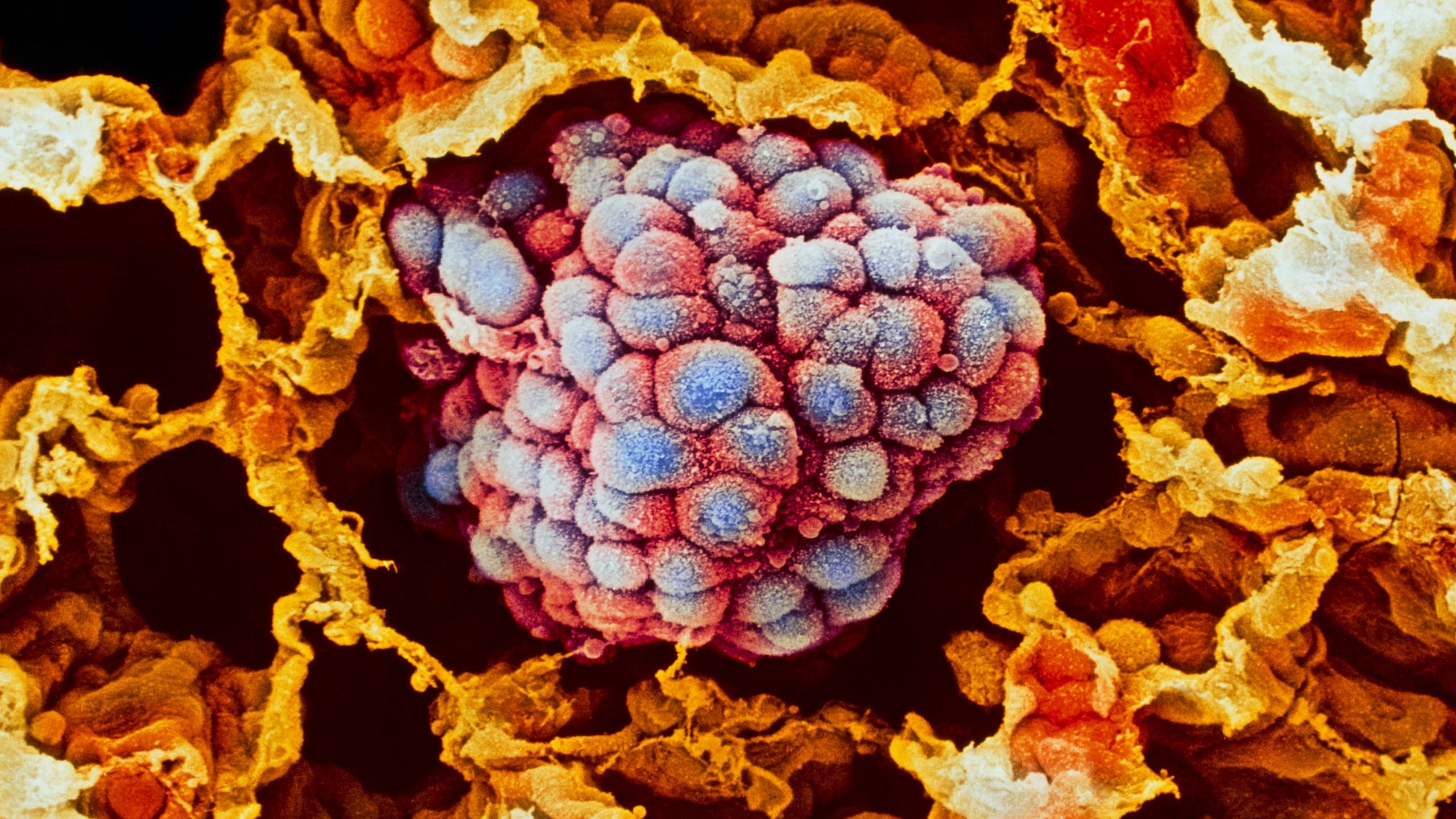
Шимэгч хорхойн эсрэг эм болон уушгины хорт хавдрын эмчилгээг хослуулах нь эмэнд тэсвэртэй хавдрын эсийг устгахад тус дэм болж болзошгүйг шинэ судалгаа харууллаа.
RAK Medical and Health Sciences University-ийн судлаач Шакта Мани Сатям болон түүний баг PLOS ONE сэтгүүлд нийтлэгдсэн судалгаагаараа уушгины хорт хавдрын EGFR мутацитай, gefitinib эмэнд тэсвэртэй болсон эсүүдэд mebendazole эмийг хослуулан туршжээ. Gefitinib нь хавдрын эсийн өсөлтийн дохиог хаадаг бол mebendazole нь эсийн хуваагдал болон ДНХ-ийн хуулбарлалтын үйл явцад саад учруулдаг байна. Лабораторийн туршилтаар эдгээр хоёр эмийг хослуулан хэрэглэхэд 72 цагийн дараа хавдрын эсийн амьдрах чадвар 38 хувь хүртэл буурч, ДНХ-д гэмтэл үүсэж байгаа нь ажиглагджээ.
Хулганы биед хийсэн 40 хоногийн туршилтаар дангаар нь эм хэрэглэснээс хоёр эмийг хослуулан хэрэглэхэд хавдрын хэмжээ хоёр дахин өсөх хугацаа 25 хоног хүртэл удааширсан байна. Энэ нь эмийг хослуулах нь хавдрын эсийг хоёр талаас нь зэрэг дайрах замаар эмчилгээний үр дүнг сайжруулж болохыг илтгэж байгаа юм. Гэсэн хэдий ч энэ нь урьдчилсан шатны судалгаа бөгөөд хавдрыг бүрэн устгаагүй тул эмнэлзүйн хэрэглээнд нэвтрүүлэхээс өмнө аюулгүй байдал, тун болон хүний биед үзүүлэх нөлөөг нарийвчлан судлах шаардлагатай гэж судлаачид онцолжээ.
Дэлгэрэнгүйг эх сурвалжаас харах
↓Эх сурвалжийг нээх ↓
When cancer cells learn to survive a drug designed to stop them, where do you turn next? A new study points to an unexpected possibility: a medicine used to treat parasitic worms.
Researchers combined the deworming medicine with a targeted lung cancer drug. In laboratory experiments, the pairing reduced resistant cancer-cell viability. In mice, tumors took longer to double in size with the combination than with either drug alone.
The idea was to find a weakness in cells that had learned to withstand treatment, then put that weakness under pressure.
“The exciting message is that drug resistance may not make cancer cells invulnerable; it may leave them with weaknesses that we can target,” pharmacology researcher Shakta Mani Satyam of RAK Medical and Health Sciences University in the United Arab Emirates told ScienceAlert.
The study, published in PLOS ONE, paired gefitinib, a targeted cancer treatment, with mebendazole, a medicine used against parasitic worm infections.
It focused on one model of EGFR-mutant non-small cell lung cancer that had become resistant to gefitinib.
EGFR is a protein that helps relay signals telling cells to grow. Certain genetic changes can keep those signals active, driving cancer-cell multiplication. Gefitinib blocks this protein, but resistant cells can find ways to keep growing.
The researchers wondered whether disrupting another part of those cells could make them more vulnerable.
Mebendazole interferes with tiny structures inside cells that help organize division and move materials around. These structures support essential processes that multiplying cells depend on.
“Our idea was to attack the cancer from two directions simultaneously,” Satyam said.
“Gefitinib blocks the growth signal, while mebendazole disrupts the cell’s internal machinery and increases stress associated with DNA replication.”
Every dividing cell must copy its DNA. The team’s reasoning was that disrupting both growth signaling and internal machinery might make it harder for resistant cells to cope with continued multiplication.
First, they tested the medicines on resistant human lung cancer cells.
After 72 hours, cell viability with gefitinib alone remained at about 93 percent of the untreated control level. A low concentration of mebendazole alone lowered it to approximately 80 percent.
Combining the two brought that laboratory measure down to about 38 percent.
A fivefold higher concentration of mebendazole alone reduced viability further, to around 30 percent.
The combination with the lower mebendazole concentration produced a reduction comparable to that of the higher concentration alone, according to the paper.
In the cell experiments, tests also detected DNA damage, including breaks in one or both strands. The researchers interpret the findings as consistent with increased stress associated with copying DNA.
Next came experiments in mice carrying tumors grown from the resistant human cells.
In a 40-day study with eight mice per treatment group, the median time for tumors to double in size was 6.2 days without treatment. Mebendazole alone extended it to 10.3 days, while gefitinib alone extended it to 15.5 days.
With both drugs, the doubling time reached 25 days.
However, the tumors were not eliminated, and the findings are preclinical. Results from one resistant cancer model cannot establish how other lung cancers would respond.
The researchers also cannot yet determine whether mebendazole reverses resistance to gefitinib or adds damage that makes resistant cells less able to survive. They did not formally quantify drug synergy or directly track how the DNA-copying machinery failed.
“Our findings suggest that the combination does more than simply add another source of damage, but we cannot yet say conclusively that it fully restores sensitivity to gefitinib,” Satyam said.
Delivering enough medicine to a human tumor is another hurdle. Mebendazole’s absorption after swallowing can vary, so effective drug exposure and dosing need further investigation.
The mice showed no sustained body-weight loss, but that alone cannot establish safety. Further experiments must examine effects on organs and healthy tissues, prolonged use, and interactions between the medicines.
Additional resistant cell lines and patient-derived tumor models are research priorities. Satyam said resistance to osimertinib, a newer EGFR-targeted treatment, is an important question for future research.
“We are encouraged by the results, but further preclinical validation and careful assessment of drug exposure and safety must come before any conclusions about its clinical potential,” Satyam said.
The research has been published in PLOS ONE.
This article was fact-checked by Fiona MacDonald and edited by Fiona MacDonald. While we pride ourselves on our process, we are only human. If you spot a mistake, please let us know.

