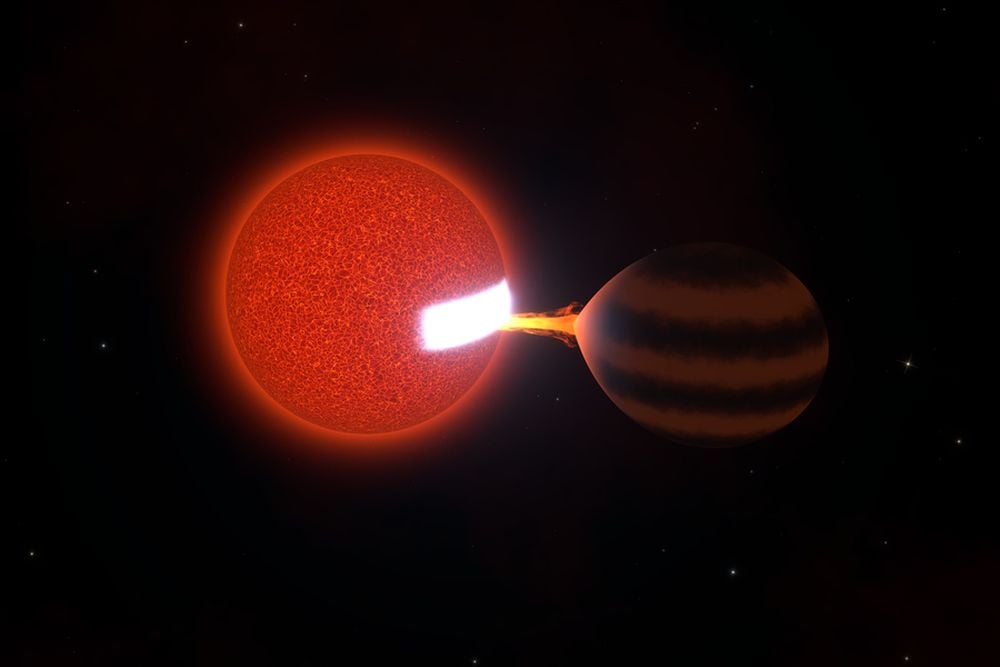
Эрдэмтэд хоёр одны системд илүү том масстай улаан одой од хамтрагч хүрэн одойгийнхоо бодисыг удаан хугацааны туршид тогтвортойгоор шимэн авч байгааг анх удаа ажиглажээ.
MIT-ийн судлаачдын Nature Astronomy сэтгүүлд нийтэлсэн судалгаагаар ZTF J0440+2325 нэртэй хос одны системд өрнөж буй энэхүү үйл явцыг илрүүлсэн байна. Zwicky Transient Facility (ZTF)-ийн архивын өгөгдлийг шинжлэх явцад одон орон судлаач Аарон Хаусхолдер болон Кевин Бөрд нар гэрлийн муруй нь гурвалжин хэлбэртэй байх ер бусын үзэгдлийг олж харжээ. Энэхүү өвөрмөц дохио нь хүрэн одой одны бодис улаан одой одны гадаргуу дээр шууд цохилт өгч, халуун цэг үүсгэн, 87 минутын давтамжтайгаар эргэлддэгтэй холбоотой болохыг тогтоосон байна.
Ихэнх тохиолдолд од өөрийн гариг эсвэл хамтрагч биетээ бүрмөсөн залгиж устгадаг бол энэ системд масстай тэнцвэртэй байдлаас шалтгаалан уг үйл явц олон сая, магадгүй тэрбум жилээр үргэлжлэх боломжтой аж. Улаан одой од нь ойролцоогоор 85 Бархасбадь гаригийн масстай, харин хүрэн одой нь 25 Бархасбадь гаригийн масстай бөгөөд тэдгээр нь бие биенээсээ бодисыг маш удаан хурдаар шилжүүлж байна. Энэ нь хар нүх эсвэл нейтрон одны хийдэг хүчтэй таталцлын нөлөөллөөс ялгаатай бөгөөд бодис нь халуун цэг үүсгэн одны гадаргуу дээр шууд буудаг байна.
Энэхүү ололт нь оддын хувьслын явцад тохиолддог бодис шилжүүлэх тогтвортой механизмын анхны баталгаа болж байгаа юм. Цаашид Vera Rubin Observatory-ийн Legacy Survey of Space and Time судалгааны хүрээнд ижил төстэй шинж чанартай олон системийг илрүүлж, оддын харилцан үйлчлэлийн талаарх ойлголтоо өргөжүүлэх боломжтой гэж судлаачид үзэж байна.
Дэлгэрэнгүйг эх сурвалжаас харах
Эх сурвалжийг нээх ↓
Most of what happens to any individual star during its lifetime is determined by its mass. Massive stars die young in supernova explosions, small red dwarfs linger for trillions of years, and mid-size stars like our Sun enjoy about ten billion years of fusion. But interactions between stars aren’t uncommon, and they shape stellar destinies, too.
Stars are born in clusters that slowly drift apart. But many stars stay bound to one another in binary systems. Astronomers observed one such binary star where the more massive of the pair, a small red dwarf (M dwarf) is very slowly consuming its companion. In this case, the companion is a brown dwarf. Putting aside the argument over whether a brown dwarf is truly a star or not, the pair, which is only about 300 light years away, is giving astronomers an opportunity to study stellar cannibalism.
New research in Nature Astronomy presents their observations and analysis. It’s titled “Stable mass transfer from a substellar object onto an M dwarf,” and the first author is Aaron Householder, a graduate student in MIT’s Department of Earth, Atmospheric and Planetary Sciences. Householder works with Kevin Burdge, assistant professor of physics at MIT.
Massive stars consuming less massive objects like planets is not rare. There are many examples of stars engulfing exoplanets. In those cases, the planet doesn’t last long before being drawn into the star and being destroyed. The only evidence of the engulfment is often an unusual concentration of metals in the star’s upper layer.
But in this case, the size mismatch between eater and meal isn’t as pronounced as between a star and a planet. Red dwarfs aren’t that much more massive than brown dwarfs. That means this meal will last millions of years, or even billions.
“When we think of stars interacting with planets or brown dwarfs, the picture is always that the star eventually swallows the other thing,” co-author Burdge said in a press release. “This is what will happen to the Earth when the sun becomes a red giant. But here, we’ve found an alternative: Instead of swallowing the thing up, the star can gradually eat it, for billions of years.”
The system is named ZTF J0440+2325, where ZTF stands for the survey that detected it, the Zwicky Transient Facility. Rapid changes in brightness are called transients in astronomy, and the ZTF uses a robotic telescope to scan the sky for them. Many things present as transients, including supernovae, tidal disruption events (TDE), and Gamma-Ray Bursts (GRBs).
In this work, Burdge was studying archival ZTF data, on the hunt for light curves from Black Widow Binaries (BWB). BWBs feature a rapidly spinning neutron devouring its companion. In those systems, the neutron star is extremely dense and its companion is another star, which is much less dense, no matter its size or type.
In the archival data, Burdge found a strange light pattern. The pattern was like a triangle, where the brightness peaked and subsided repeatedly.
“I remember first looking at this and thinking: Stars don’t make triangular waveforms like this,” Burdge said.
Astronomers know what the light curve from BWBs looks like, and this didn’t match. In a BWB, the companion star whips around the neutron star, creating a wobbling light.
“We weren’t seeing that whipping back and forth here,” Burdge says. “It didn’t make any sense. We couldn’t explain what this was.”
This image shows the triangular shape of the lightcurve from ZTF J0440+2325. Image Credit: Householder et al. 2026. Nat Astr.
The researchers wondered if they were looking at a system where the binary components had similar masses, rather than in a BWB, where one component was far more massive than the other.
“If you have less mass in the system overall, things can gently orbit each other without whipping back and forth,” Burdge says. “That was the idea. But we never had any proof. And this weird triangle just sat for years.”
ZTF’s job is to detect transients, then other telescopes, which are better suited to observe them in detail, are used to study their light more thoroughly. In this case, the researchers used the Low Resolution Imaging Spectrometer (LRIS) on the 10-m Keck I telescope, and the Echellette Spectrograph and Imager (ESI) on the Keck II telescope.
“The spectra of ZTF J0440+2325 had M dwarf absorption features,” the authors write in their paper, saying that the spectra agreed with an important template for M dwarf spectra.
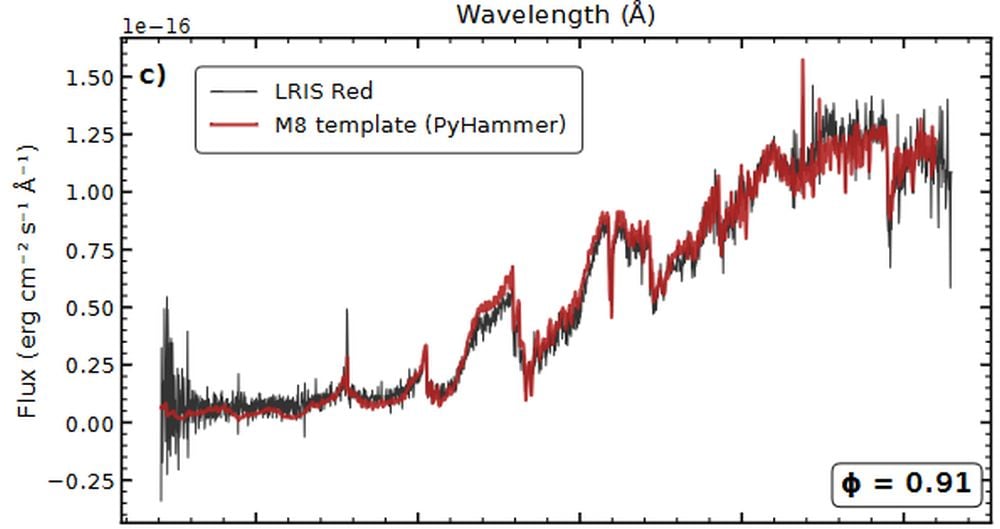 This figure shows how the LRIS spectra from ZTF J0440+2325 matches that of a template of M8 red dwarfs. Image Credit: Householder et al. 2026. Nat Astr.
What wasn’t clear, however, was which of the binary companions is the red dwarf, and which is the brown dwarf.
“The observations above indicate that ZTF J0440+2325 is a mass-transferring brown-dwarf–M dwarf binary, but they do not immediately distinguish which component is the donor and which is the accretor, since brown dwarfs and M dwarfs often have similar mean densities,” the authors write in their paper.
To try to determine which was which, the researchers included observations from HiPERCAM. HiPERCAM is a high-speed quintuple beam CCD camera attached to the Gran Telescopio CANARIAS. It observes five wavelengths at once, and is a powerful tool for observing stellar objects through variations in their brightness.
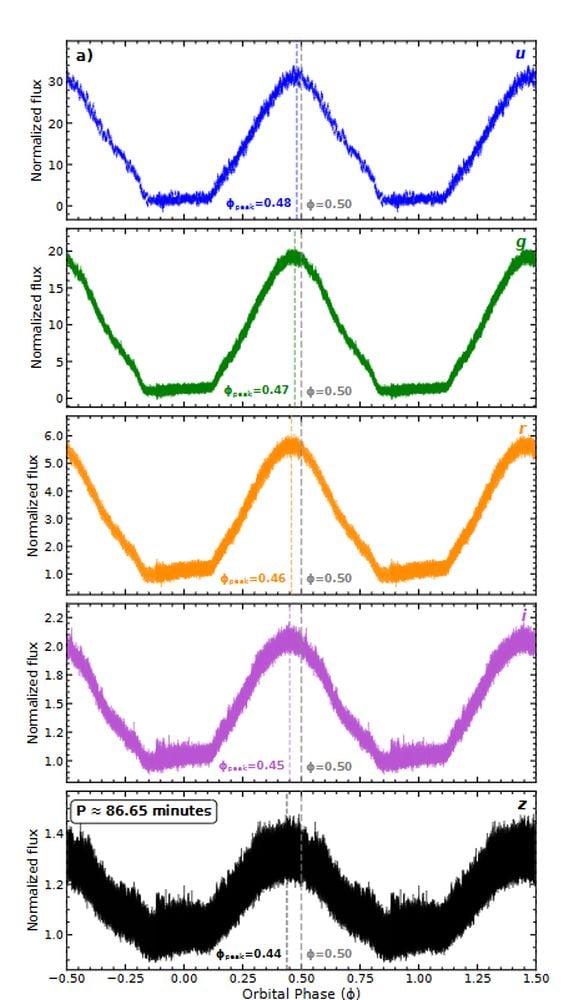 These panels shows the triangular lightcurves from ZTF J0440+2325 in five different wavelengths. The dashed vertical lines in each panel show the peak brightness. The lightcurves are generated by material from the brown dwarf streaming onto a location on the surface of the red dwarf and creating a hotspot, over an 86.65 minute period. Image Credit: Householder et al. 2026. Nat Astr.
HiPERCAM light curves combined with phase data from LRIS and ESI helped determine which body was the accretor and which was the donor. The researchers determined that the hot spot must lie on “either the day side of the M dwarf or the night side of the brown dwarf.” They add that there’s “strong evidence that the brown dwarf is transferring mass onto the M dwarf in ZTF J0440+2325.”
The researchers determined that the brown dwarf orbits the M dwarf every 87 minutes. The orbit is small enough to fit within the Sun’s diameter. They also found that the M dwarf has about 85 Jupiter masses, and the brown dwarf has about 25 Jupiter masses.
During a tidal disruption event, a massive yet small black hole or neutron star draws material from a star that strayed too close. In those cases, the material forms an accretion disk around the black hole. But in ZTF J0440+2325, the material accretes directly onto the star.
“The difference here is: The thing absorbing matter is not a tiny black hole but a star, which is relatively big in size,” Burdge explains. “So matter just pummels directly onto the surface, at very high speeds, like an asteroid hitting the moon.”
The team ran particle simulations to test their idea.
“When we track those test particles, we see they indeed fall right onto the surface of the star,” said first author Householder. “This is the first time we’ve caught a low-mass star actively accreting from another low-mass object.”
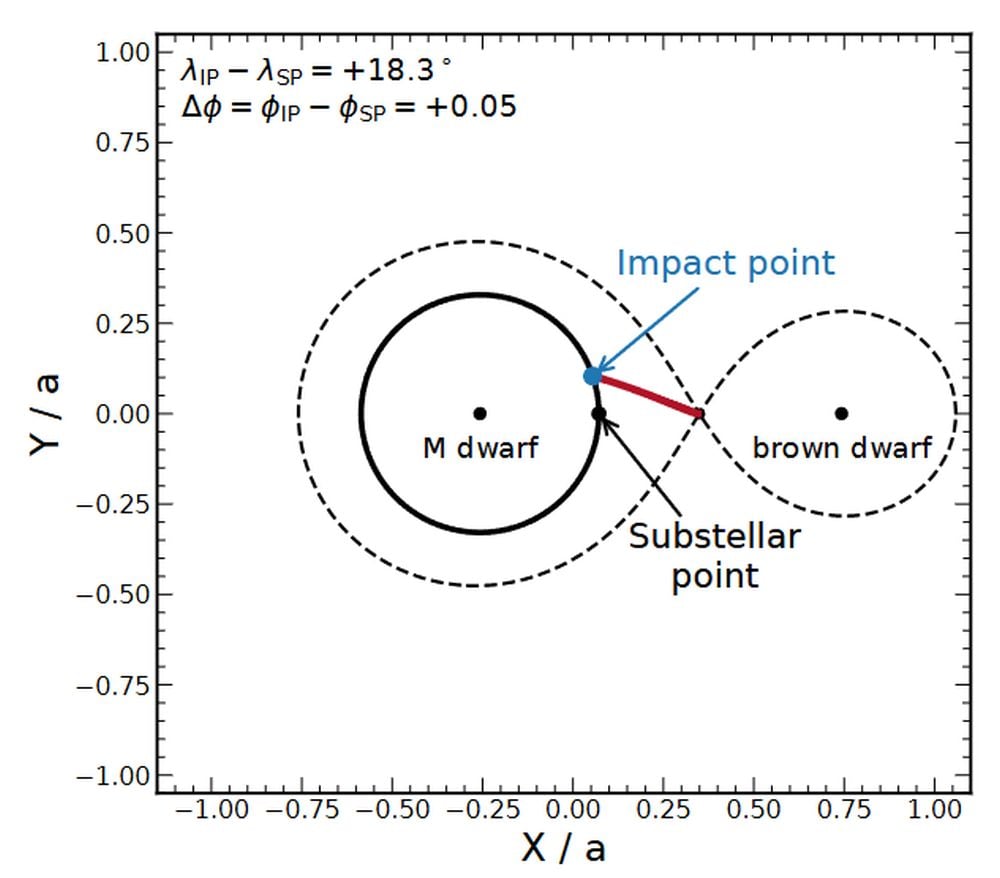 In this figure, the black points mark the centers of mass of the two components and the solid black circle shows the surface of the accretor. The red line shows particles from the donor brown dwarf moving onto the M dwarf. Rather than forming an accretion disk, the material accretes directly onto the M dwarf, forming a hot spot. Image Credit: Householder et al. 2026. Nat Astr.
According to the researchers’ calculations, about 1/100,000 of an Earth’s mass is transferred from the brown dwarf to the M dwarf each year. This is a very slow rate of transfer, and should continue for billions of years. This slow rate of transfer, combined with the 87 minute orbit, creates the triangular light curve.
“It’s like you’ve got this continuous fireball onto one of the objects, and as one orbits the other, that hotspot comes in and out of view, and the peak of the triangle signal is when you’re looking right at the fireball,” Burdge said.
“These systems demonstrate that the fate of some substellar companions to main-sequence stars is not rapid engulfment and destruction, but instead long-lived stable mass transfer, likely persisting for at least ∼ 107 yr and potentially much longer,” the researchers write.
They’ve long been theorized to exist, but this is the first time one of these systems been confirmed observationally. Now, as is usually the case in astronomy, the goal is to find more of these systems. The Vera Rubin Observatory’s Legacy Survey of Space and Time is expected to detect multitudes of transients, and some are bound to be similar to ZTF J0440+2325. This new understanding of what’s behind the unusual triangular light curve is what will give them away.
“It’s inspiring a lot of new searches on our part,” Householder says. “I think we’re going to learn a lot about a different kind of way that planets and brown dwarfs interact with their host stars.”

