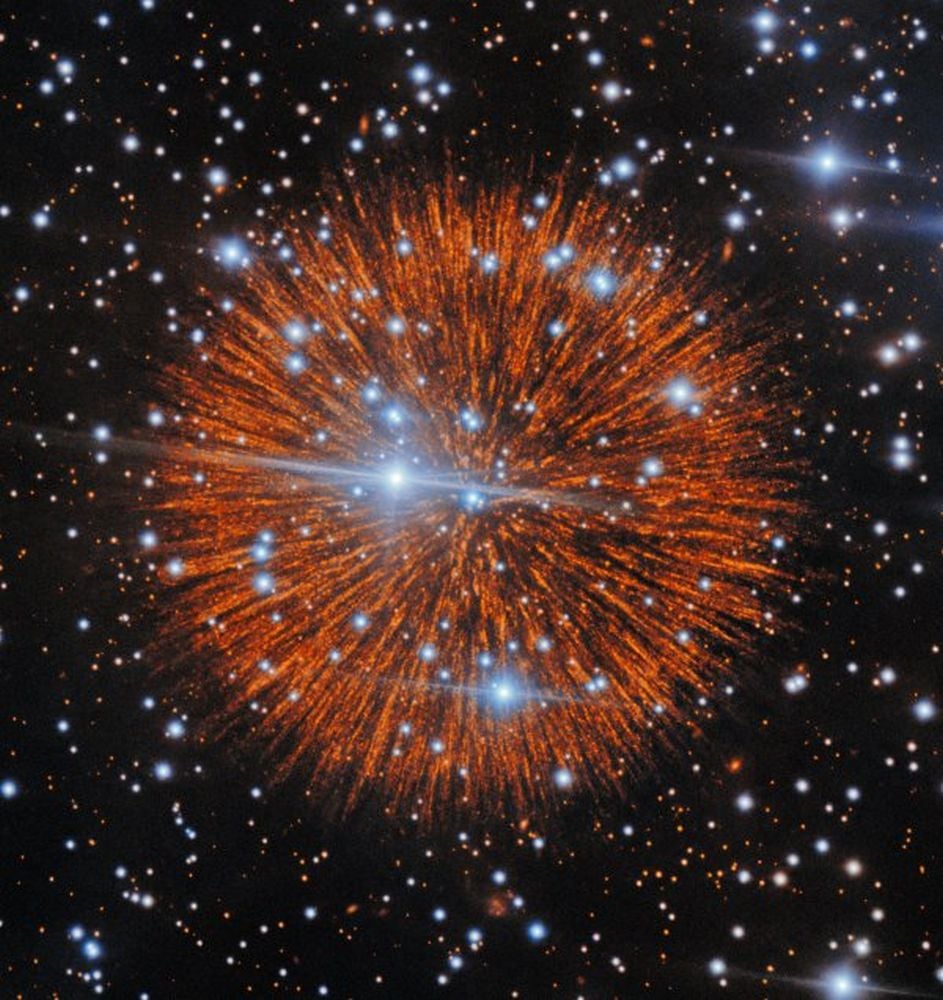
Одон орон судлаачид Gemini North дуран авай ашиглан манай галактик дахь ховор төрлийн суперновагийн үлдэгдлийн нарийн бүтэц, төвд байрлах одны байрлалыг тодорхойлов.
1181 онд Хятад болон Японы одон орончид Кассиопея одны орчимд зургаан сарын турш үзэгдсэн “зочин од”-ыг тэмдэглэн үлдээсэн байдаг. Орчин үеийн судлаачид энэхүү үзэгдлийг Па 30 (IRAS 00500+6713) хэмээх суперновагийн үлдэгдэл гэдэгт бараг бүрэн итгэлтэй байна. Энэхүү үлдэгдэл нь аварга оддын мөхлөөс бус, хоёр цагаан одой од нэгдсэний улмаас үүссэн Type Iax төрлийн суперновагийн дэлбэрэлтийн үр дүн гэж үзэж байна.
Уорвикийн их сургуулийн физикийн тэнхимийн туслах профессор Тим Каннингхэмээр удирдуулсан баг Gemini North дуран авай болон GMOS багажийг ашиглан Па 30-д судалгаа хийжээ. Шинэ дүрслэлүүд нь урьд өмнөхөөс арав дахин олон филамент буюу хийн судлыг илрүүлсэн бөгөөд эдгээр нь гөлгөр зураас бус, харин зангилаа эсвэл бөөгнөрлүүдийн цуваа болохыг тогтоосон байна. Энэхүү онцлог нь суперновагийн дэлбэрэлтийн бодис гадагш тэлэх явцдаа хүрээлэн буй орчны нягтрал болон температурын өөрчлөлттэй мөргөлдсөнийг гэрчилж байна.
Па 30 нь суперновагийн үлдэгдлийн төвд одны үлдэгдэл бүхий ховор тохиолдол юм. Ихэвчлэн ийм дэлбэрэлтийн дараа үлдсэн од нь хүчтэй түлхэлт авч төвөөсөө шилждэг бол, Па 30-ын төвд байрлах, 200,000°C хүртэл халдаг, маш хурдан одны салхитай цагаан одой од нь төвдөө тогтвортой байрлаж байгаа нь эрдэмтдийн анхаарлыг татаж байна. Энэхүү онцгой байрлал нь тухайн одны дэлбэрэлтийн загвар болон хөдөлгөгч хүчийг илүү сайн ойлгоход туслах юм.
Цаашид илүү нарийвчлалтай ажиглалт хийх замаар уг үлдэгдлийн морфологи болон дэлбэрэлтийн механизмыг бүрэн тайлбарлах боломжтой болно. Судлаачид Hubble Space Telescope-ийн өндөр нарийвчлалын тусламжтайгаар илүү гүнзгий судалгаа хийх шаардлагатай байгааг тэмдэглэв. Хүн төрөлхтөн огторгуйн ажиглалтыг харьцангуй богино хугацаанд хөтөлж ирсэн тул манай галактикт одоогоор нээгдээгүй, ижил төстэй олон суперновагийн үлдэгдэл байх магадлалтай байна.
Дэлгэрэнгүйг эх сурвалжаас харах
Эх сурвалжийг нээх ↓
In 1181, astronomers, poets, and diary keepers in China and Japan recorded a ‘guest star’ in Cassiopeia. The luminous transient lit up the sky for 6 months. Those ancient astronomers didn’t know it was an exploding star—a supernova—but we do.
Today, astronomers are almost certain that they’ve found the SN’s remnant. It’s named Pa 30, or IRAS 00500+6713. Researchers think that this SN wasn’t a core-collapse supernova, a massive star exploding at the end of its life, but the result of two white dwarfs merging and creating a Type Iax SN.
The remnant, Pa30 is a heavily-studied astronomical object. It provides an opportunity to study the aftermath of SN explosions, their nebulae, and how material from the explosion is spread out into space, where it can eventually be taken up in new star formation. As the only known supernovae remnant (SR) in the Milky Way, Pa30 is elevated to the top of many astronomers’ list of observing targets.
In new research, astronomers used the Gemini North Telescope and its Gemini Multi-Object Spectrographs (GMOS) instrument to uncover new details in the SN remnant. It’s titled “Detection of Knots in the Type Iax Supernova Remnant Pa 30,” and the lead author is Tim Cunningham. Cunningham is an assistant professor in the Department of Physics at the University of Warwick, and is also associated with the Center for Astrophysics—Harvard & Smithsonian.
“We present deep, narrowband Gemini North/GMOS images of the Pa 30 nebula that reveal rich small-scale structure in the ejecta filaments,” the authors write. Their observations revealed an order of magnitude more filaments than previous observations. “The imaging further reveals that the filaments are not smooth radial streaks, but instead are composed of cascades of knots or clumps,” the researchers explain.
“We can see this much detail because of Pa 30’s proximity to Earth,” study co-author Ilaria Caiazzo from the Institute of Science and Technology Austria said in a press release. “This proximity makes Pa 30 uniquely valuable for study.”
These new observations rely on the GMOS’ ability to observe different chemical elements. In this case, emission lines from [S ii], or singly-ionized sulfur, play a leading role. [S ii] is an important emission line in astronomy that lets astronomers study ionized gas clouds.
These images of Pa30 were captured with the Gemini North Telescope and its [S ii] filter. It reveals far more filaments than previous images, and shows that the filaments are cascades of knots. Image Credit: Tim Cunningham et al 2026 ApJ 1010 28
The new images show that the filaments are not smooth streaks of gas, but rather continuous chains of knots. This is evidence of variations in density and temperature in the circumstellar medium that material from the SN explosion slammed into. These variations shaped the SN ejecta as it expanded outward.
The greater level of detail in the [S ii] images contrasts with previous [O iii] or doubly-ionized oxygen images of Pa30.
![These panels compare [S ii] images of Pa30 with [O iii] images. [S ii] is on the top and [O iii] is on the bottom, and top and bottom panels are aligned. Clearly, the [S ii] images reveal much more detail. Image Credit: Tim Cunningham et al 2026 ApJ 1010 28](https://www.universetoday.com/article_images/apjae9cb2f2_hr_20261014_143429.jpg) These panels compare [S ii] images of Pa30 with [O iii] images. [S ii] is on the top and [O iii] is on the bottom, and top and bottom panels are aligned. Clearly, the [S ii] images reveal much more detail. Image Credit: Tim Cunningham et al 2026 ApJ 1010 28
These panels compare [S ii] images of Pa30 with [O iii] images. [S ii] is on the top and [O iii] is on the bottom, and top and bottom panels are aligned. Clearly, the [S ii] images reveal much more detail. Image Credit: Tim Cunningham et al 2026 ApJ 1010 28
The Pa30 SNR is more than just an expanding cloud of ejecta. There’s also a stellar component, a white dwarf. It may be an exceptional white dwarf called a super-Chandrasekhar white dwarf. This means the white dwarf exceeds the normal mass limit of white dwarfs, which is about 1.4 solar masses. Pa30’s white dwarf may have about 1.5 solar masses. The white dwarf also has an extremely high temperature, about 200,000 C, and stellar winds with a record-breaking high velocity of about 16,000 km/second.
SNe remnant white dwarfs typically recieve a kick from the SN explosion that moves them from the nebula’s center. Not only is the existence of Pa30’s white dwarf unusual, since it’s a Type Ia(x), but so is its position in the very center of the nebula.
“A unique characteristic of the Pa 30 nebula as a historical SN of Type Ia(x) is the presence of a central stellar remnant,” the researchers write. “Because the explosion in many Type Iax models proceeds as a failed detonation or an off-center partial deflagration of the white dwarf, the surviving remnant can receive a substantial recoil kick.”
“We measure a nebula center consistent with the position of the central star, indicating that the remnant has not received a large transverse kick,” the authors write. This is extremely unusual, since nebulae are messy and their central stars are usually offset, and noticeably so.
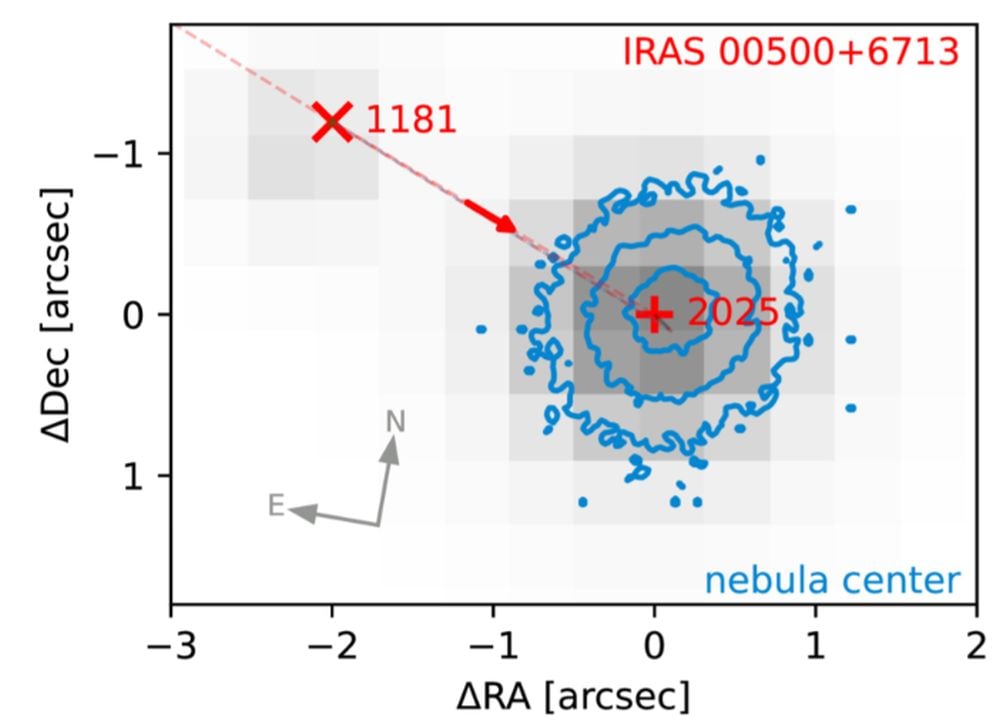 This figure shows the center of the Pa30 nebula in two epochs, 1181 and 2025. The blue shows the nebula center in 1, 2, and 3 sigma uncertainty contours. Compared to other nebula, the stellar remnant is in the center of the nebula. Image Credit: Tim Cunningham et al 2026 ApJ 1010 28
The authors explain that Pa30’s unusual knotty filaments place useful constraints on models that can explain its morphology. A better understanding of the recoil kick it received can also help astronomers understand its progenitor better. Progress on those fronts awaits better observations.
“Further observations exploiting the exquisite angular resolution of the Hubble Space Telescope would greatly enhance this analysis,” the researchers write.
There are likely other Type Ia(x) SNR in the Milky Way awaiting discovery. Human beings have only been recording their observations of the heavens for a very short period of time, compared to the age of the Milky Way.
“Reliable historical records of stellar explosions extend back only about a thousand years. For all we know, there might well be similar remnants still lurking in the dark in our own galaxy,” Cunningham said. “Today, we are lucky to study an intriguing object we know was observed by astronomers who made three independent historical records of the event centuries before the invention of the telescope.”
“We will likely identify more similar objects as new telescopes continue to inspect the depths of our night sky,”

