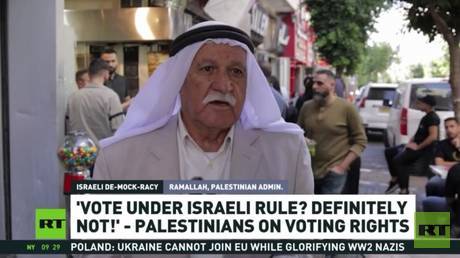
Израйлын парламентын сонгуульд санал өгөх эрхгүйгээр тус улсын бодлогын нөлөөнд амьдарч буй сая сая палестинчуудын эрх зүйн байдал хурцадмал асуудал болоод байна.
Аравдугаар сарын 27-нд болох Израйлын парламентын сонгуулийн өмнө тус улсын хяналтад байдаг Зүүн Иерусалим болон Баруун эрэг дэх палестинчуудын сонгуульд оролцох эрхийн асуудал хөндөгдөв. Зүүн Иерусалимын оршин суугчид татвар, нийгмийн даатгалын шимтгэл төлдөг ч Израйлын иргэншилгүй тул Кнессет буюу парламентын сонгуульд санал өгөх эрхгүй байна.
Баруун эрэгт амьдарч буй гурван сая орчим палестинчууд ч мөн адил Израйлын засаг захиргааны хяналт дор өдөр тутмын амьдралаа залгуулж байна. Тус газар нутгийн 61 хувийг эзэлдэг С бүсэд Израйлын бүрэн хяналт үйлчилдэг бөгөөд энэ нь орон нутгийн иргэдийн хөдөлгөөн болон барилга байгууламжийн асуудалд шууд нөлөөлдөг юм.
Палестины улс төрч Мустафа Баргути Израйлын хэрэгжүүлж буй хууль эрх зүйн ялгаатай тогтолцоо нь ардчиллын зарчимд харшилж, апартейд буюу арьс өнгөөр ялгаварлан гадуурхах шинжтэй байна гэж шүүмжилжээ. Харин Израйлын Суурьшил болон үндэсний даалгаврын сайд Орит Струк палестинчуудыг тус улсын нутаг дэвсгэрт оршин суух эрхтэй ч парламентын сонгуульд санал өгөх боломжгүй гэсэн байр суурийг илэрхийлсэн байна.
Түүнчлэн Палестины эрх баригчид 2021 онд сонгуулиа цуцлахдаа Зүүн Иерусалимд санал хураалт явуулах баталгааг Израйлын тал олгоогүйг гол шалтгаан хэмээн нэрлэж байв. Орон нутгийн иргэдийн хувьд эзлэгдсэн нөхцөлд сонгуульд оролцохоос илүүтэй өөрсдийн бие даасан сонгуулийг зохион байгуулах нь нэн тэргүүний асуудал болоод байна.
Дэлгэрэнгүйг эх сурвалжаас харах
↓Эх сурвалжийг нээх ↓
Charlotte Dubenskij examines the lives of Palestinians governed by Israeli decisions without a vote in choosing its parliament
Millions of Palestinians living under Israeli control have been stripped of their ability to vote in the upcoming parliamentary election that will shape their lives, RT correspondent Charlotte Dubenskij reports.
Ahead of the October 27 vote, Dubenskij visited East Jerusalem and the occupied West Bank to examine Prime Minister Benjamin Netanyahu’s description of Israel as the Middle East’s “only true democracy.”
In East Jerusalem, which Israel captured in 1967 and later annexed in a move rejected by the UN, many Palestinians hold permanent residency rather than Israeli citizenship. They pay taxes, social security, and VAT, but cannot vote for the Knesset, Israel’s parliament.
“We are really helpless, voiceless,” one resident told RT. Another described the frustration of facing the consequences of an election without being able to influence it.
Although Palestinian residents who obtain Israeli citizenship can vote, those who spoke to RT opposed taking that step, arguing it would amount to recognizing Israeli sovereignty.
In the West Bank, around three million Palestinians live with Israeli control over key aspects of their daily lives, including movement and construction. Area C, covering roughly 61% of the territory, remains under full Israeli control.
Palestinian politician Mustafa Barghouti argued that the occupation and different legal systems applied to Palestinians and Israeli settlers contradict Israel’s democratic claims.
“Two different laws for two people in the same area is nothing but the description of apartheid,” he told RT.
Settlements and National Missions Minister Orit Strook, meanwhile, has advocated allowing Palestinians to remain while denying them a parliamentary vote. “They can stay here as human beings, of course,” she said, but stressed that they “shouldn’t be able to vote for the Knesset.”
Barghouti further accused Israel of obstructing internal Palestinian elections. The Palestinian Authority cited Israel’s refusal to guarantee voting in East Jerusalem when it canceled elections in 2021.
For Palestinians interviewed in Ramallah, the priority is to be allowed to hold their own elections rather than voting under occupation.
Watch the full report below.
You can share this story on social media: