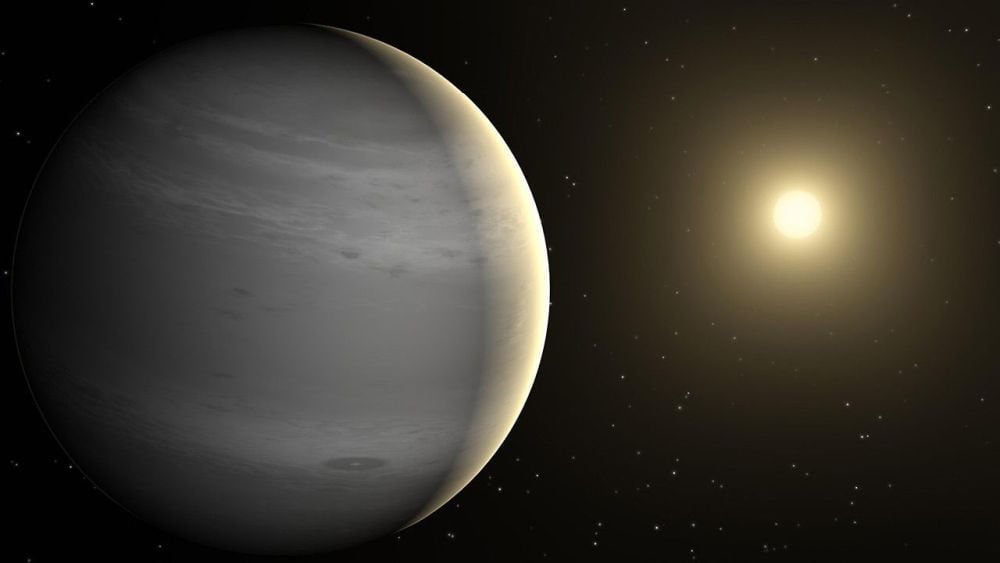
Энэхүү судалгааны ажил нь Lazuli сансрын дуран авайг ашиглан одны гэрлийн ойлтоор экзопланетуудын уур амьсгалыг судлах боломжийг бүрдүүлж байна.
Google-ийн гүйцэтгэх захирал асан Эрик Шмидтийн санаачилсан Lazuli сансрын дуран авай нь 3 метрийн диаметртэй тольтой бөгөөд 2029 он гэхэд хөөргөх төлөвлөгөөтэй байна. Уг дуран нь өргөн хүрээний оптик дүрслэгч, спектрограф болон ExtraSolar Coronagraph (ESC) хэмээх гурван үндсэн багажтай байх аж. Мичиганы их сургуулийн Логан Пирс болон Аризонагийн их сургуулийн Стюард ажиглалтын төвийн Эван Дуглас нар ESC-д зориулсан хамгийн оновчтой 27 экзопланетын жагсаалтыг шинэ судалгаагаараа тодорхойлжээ.
Тус дурангийн ESC багаж нь экзопланетуудыг өөрийнх нь дулааны ялгаруулалтаар биш, харин эх одны гэрлийн ойлтоор нь судлах юм. Энэ арга нь гаригийн насжилт болон үүсэлтэй холбоотой дулааны нөлөөллөөс хамаарахгүйгээр уур амьсгалыг нь тодорхойлох боломжийг олгоно. Мөн богино долгионы урттай гэрлийг ашигладаг тул эх одтойгоо илүү ойр байрлах гаригуудыг ажиглах давуу талтай юм.
Судлаачдын сонгосон 27 экзопланет нь бүгд аварга гаригууд бөгөөд тэдгээрийн дотор Бархасбадь гаригтай төстэй 55 Cancri d, эрс тэс тойрог замтай HD 181433 d, мөн анхны шууд дүрслэгдсэн гаригуудын нэг болох β Pic b зэрэг багтаж байна. Энэхүү жагсаалт нь өмнө нь ажиглагдаж байгаагүй хүйтэн бүс дэх гаригуудыг судлах боломжийг нээж, Nancy Grace Roman сансрын дуран болон ELT-ийн METIS төхөөрөмжтэй хамтран ажиллах нөхцөлийг бүрдүүлэх юм.
Гэсэн хэдий ч сансрын 3 метрийн дуран авайд зориулсан энэхүү ажиглалт нь өндөр тодосгогчтой, 10-100 цаг үргэлжлэх урт хугацааны өртөлт шаарддаг тул тодорхой сорилтуудтай тулгарч байна. Иймд судалгааны үр ашгийг дээшлүүлэхийн тулд тойрог зам нь сайн мэдэгдэж буй гаригуудыг урьдчилан сонгож, ажиглалтын хугацааг оновчтой төлөвлөх нь чухал гэж зохиогчид тэмдэглэжээ. Хувийн эзэмшлийн анхны энэхүү сансрын дуран авай нь экзопланетын шинжлэх ухаанд шинэ хуудас нээх төлөвтэй байна.
Дэлгэрэнгүйг эх сурвалжаас харах
Эх сурвалжийг нээх ↓
The Lazuli Space Telescope will be the first private space telescope. It’s the scientific child of Eric Schmidt, Google’s former CEO. It will have a 3-meter mirror, larger than the Hubble’s 2.4 meter mirror, and will be launched by 2029.
Lazuli will have three instruments: a wide-field optical imager, an integral field spectrograph, and the ExtraSolar Coronagraph (ESC).
New research proposes a list of targets for the ESC. It’s titled “The first selection of optimal targets for the Lazuli ExtraSolar Coronagraph’s reflected starlight exoplanet campaign,” and is available at arxiv.org. The authors are Logan Pearce from the Department of Astronomy at the University of Michigan, and Ewan Douglas from the Steward Observatory at the University of Arizona.
“Direct detection and characterization of exoplanet atmospheres via reflected starlight enables probes of composition of mature exoplanet systems (since flux is decoupled from age) at closer separations than via thermal emission (due to observations in visible wavelengths), and even probes of biosignatures,” the authors write.
An illustration of the Lazuli Space Telescope. It will have a 3-meter mirror and three instruments. One of them is the ExtraSolar Coronagraph (ESC). The ESC will allow observations of exoplanets and their atmosphere with reflected starlight, rather than by their thermal emissions. Image Credit: Schmidt Sciences
The telescope’s ESC will be especially important in this context. Characterizing exoplanet atmospheres in mature exoplanet systems with reflected starlight means the observations will not depend on an exoplanet’s leftover heat from formation. Since older planets have aged, their leftover heat makes them dimmer over time. By using reflected starlight, the ESC will bypass that effect. It will also allow observations at closer separations than an infrared telescope, meaning it can observe planets closer to their stars, because planets closer to their stars reflect more light. (That’s a simplified picture that ignores some details.)
“To date all exoplanets have been imaged through their self-luminous thermal emission, but direct, spatially resolved imaging of planets via reflected starlight is on the near horizon,” the authors write. “Reflected light imaging enables detection and characterization of planets decoupled from age (since reflected starlight luminosity does not decrease with age), and the smaller resolution limits provided by imaging shorter wavelengths (∼0.5–2μm), where the star luminosity peaks, allows access to closer-in planets compared to thermal emission.”
The researchers present a list of 27 targets for observations with the ESC, and all of them are giant exoplanets. “Our target list spans ages and temperatures of planets not probed before by direct imaging,” the authors write, adding that some of them will also be accessible to the ELT’s METIS thermal imager and the Nancy Grace Roman Space Telescope’s coronagraphic instrument. The targets will benefit from synergies created by multiple observations, and that will “provide comprehensive atmosphere characterization.”
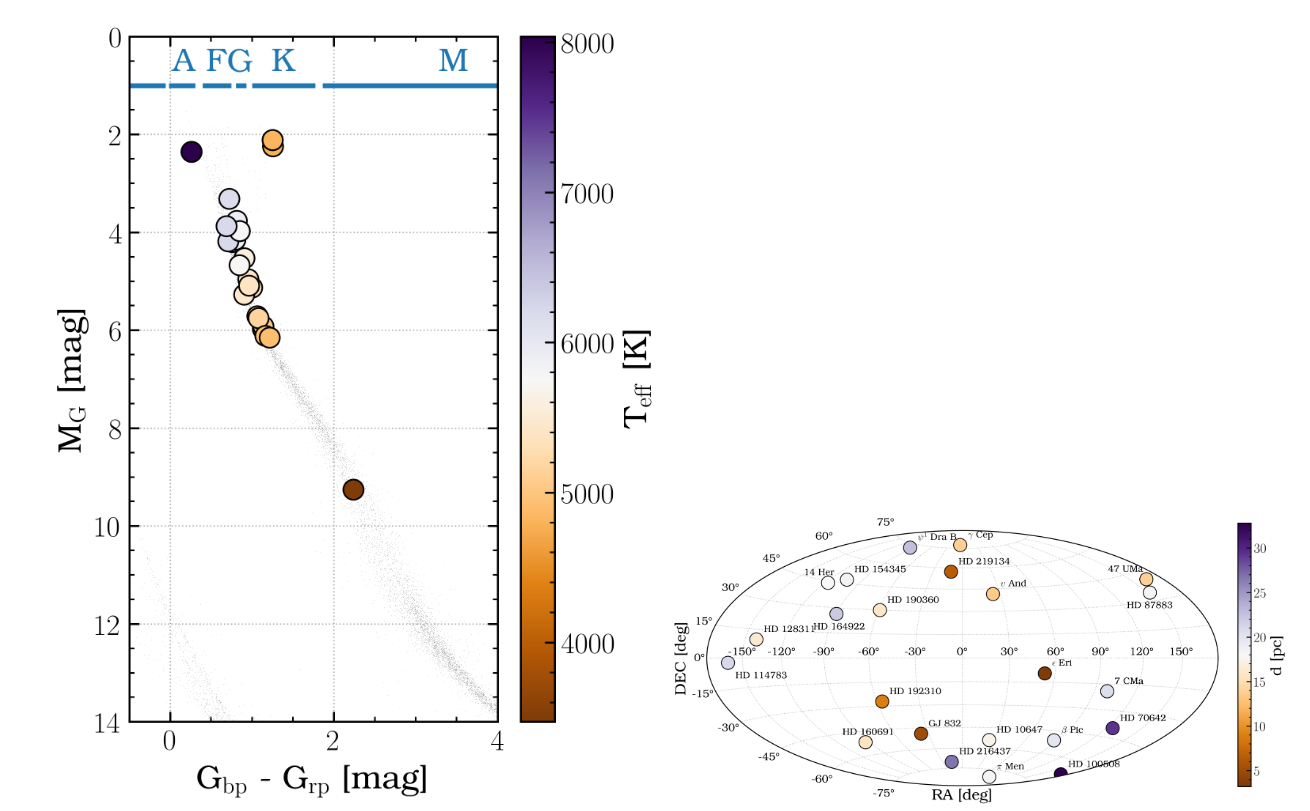 The panel on the left shows a Gaia color-magnitude diagram showing the effective temperature (colormap) and spectral type of the host stars for the 27 planets on the list. Only one is an M-dwarf. The panel on the right shows the sky locations of the stars. Image Credit: Logan Pearce and Ewan Douglas 2026.
While observations with the ESC will be valuable, and open a new pathway to observing potential biosignatures, there are some restraints. In particular, the required exposure times. “The high contrasts involved in reflected light detection (𝒪 10−7−10-9) and subsequent long exposure times (10s–100s of hours) make uninformed searches challenging for a 3m class observatory,” the authors explain. “Campaign efficiency can be dramatically improved by targeting known planets and leveraging well constrained orbital priors in order to prioritize targets and time observations for the maximum likelihood of detection.”
The list of targets is based on exoplanets with well-known orbits, since that will make the best use of observing time.
Those interested in exoplanets may recognize some of the 27 giant exoplanets on the list:
- 55 Cancri d, notable for being a Jupiter analog.
- HD 181433 d, notable because it follows a highly-eccentric orbit and is part of an exoplanet family that also features an ultra-short period super-Earth.
- β Pic b, notable because it was one of the first exoplanets to be directly imaged and also interacts with a well-known debris disk.
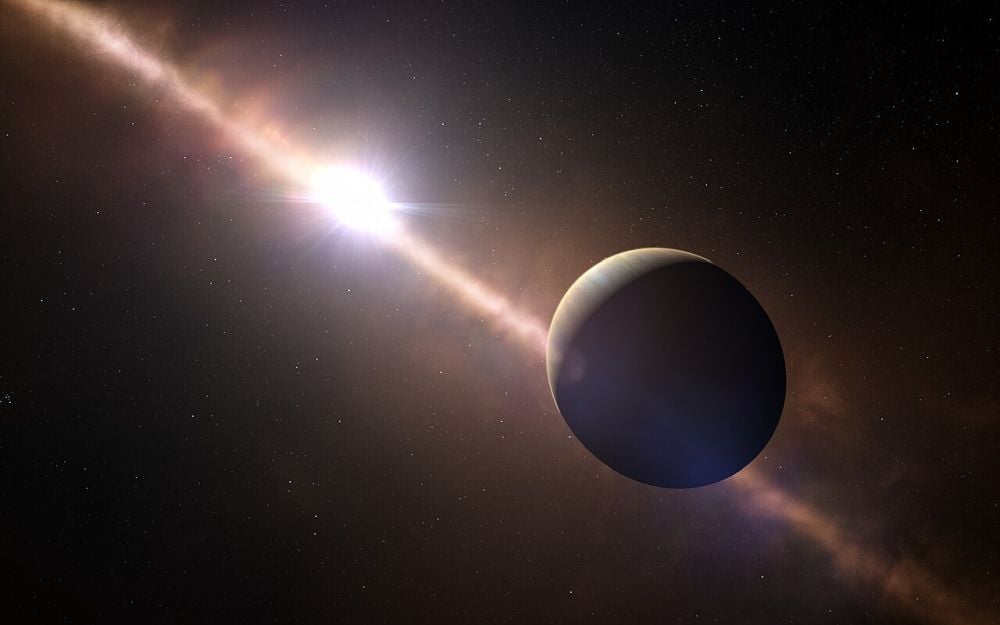 This artist’s illustration shows Beta Pictoris b, one of the most deeply-studied exoplanets. It was one of the first directly-imaged exoplanets, and orbits a young star that’s also well-known because of its debris disk, shown in the illustration. Image Credit: By ESO, CC BY 4.0, https://commons.wikimedia.org/w/index.php?curid=32625365
A private space telescope is something not seen before. It remains to be seen how effective it will be. It also remains to be seen what private ownership might mean, and if that makes it more efficient, or if it introduces unanticipated problems, or both.
Ultimately, it’s all about the contribution it makes to exoplanet science.
“Our target list expands direct imaging of gas giant planets into regimes colder than previously imaged, probing mature exoplanet systems, with some overlap with Roman CGI and ELT-METIS imaging, providing more comprehensive atmosphere characterization through synergies with those platform capabilities,” the authors conclude.

