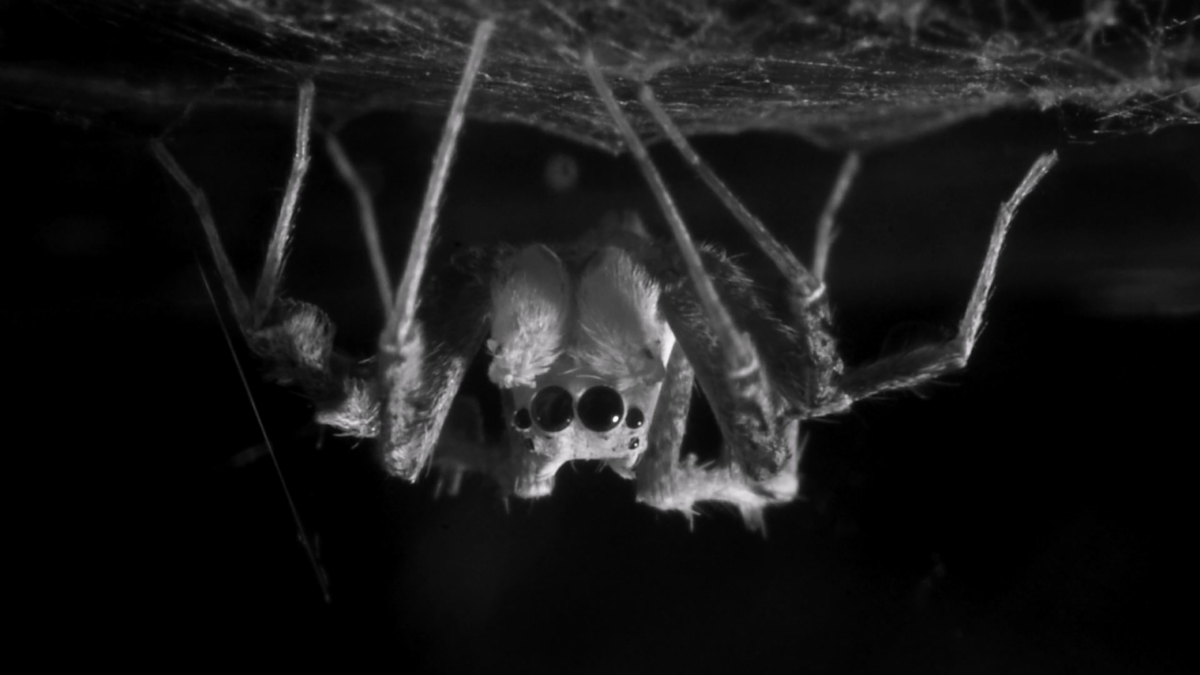
Германы судлаачид Portia fimbriata төрлийн үсэрдэг аалз нь сээр нуруутан амьтдынхтай ижил бүтэц, зохицуулалт бүхий REM (нүдний хурдан хөдөлгөөн) нойрны төлөвт ордог болохыг анх удаа баталлаа.
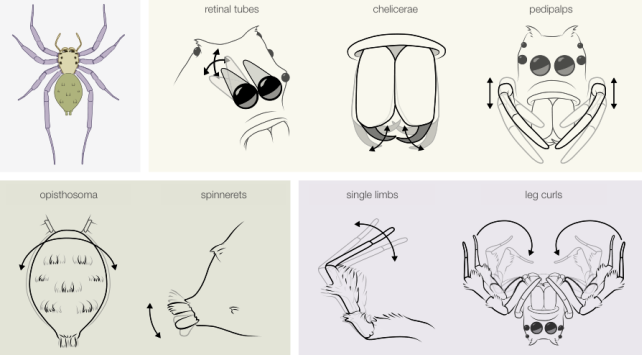
Бонны их сургуулийн судлаачид Надя Гэйгер болон Даниела К. Рөсслер нар хэт ягаан туяаны камер ашиглан аалзны шөнийн идэвхжилийг ажиглажээ. Судалгааны явцад аалзнууд шөнийн цагаар хөдөлгөөнгүй байх үедээ мөчөө татах, амны хөндийгөө хөдөлгөх, нүдний торлог бүрхэвчээ идэвхтэй хөдөлгөх зэрэг шинж тэмдгүүд илэрсэн байна. Энэ нь амьтны ертөнцөд мэдрэлийн тогтолцоо нь тэс өөр амьтад ч нойрны ижил төстэй үе шаттай байдгийг харуулсан чухал нээлт боллоо.
Судлаачид аалзны нойрыг албадан сэрээж туршилт хийсний үр дүнд тэд нойрны нөхөн төлжилт буюу “REM rebound” үзэгдлийг харуулж байгааг тогтоов. Тодруулбал, нойр нь хулгайлагдсан аалзнууд дараагийн шөнө нь өмнөхөөсөө 80 орчим хувиар илүү хугацааг REM-тэй төстэй нойрны төлөвт зарцуулжээ. Энэ нь аалзнуудад тухайн нойрны үе шат нь зүгээр нэг амралт бус, биологийн зайлшгүй хэрэгцээ болохыг нотолж байна.
Эрдэмтэд энэхүү идэвхтэй нойрны үе шат нь аалзны танин мэдэхүйн чадвар, ой тогтоолт, шийдвэр гаргах үйл явцад чухал үүрэгтэй гэж таамаглаж байна. Уг судалгааны үр дүн нь амьтны ертөнцөд нойрны хувьсал хэр гүнзгий үндэстэй болохыг харуулж, бидний төсөөлж байснаас илүү олон амьтан ийм төвөгтэй нойрны механизмтай байж болзошгүйг сануулж байна.

Судалгааны үр дүнг Proceedings of the National Academy of Sciences сэтгүүлд нийтэлжээ.
Дэлгэрэнгүйг эх сурвалжаас харах
↓Эх сурвалжийг нээх ↓
Tucked in a corner of an enclosure, swaddled in darkness, a tiny spider sleeps.
But as the night progresses, he doesn’t remain still.
His tiny limbs twitch, his chelicerae tremble, his retinas flutter back and forth as though tracking the motions of something that isn’t actually there.
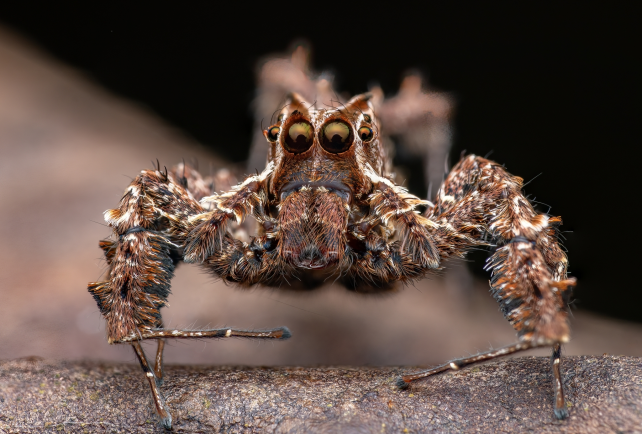
He is Portia fimbriata – the fringed jumping spider – among the most intelligent of the Araneads. And his nocturnal behavior, scientists say, is the best evidence yet that spiders undergo a distinct stage of REM-like sleep.
“What surprised us was how closely spider sleep mirrors vertebrate sleep in its structure and regulation,” behavioral ecologists Nadja Geiger and Daniela C. Rößler of the University of Bonn in Germany told ScienceAlert.
“Seeing such strong parallels, especially in the homeostatic control of sleep, in animals with such a different neural architecture was genuinely exciting and opens up a new comparative window into how sleep operates across the animal kingdom.”
Sleep is one of the biggest mysteries in biology.
We know we need it, and scientists have managed to discover an enormous amount about what happens during it, but what we don’t know is why it evolved in the first place.
We spend a significant percentage of our lives locked away in a highly vulnerable state with dramatically reduced awareness of our surroundings. Whatever the benefits, they must be great indeed to outweigh these downsides.
We know what some of those benefits are. It improves memory and learning, facilitates brain waste management, boosts physical maintenance processes and immune function, and helps with emotional regulation.
But which of those, if any, were the trigger for the evolution of sleep? Were all of them present from the beginning, or did sleep’s benefits accumulate over time? And why is it so closely linked to the day-night cycle, anyway?
REM sleep is especially intriguing – a periodic phase during sleep wherein the brain becomes active even while the body stays asleep. Why does the body need to do this – so much so that insufficient REM can accrue a debt that the body subsequently tries to repay?
“We do think our findings support the idea that distinct sleep stages, including REM-like or active sleep, may have very deep evolutionary roots,” Geiger and Rößler said.
“The fact that comparable active sleep stages have now been described in animals as evolutionarily distant as spiders, cephalopods, and vertebrates makes that possibility particularly striking.”
In 2022, a team led by Rößler announced something remarkable. In a species of jumping spiders called Evarcha arcuata, they had recorded something compellingly similar to a REM-like sleep state.
While otherwise motionless, the spiders’ limbs and bodies twitched, and their retinas tracked phantom movements.
But there was a catch.
Although the spiders looked like they were experiencing REM sleep, the researchers hadn’t yet established that they were actually asleep. That’s a really important distinction – because a REM-like sleep state cannot be established without the sleep part.
Enter Portia. With their big, limpid eyes, they’re like the puppydogs of the spider kingdom, but these tiny arachnids cognitively punch heavily above their weight.
They can plot complicated routes to prey even after losing sight of their targets, and trick other spiders into approaching by plucking their webs to imitate the vibrations of trapped insects. When a tactic fails, they can improvise, testing different signals until they find one that works.
This ability to solve problems and retain information raises an intriguing question: Does REM-like sleep help them do it?
Building on the prior research with Evarcha, the first thing Geiger, Rößler, and their colleagues needed to do was establish that the spiders really were sleeping.
Sleep has several telltale characteristics that distinguish it from simply resting. An animal adopts a characteristic posture, becomes less responsive to its surroundings, and can be awakened by sufficiently strong stimulation. And sleep is also regulated: when an animal is deprived of it, it tends to compensate later.
The researchers set out to test these characteristics in Portia, using infrared cameras to monitor the spiders’ movements, experiments to establish their responses to disturbances, and disruptions to their nightly rest to see what happened afterward.
Portia passed the sleep test with flying colors. The spiders were predominantly active during the day, settled into characteristic resting positions at night, and became less responsive to disturbances during rest – especially during REM-like episodes.
And their nighttime rest wasn’t uniform. Periods of stillness were regularly interrupted by bouts of twitching limbs, trembling mouthparts, and moving retinas – the same REM-like behaviors observed in Evarcha.
But the most compelling evidence came when the researchers disrupted the spiders’ sleep.
To keep the spiders awake, the researchers introduced 25 live fruit flies into their enclosures at night, disturbing their usual rest.
Then, when the spiders were allowed to recover the following night, something amazing happened.
They spent nearly 80 percent more time exhibiting REM-like sleep behaviors than they had before the disruption. Rather than experiencing longer individual episodes, they had more of them – as though making up for what they’d missed.
This phenomenon is known as REM rebound, and it’s compelling evidence that spiders actually need REM-like sleep, the researchers said.
“To our knowledge, this is the first demonstration of REM rebound in an invertebrate, which makes the finding particularly exciting,” Geiger and Rößler told ScienceAlert.
“Seeing that spiders show a clear REM‑like sleep pressure, essentially a need to compensate for lost REM‑like sleep, strongly suggests that this stage fulfills an important biological function rather than being an incidental feature of rest.”
And, they noted, the pattern was remarkably similar to REM rebound in vertebrates – suggesting that, whatever that need is, spiders may share it with a whole range of other creatures.
What could that function be? Well, the researchers did not test that.
But one tantalizing possibility brings us back to Portia‘s remarkable intelligence. In vertebrates, REM sleep has been linked to learning and memory processing. Could something similar be happening in the brains of these tiny, cunning hunters?
“We suspect that, much like REM sleep in vertebrates, this active sleep stage plays a role in information processing, including learning and memory consolidation,” the researchers said.
“Given Portia‘s remarkable hunting strategies, it’s very plausible that their experiences during the day shape what happens during REM‑like sleep at night, helping them refine their decision‑making, improve their precision, and learn from past encounters.”
And that raises another, even more intriguing possibility. If the spiders are processing their experiences during REM-like sleep, could they also be dreaming?
Well, no. That is, they could be. But how would we know?
Geiger and Rößler note that confirmation of a REM-like sleep state certainly brings them closer to considering it. But the more interesting question is whether they are experiencing something called behavioral replay – internally generated movements that reflect actions performed while awake.
Those twitching limbs and darting retinas could, potentially, be traces of the spiders replaying patterns of activity from their waking lives, a process that might help consolidate memories.
Future research may help answer this question by revealing which parts of the spiders’ brains become active during REM-like sleep, and whether those patterns resemble activity while they’re awake.
Whatever the answers, though, the discovery raises tantalizing questions about how long complex sleep has existed, and how widespread it might be across the animal kingdom.
Geiger and Rößler suspect that spiders might not be particularly unusual in this respect. Perhaps, they say, we’ve simply not been looking closely enough.
“One thing we definitely learned while studying them was that once you look at their behavior in detail, they stop feeling alien and start feeling surprisingly familiar,” they said.
The research has been published in Proceedings of the National Academy of Sciences.
This article was fact-checked by Fiona MacDonald and edited by Fiona MacDonald. While we pride ourselves on our process, we are only human. If you spot a mistake, please let us know.

