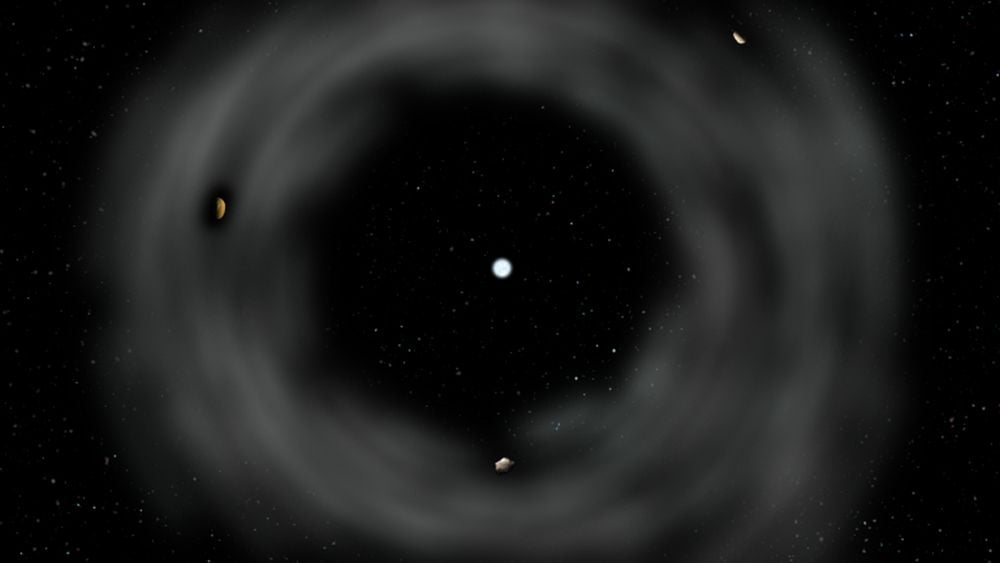
Цагаан одой оддын хүчтэй таталцал нь тэдгээрийг тойрсон жижиг биетүүдийг бүрэн нунтаглаж чаддаггүй болохыг шинэ судалгаагаар илрүүллээ.
Цагаан одой одууд нь манай Нар шиг оддын хувьслын төгсгөлийн шат бөгөөд маш нягт, асар их таталцлын хүчтэй байдаг. Уг хүч нь ойр орчимд нь ирсэн солир, сар болон бусад жижиг биетүүдийг татаж, задралд оруулах чадвартай юм. Одон орон судлаачид цагаан одой оддын гадаргуу дээрх металлын ул мөр болон тэднийг тойрсон хог хаягдлын цагираг, дискийг судалснаар энэхүү үйл явцыг илүү гүнзгий ойлгохыг зорьж байна.
The Astrophysical Journal Letters сэтгүүлд нийтлэгдсэн шинэ судалгаагаар Жордан К.Стеклофф болон түүний багийнхан цагаан одой оддын түрлэгийн хүч солируудыг хэрхэн задалдгийг шинжилжээ. Өмнөх загварчлалуудад солируудыг дотоод бат бэх чанаргүй, сул хог хаягдлын бөөгнөрөл гэж үздэг байсан бол шинэ судалгаагаар тэдгээр нь “Ван дер Ваальс”-ын хүчний нөлөөгөөр тодорхой хэмжээний бат бэхтэй болохыг харууллаа. Энэхүү сул хүч нь солир, сүүлт оддын дотоод бүтцийг нэгтгэн барьж байдаг бөгөөд тэдгээрийг бүрэн нунтаглан тоос болгоход саад болдог байна.
Судалгааны үр дүнгээс үзэхэд солируудын дотоод бат бэх нь хатуу чулуулгаас сая дахин сул боловч 0.1-ээс 1 км диаметртэй хэлтэрхий болон задрах хязгаарыг тогтоодог байна. Үүнийг “километрийн хэмжээст хаалт” гэж нэрлэж байгаа бөгөөд ихэнх хог хаягдал нь үүнээс жижиг тоос болон хувирдаггүй болохыг тогтоожээ. Иймд цагаан одой оддыг тойрсон тоосонцрын диск үүсэхэд зөвхөн таталцлын хүч хангалтгүй бөгөөд биетүүдийн хоорондын мөргөлдөөн зэрэг өөр хүчин зүйлүүд шаардлагатай гэж эрдэмтэд үзэж байна.
Энэхүү үйл явц нь манай нарны аймаг дахь үйл явдалтай ижил төстэй юм. Тухайлбал, 1992 онд Бархасбадь гарагийн таталцалд өртсөн Шумейкер-Леви 9 сүүлт од нь тоос болон замхрахын оронд 100-аас 1000 метрийн хэмжээтэй хэлтэрхий болон задарч байв. Судлаач Кат Волкын тэмдэглэснээр, оддын амьдралын төгсгөлийн шатанд эргэн тойрон дахь жижиг биетүүд хэрхэн хувьсдаг болохыг ойлгох нь сансар огторгуйн эволюцийг танин мэдэхэд чухал ач холбогдолтой юм.
Дэлгэрэнгүйг эх сурвалжаас харах
Эх сурвалжийг нээх ↓
White dwarfs are the remnants of a stars like our Sun. For their size—they’re roughly the size of Earth—they’re extremely dense, and have about as much mass as the Sun. That means they have enormous gravitational power, enough power to tear apart objects that get too close.
For a long time, white dwarfs appeared to be alone in space, not including any stellar companions. Then observations showed that some of their surfaces were polluted with metals. Astronomers surmised that these metals were raining down onto their surfaces from rocky debris. Then came observations that some white dwarfs were surrounded by debris disks. After that, even more piercing observations found evidence of rocky bodies in the disks: small planets, moons, or asteroids.
An example of these is WD 1145+017, which seems to be orbited by several small rocky bodies, being torn apart and raining debris down onto the white dwarf’s surface.
Scientists are curious about this process and how effectively white dwarfs can shred smaller bodies and form debris disks. As they find white dwarfs with disks, asteroids, and even planetary systems, explanations need to keep pace.
In new research in The Astrophysical Journal Letters, researchers examined how efficiently white dwarf tidal forces can break asteroids apart. The research is titled “Size Limits on Tidal Debris around White Dwarfs: The Kilometer-size Barrier.” The lead author is Jordan K. Steckloff, senior scientist at the Planetary Science Institute.
“Compact disks of planetary debris orbiting white dwarfs provide a crucial window into our understanding of evolved planetary systems,” the authors write. “The formation of these disks has been widely modeled with tidal fragmentation of minor planets that are rubble piles with no internal strength.”
This artist’s illustration shows a white dwarf surrounded by a debris disk, with asteroidal fragments in the foreground. The more astronomers find white dwarfs with debris disks, the more they want to understand how they’re created. Image Credit: NASA’s Goddard Space Flight Center/Scott Wiessinger
That’s a problem because real rubble piles have some cohesive strength. Also, all three of the asteroids we’ve sampled—Itokawa, Ryugu, and Bennu—are rubble piles. The force that holds these types of asteroids together is called the Van der Waals force. It’s a weak, short-range force that attracts and repulses atoms and molecules. But as gecko feet show, it can be very effective.
In their work, Steckloff and his co-authors show what happens when this strength is included in modelling: “breakup of these rubble piles sets a maximum fragment size, and we calculate this size for water ice, iron, and material densities corresponding to the lunar highlands, Vesta, and the Earth,” they write.
“Nothing is truly strengthless,” Steckloff said. “Tiny attractions between grains called Van der Waals forces give comets and asteroids a minimum strength 10 to 100 times weaker than pulling apart freshly fallen snow.”
According to this research, the typical internal strength of a rubble pile is ∼10–1000 Pa, which is about one million times weaker than solid rock. In that range, the maximum size for fragments is about the same as small asteroids, between about 0.1 and 1 km in diameter. “This limit—the kilometer-size barrier—also represents the characteristic sizes of tidal fragments,” the authors explain. “Most of the debris mass is contained in fragments of this size.”
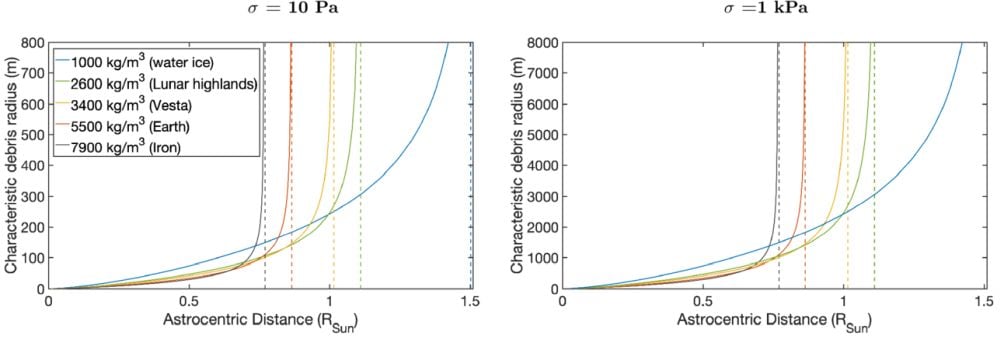 These panels show characteristic debris size by distance from a white dwarf with about 0.6 solar masses and cohesive strength. The panel on the left is for a strength of 10 pascals, and the panel on the right is for a strength of 1 kilopascal. The results show characteristic fragment sizes of about 100 meters and 1,000 meters respectively. Image Credit: Jordan K. Steckloff et al 2026 ApJL 1004 L27
The authors say that as a consquence, models of disk formation around white dwarfs need to include another dust-generating factor in order to explain the dusty disks in observations. That likely means collisions rather than tidal forces.
The force that shapes the end-state of the disk is called Poynting–Robertson drag. It explains how solar radiation affects dust grains around stars, including white dwarfs, making the dust spiral inward. This only works if the dust grains are small enough to be subjected to the drag but not so large that radiation pressure drives them away. This work shows that fragmentation itself isn’t enough to create dust this small.
Observations in our Solar System agree with these results. When the comet Shoemaker-Levy 9 approached Jupiter in 1992, the gas giant’s powerful tidal force pulled the comet apart. But not into dust; instead, the comet was torn into fragments 100m to 1,000m in diameter, which then plunged into the planet.
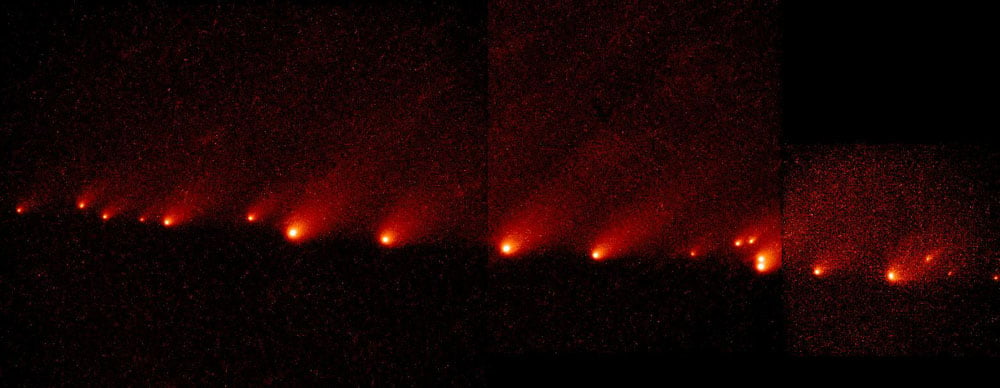 This Hubble Space Telescope image shows comet Shoemaker-Levy 9 broken into fragments after it approached Jupiter in 1992. Two years later the fragments approached Jupiter again and plunged into its atmosphere. Image Credit: NASA.
The research extends beyond asteroid fragment sizes in disks. It also shows that fragments maintain their orbits. They experience only tiny, fractional changes in their velocities “on the order of one part per million to one part per 100 million,” the authors explain. “Such tiny changes in speed result in negligible changes to the orbits of the fragments, which remain in practically the same orbit as prior to disruption.”
There are a lot of factors involved in the creation of a white dwarf’s dust disk, and this work places an important constraint on one of them. “Understanding the progression from an intact minor planet to a sea of dust that is accreted onto a white dwarf is an outstanding challenge,” the authors write. “In this Letter, we demonstrate a sharp constraint on the first step of this process.” The work shows that some type of grinding process like collisions is required to generate white dwarf dust disks.
“Understanding the details of how debris around white dwarfs is produced and evolves is important for putting the observations into context,” said study co-author Kat Volk from the Planetary Science Institute. “This will help us understand what happens to the small bodies in orbit around a star as it undergoes the end stages of its life.”

