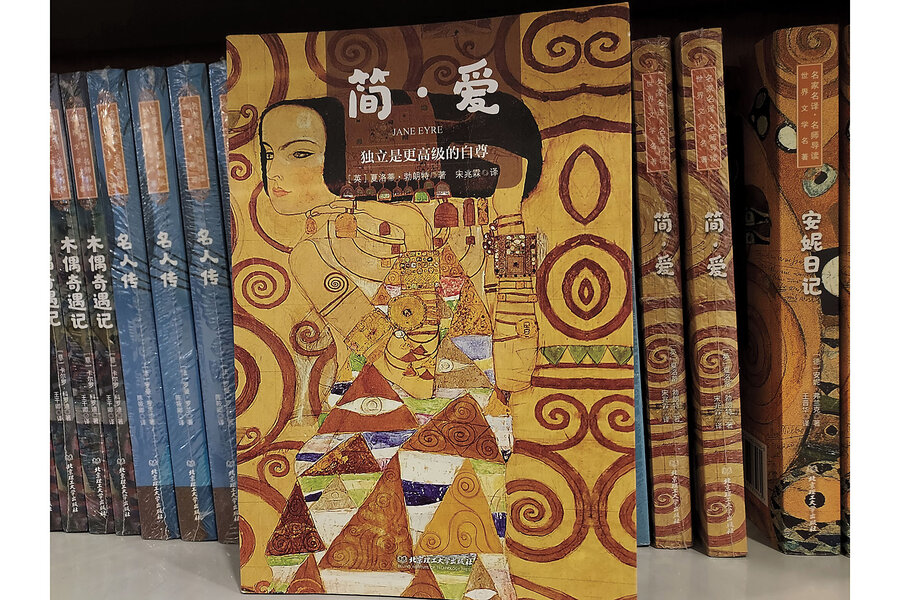
АНУ-ын Техас мужийн зарим сургуулийн номын сангаас зохиолыг хязгаарласан бол Хятадад есдүгээр ангийн сурагчдын заавал унших бүтээлд оруулжээ.
Шарлотт Бронтегийн 1847 онд хэвлүүлсэн “Жейн Эйр” зохиол энэ онд АНУ-ын PEN America байгууллагын хориглосон номын жагсаалтад багтжээ. Техасын Макаллен болон Шерц-Сиболо-Юниверсал-Сити сургуулийн дүүргүүд уг зохиолыг дунд сургуулийн номын сангаас гаргахаар төлөвлөсөн бол Нью-Браунфелсийн дүүрэг зөвхөн ахисан түвшний уран зохиолын сурагчдад уншуулахаар хязгаарласан байна.
Сургуулийн номын сангийн агуулгад тавих хяналтыг нэмэгдүүлсэн, өнгөрсөн жил баталсан SB13 хуулийн хэрэгжилттэй холбоотойгоор ийм шийдвэр гаргажээ. Хуулийг дэмжигчдийн нэг Бонни Уоллес “Жейн Эйр”-ийг ёс бус, зохисгүй агуулгатай бүтээл биш гэж үзээд, зарим дүүрэг хуулийн зорилгоос давуулан хэрэгжүүлж байж болзошгүй гэжээ. Техасын “Унших эрх чөлөө” төслийг хамтран үүсгэн байгуулагч Анн Руссигийн таамагласнаар, сургуулиудын ашигласан хиймэл оюун ухаан зохиолыг алдаатайгаар асуудалтай гэж тэмдэглэсэн байж магадгүй.
Харин Хятадад уг зохиолыг Бээжингээс Чэнду хүртэлх сургуулиудын есдүгээр ангийн сурагчдад заавал уншуулж байна. Тус улсад Жейн өөрийнхөөрөө шийдвэр гаргадаг, эд хөрөнгийг эрхэмлэдэггүй эмэгтэй дүрээр олон үеийн уншигчдад танигдсан бөгөөд Бээжингийн хэвлэл мэдээлэл уг зохиолыг хайр дурлалыг хөрөнгө чинээ, гадаад төрхөөр бус, сэтгэл санааны тэгш байдлаар ойлгуулахад тустай гэж онцолжээ. Хүн амын насжилт нэмэгдэж буй нөхцөлд Хятадын эрх баригчид хүүхэд асрах тэтгэмж зэрэг гэр бүл зохиохыг дэмжсэн арга хэмжээ хэрэгжүүлж байна.
Зохиолын сэтгэцийн эрүүл мэнд зэрэг хүнд сэдвүүдийг зарим хүн хүүхдэд тохирохгүй гэж үзэж байгаа ч Бронте музейн ажилтан Сью Ньюби үүнийг өсвөр насныханд тэсвэр хатуужил, бусдыг ойлгох, эрх мэдэлтэй хүний өмнө үзэл бодлоо хэлэхийн үнэ цэнийг харуулдаг бүтээл хэмээн тайлбарлажээ. Гэхдээ өнөөгийн залуу уншигчид Жейний Рочестертэй гэрлэсэн төгсгөлийг өөрийн замаар явж болох байсан гэж шүүмжлэх нь түгээмэл болсон байна.
Дэлгэрэнгүйг эх сурвалжаас харах
↓Эх сурвалжийг нээх ↓
Boston; Beijing; and Texas
|
Nov. 05, 2026, 12:12 p.m. ET
|
4 min read
When Charlotte Brontë released her 1847 novel “Jane Eyre,” about a young woman coming of age among the moors and manors of northern England, the book certainly had its critics.
The focus on Jane’s rich, internal world was radical for the time. Some readers bristled at the depiction of a self-assured, outspoken child – nothing like the sweet little girls who appeared in Charles Dickens’ novels – and decried the book’s emotional intensity as “coarse.”
“We are talking about the Victorian period, after all,” says Sue Newby, learning officer at the Brontë Parsonage Museum in Haworth, England. But even still, these critics were the minority. The book was an immediate bestseller, and has only grown more popular in the nearly 180 years since.
That’s why Ms. Newby – and many parents – are so stumped by the novel’s recent debut on PEN America’s banned books list. This year, at least three Texas school districts restricted access to the novel as state lawmakers try to rid public school libraries of what they consider explicit content.
Even more perplexing is where the book is being celebrated: China. The country known for its strict internet and literary censorship just made “Jane Eyre” required reading for ninth graders from Beijing to Chengdu. The mixed reception hints at authorities’ shifting priorities in both countries.
“Maybe this isn’t the truth anymore, but we still think of America as being this kind of bastion of liberal values, and we think of China as being the opposite,” Ms. Newby says. “It’s very ironic.”
Transition novel
So why have some schools taken issue with “Jane Eyre”?
Reader, nobody knows.
Two Texas school districts – McAllen and Schertz-Cibolo-Universal City – have announced plans to move “Jane Eyre” out of middle school libraries, citing compliance with Senate Bill 13. That’s a law passed last year that redefines what qualifies as harmful, indecent, or profane content in library books. New Braunfels’ school district went a step further, restricting the title to advanced literature students only.
Yet supporters of the bill, which also gives parents and school districts greater oversight of school library catalogs, say that books like “Jane Eyre” were never the intended targets.
“‘Jane Eyre’ is not profane, it is not indecent,” says Bonnie Wallace, a grassroots activist who helped lead the campaign to scrutinize the content of public school libraries. She suspects that some school districts “are going well beyond the intention of SB13 and trying to make it seem like [the law] is overreaching or exclusionary or reactionary.”
Another theory: These districts have all used AI “pretty extensively,” says Anne Russey, co-founder of the Texas Freedom to Read Project, which might have erroneously flagged “Jane Eyre” as problematic.
To be sure, the novel tackles some heavy themes, including mental illness. But Abigail Gordy, a mother who recently moved with her family from Schertz, Texas, to San Antonio because of the book bans, says these things are part of life.
“There’s nothing in there that’s too dark for an intermediate child to read. They see way worse online,” she says, adding that restricting children’s access to books “makes us closed-minded.”
Ms. Newby calls it a “perfect transition novel,” teaching teens resilience, compassion, and the importance of speaking truth to power as they start to confront the adult world for the first time.
China embraces Jane Eyre – and Mr. Rochester
A Beijing secondary school is about as far as one can get from Thornfield Hall, the Gothic estate of the brooding Mr. Rochester, Jane’s love interest in the novel. But she has long been celebrated in China as an independent heroine who eschews materialism, showing there is dignity in being “poor, obscure, plain and little.”
Her story has taught generations of young readers “to love ourselves and other people around us,” says Zhao Dongqing, a mother and physician in Beijing. “It’s very good for teenagers to read – as well as for adults.”
For Ethan Huang, a ninth-grade student who recently finished reading “Jane Eyre,” it was the childhood scenes that resonated the most – particularly when a young Jane stood up to her principal. “This made me think,” he says, standing outside a large bookstore in the Xidan neighborhood of Beijing. “I can take the initiative. When the teacher says something wrong, I will point [it] out.”
And nowadays, the Chinese government sees another potential perk to teaching “Jane Eyre”: promoting romantic love.
Faced with an aging population, authorities in China have rolled out various incentives for people to start families, from childcare subsidy programs to photo-friendly marriage registration offices. Beijing Daily, the mouthpiece of the Communist Party’s Beijing branch, says “Jane Eyre” can help counteract the “mixed bag of love stories” that kids encounter online and in pop culture, which often focus on a romantic interest’s looks and wealth. Famously, Jane finally marries Mr. Rochester once he’s lost his fortune, eyesight, and left hand to a fire. “Jane Eyre thinks love should be founded on spiritual equality,” states the Beijing Daily.
But teachers in China and beyond might have trouble selling this storybook ending to Generations Z and Alpha.
“How students respond to Rochester has changed quite a lot,” says Ms. Newby. “Young girls are much less romantic about him than I used to be.”
Deepen your worldview
with Monitor Highlights.
Politics with respect
Get political stories with respectful analysis.
There‘s a world of new ideas in every
Books newsletter.
There‘s more to life, enrich yours with
Culture & Learning weekly.
Follow humanity‘s discoveries with
Science & Nature stories in your inbox.
Gain a spiritual perspective
from the stories in your inbox.
Want to understand the deeper impact of critical events? Learn the Monitor‘s insight.
Already a subscriber?Log in to hide ads.
segment.length > 0);
for (const segment of segments) {
if (pathMap[segment]) {
const targetValue = pathMap[segment];
const widget = document.getElementById(‘inbody_nl_widget’);
if (widget) {
// set the active class to the correct message
const activePara = widget.querySelector(‘.signup-intro .active’);
const targetPara = widget.querySelector(‘.’ + targetValue);
if (activePara && targetPara) {
activePara.classList.remove(‘active’);
targetPara.classList.add(‘active’);
}
// update input hidden field
const hiddenInput = widget.querySelector(‘input.section[type=”hidden”]’);
if (hiddenInput) {
hiddenInput.name = targetValue;
}
}
// stop execution when first match is found
// change match priority by updating the pathMap array
break;
}
}
]]>
Instead, they’re more likely to see Jane’s marriage as “a cop out,” and say she “should have blazed her own trail and gone off traveling” at the end.
Henry Gass in Texas, Jingnan Peng in Boston, and Ann Scott Tyson in China contributed reporting for this story.

