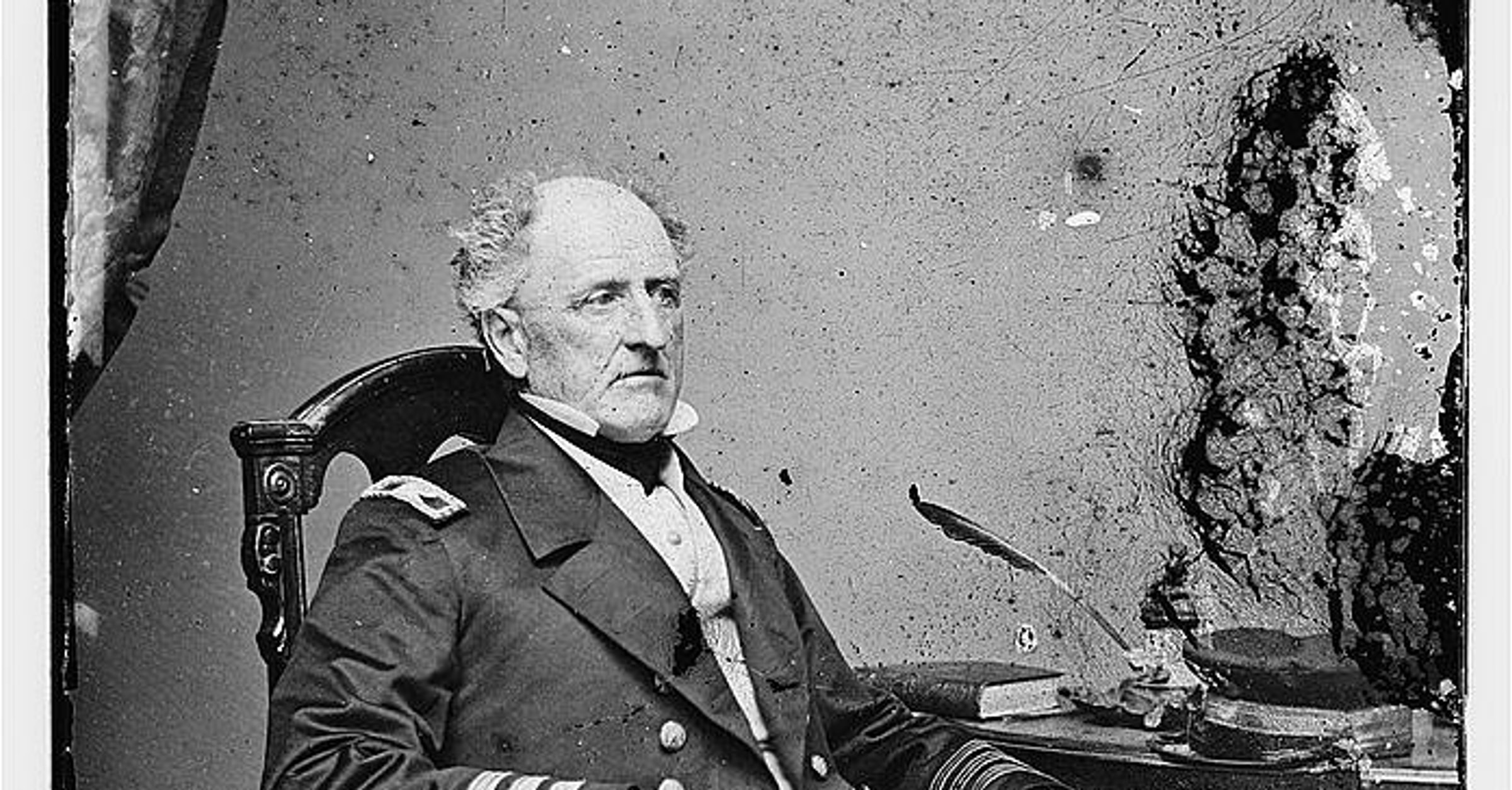
Америкийн иргэний дайны үед болсон Хэмптон Роудсын тулалдааны үеэр шархадсан Холбооны тэнгисийн цэргийн командлагч Франклин Бьюкенений түүхэн үүрэг, намтар болон түүний байлдааны тайлангийн ач холбогдлын тухай өгүүлнэ.
1862 оны гуравдугаар сарын 8-нд болсон Хэмптон Роудсын тулалдааны төгсгөл хэсэгт Франклин Бьюкенен гуяндаа шархадсан тул маргааш нь буюу гуравдугаар сарын 9-нд болсон “CSS Virginia” болон “USS Monitor” хөлөг онгоцнуудын тулалдаанд “Virginia”-г удирдаагүй юм. Тухайн үед уг хөлгийг дэд хурандаа Кэтсби ап Рожер Жонс удирджээ. Гэсэн хэдий ч тулалдааны ерөнхий командлагчийн хувьд байлдааны тайлан гаргах үүрэг нь Бьюкененд хэвээр үлдсэн бөгөөд тэрээр 1862 оны гуравдугаар сарын 27-нд Норфолк хотын эмнэлгийн орон дээрээс тайлангаа бичсэн байна. Бьюкенений энэхүү тайлан нь Хэмптон Роудсын тулалдааны талаарх чухал анхдагч эх сурвалж болон үлджээ.
Франклин Бьюкенен 1800 оны есдүгээр сарын 13-нд Мэрилэнд мужийн Балтимор хотод төржээ. Тэрээр 1815 онд АНУ-ын Тэнгисийн цэргийн хүчинд элсэж, 1825 онд дэслэгч, 1841 онд командлагч, 1855 онд ахмад цол хүрттэлээ алба хаасан байна. 1835 онд тэрээр Энн Кэтрин Ллойдтой гэрлэж, есөн хүүхдийн эцэг болжээ. Тэрээр Япон болон Мексик-Америкийн дайнд оролцож байсан бөгөөд 1845 онд Тэнгисийн цэргийн сургуулийг (1850 онд АНУ-ын Тэнгисийн цэргийн академи болсон) үүсгэн байгуулахад хувь нэмрээ оруулж, 1845-1847 оны хооронд анхны захирлаар нь ажиллаж байв.
Виржиниа муж 1861 оны дөрөвдүгээр сарын 17-нд Холбооны бүрэлдэхүүнээс гарахаар шийдвэрлэхэд Бьюкенен Мэрилэнд муж мөн адил дагана хэмээн найдаж, төрсөн муждаа үнэнч байх үүднээс дөрөвдүгээр сарын 22-нд албан тушаалаасаа огцорчээ. Гэвч Мэрилэнд муж Холбооны бүрэлдэхүүнд үлдэхээр санал өгөхөд Бьюкенен огцрох өргөдлөө буцаан авахаар оролдсон боловч АНУ-ын Тэнгисийн цэргийн сайд Гидеон Уэллс түүнийг урвагч хэмээн үзэж хүлээн аваагүй байна.
Бьюкенен 1861 оны есдүгээр сарын 5-нд Холбооны тэнгисийн цэргийн хүчинд ахмадын цолоор элсэж, 1862 оны хоёрдугаар сард Флаг офицер, 1862 оны наймдугаар сард Холбооны тэнгисийн цэргийн цорын ганц бүрэн эрхт адмирал цолоор тус тус дэвшжээ. 1864 оны Мобайл Бэйгийн тулалдааны үеэр олзлогдсон тэрээр дайны үлдэх хугацааг хоригдол болгон өнгөрүүлж, 1865 оны хоёрдугаар сард солилцоогоор суллагдсан байна. Тэрээр Мэрилэнд муж руугаа буцаж, 1874 оны тавдугаар сарын 11-нд Талбот гүнлэг дэх гэртээ байгалийн жамаар нас баржээ. Бьюкененийг маш өндрөөр үнэлдэг байсан тул АНУ-ын Тэнгисийн цэргийн гурван устгагч хөлөг онгоцыг түүний нэрээр нэрлэж, Тэнгисийн цэргийн академийн захирлын байрыг 2023 он хүртэл “Бьюкенений байшин” гэж нэрлэдэг байв.
Түүний 1862 оны гуравдугаар сарын 27-нд Норфолк дахь Тэнгисийн цэргийн эмнэлгээс илгээсэн албан ёсны тайланд тулалдааны үйл явцыг дараах байдлаар дүрсэлжээ. Тэрээр өөрийн удирдлагад байсан “Virginia” тэргүүтэй Жеймс голын эскадрын бүрэлдэхүүнийг дурдаад, гуравдугаар сарын 8-ны өглөөний 11 цагаас эхлэн Ньюпорт Ньюс рүү хөдөлж, дайсны “Cumberland”, “Congress” хөлөг онгоцууд болон эрэг дээрх их бууны ангиудтай тулалдсанаа илтгэжээ.
Бьюкенен “Cumberland” хөлгийг өөрийн хөлөг онгоцны хошуугаар мөргөж живүүлэхээр төлөвлөсөн бөгөөд 15 минутын дараа мөргөж живүүлсэн байна. Үүний дараа “Congress” хөлөг рүү анхаарлаа хандуулсан ч усны гүн бага, шаварлаг байдал нь хөлгийг удирдахад хүндрэл учруулж байжээ. “Congress” хөлгийн багийнхан эхэндээ “Virginia”-г ухарч байна хэмээн баярлан хашхирсан боловч удалгүй бууж өгөхөөс өөр аргагүй болж, цагаан туг мандуулжээ. Гэвч тулалдааны явцад дайсны зүгээс урвагч шинжтэй гал нээж, Бьюкенений илгээсэн завь руу дайрснаар тэрээр хүнд шархадсан байна. Шархадсаны дараа тэрээр командлалыг дэд хурандаа Кэтсби Жонст шилжүүлж, хөлгийг эцсээ хүртэл тулалдахыг тушаажээ.
Маргааш нь буюу гуравдугаар сарын 9-нд эмч нарын шаардлагаар Бьюкенен болон дэслэгч Минор нарыг эрэг рүү гаргаж, эмнэлэгт хүргэсэн байна. Кэтсби Жонсын тайланд дурдсанаар, “Virginia” нь 9-ний өдөр “Minnesota” хөлөг болон “Monitor”-той тулалдсан бөгөөд хөлөг онгоцны эвдрэл, гүн усны хязгаарлагдмал байдлаас шалтгаалан тулалдааныг зогсоож, Норфолк руу буцжээ. Бьюкенен өөрийн тайлангийн төгсгөлд Кэтсби Жонсын гавьяаг өндрөөр үнэлж, түүнийг дэслэгч-командлагчийн албан тушаалд дэвшүүлэхийг хүссэн байна. Тэрээр 1862 оны гуравдугаар сарын 22-нд тушаал буурч, удирдлагыг Флаг офицер Татт
Дэлгэрэнгүйг эх сурвалжаас харах
↓Эх сурвалжийг нээх ↓
Buchanan was wounded in the thigh toward the end of the Battle of Hampton Roads on 8 March and so did not command the CSS Virginia against the USS Monitor on the 9th, when it was commanded by Lt. Catesby ap Roger Jones.
Even so, as commanding officer at the engagement, it was Buchanan’s responsibility to file a battle report, which he did from his hospital bed in Norfolk, Virginia, on 27 March 1862. Buchanan’s report has since become a significant primary source on the Battle of Hampton Roads.
Franklin Buchanan was born 13 September 1800 in Baltimore, Maryland, and joined the US Navy in 1815, rising through the ranks to lieutenant in 1825, commander in 1841, and captain in 1855. In 1835, he married Ann Catherine Lloyd, and the couple would have nine children.
He had a distinguished career in the Navy, serving in Japan and in the Mexican-American War, and encouraging the establishment of the Naval School in 1845 (which would become the United States Naval Academy in 1850), serving as its first superintendent between 1845 and 1847.
Buchanan was so highly thought of that three US Navy destroyers were named in his honor
After Virginia decided to leave the Union on 17 April 1861, Buchanan expected Maryland to follow suit and resigned his commission on 22 April 1861 out of loyalty to his home state. When Maryland voted to remain in the Union, Buchanan tried to take his resignation back but was rejected by US Secretary of the Navy Gideon Welles, who considered him a traitor.
Buchanan joined the Confederate Navy as a captain on 5 September 1861, was a Flag Officer by February 1862, and was promoted to full admiral in August 1862 (the only full admiral in the Confederate Navy). Taken prisoner at the Battle of Mobile Bay in 1864, Buchanan sat out the rest of the war as he was only exchanged in February 1865.
He returned to Maryland, where he died of natural causes at his home in Talbot County on 11 May 1874. Buchanan was so highly thought of that three US Navy destroyers were named in his honor, and the superintendent’s quarters at the US Naval Academy was known as the Buchanan House until 2023, when it was renamed in honor of David Farragut.
The following excerpt is taken from the article Official Report from Flag Officer Franklin Buchanan, CSA on the American Battlefield Trust website. The account was first published in Official Records of the Union and Confederate Navies in the War of the Rebellion (1898), Series I, Volume 7. The full text is given below except for the list of commendations toward the end.
NAVAL HOSPITAL,
Norfolk, March 27, 1862.
SIR: Having been confined to my bed in this building since the 9th instant, in consequence of a wound received in the action of the previous day, I have not had it in my power at an earlier date to prepare the official report, which I now have the honor to submit, of the proceedings on the 8th and 9th instant, of the James River Squadron under my command, composed of the following-named vessels:
Steamer Virginia, flagship, 10 guns; steamer Patrick Henry, 12 guns, Commander John R. Tucker; steamer Jamestown, Lieutenant Commanding J. N. Barney, 2 guns; and gunboats Teaser, Lieutenant Commanding W. A. Webb, Beaufort, Lieutenant Commanding W. H. Parker, and Raleigh, Lieutenant Commanding J. W. Alexander, each 1 gun; total, 27 guns.
On the 8th instant, at 11 a. m., the Virginia left navy yard, Norfolk, accompanied by the Raleigh and Beaufort, and proceeded to Newport News to engage the enemy’s frigates Cumberland and Congress, gunboats, and shore batteries.
When within less than a mile of the Cumberland, the Virginia commenced the engagement with that ship with her bow gun, and the action soon became general, the Cumberland, Congress, gunboats, and shore batteries concentrating upon us their heavy fire, which was returned with great spirit and determination.
The Virginia stood rapidly on toward the Cumberland, which ship I had determined to sink with our prow, if possible. In about fifteen minutes after the action commenced, we ran into her on starboard bow; the crash below the water was distinctly heard, and she commenced sinking, gallantly fighting her guns as long as they were above water. She went down with her colors flying.
During this time the shore batteries, Congress, and gunboats kept up their heavy concentrated fire upon us, doing us some injury. Our guns, however, were not idle; their fire was very destructive to the shore batteries and vessels, and we were gallantly sustained by the rest of the squadron.
Just after the Cumberland sunk, that gallant officer, Commander John R. Tucker, was seen standing down James River under full steam, accompanied by the Jamestown and Teaser. They all came nobly into action and were soon exposed to the heavy fire of shore batteries.
Their escape was miraculous, as they were under a galling fire of solid shot, shell, grape, and canister, a number of which passed through the vessels without doing any serious injury, except to the Patrick Henry, through whose boiler a shot passed, scalding to death four persons and wounding others.
Lieutenant Commanding Barney promptly obeyed a signal to tow her out of the action. As soon as damages were repaired, the Patrick Henry returned to her station and continued to perform good service during the remainder of that day and the following.
Having sunk the Cumberland, I turned our attention to the Congress. We were some time in getting our proper position, in consequence of the shoalness of the water and the great difficulty of managing the ship when in or near the mud.
To succeed in my object, I was obliged to run the ship a short distance above the batteries on the James River, in order to wind her. During all the time her keel was in the mud; of course, she moved slowly. Thus, we were subjected twice to the heavy guns of all the batteries in passing up and down the river, but it could not be avoided.
We silenced several of the batteries and did much injury on shore. A large transport steamer alongside of the wharf was blown up, one schooner sunk, and another captured and sent to Norfolk. The loss of life on shore we have no means of ascertaining.
While the Virginia was thus engaged in getting her position for attacking the Congress, the prisoners state it was believed on board that ship that we had hauled off; the men left their guns and gave three cheers. They were soon sadly undeceived, for a few minutes after we opened on her again, she having run on shore in shoal water. The carnage, havoc, and dismay caused by our fire compelled them to haul down their colors and to hoist a white flag at their gaff and half-mast another at the main.
The crew instantly took to their boats and landed. Our fire immediately ceased, and a signal was made for the Beaufort to come within hail. I then ordered Lieutenant Commanding Parker to take possession of the Congress, secure the officers as prisoners, allow the crew to land, and burn the ship.
He ran alongside, received her flag and surrender from Commander William Smith and Lieutenant Pendergrast, with the side arms of those officers. They delivered themselves as prisoners of war on board the Beaufort, and afterward were permitted, at their own request, to return to the Congress to assist in removing the wounded to the Beaufort.
They never returned, and I submit to the decision of the Department whether they are not our prisoners. While the Beaufort and Raleigh were alongside the Congress, and the surrender of that vessel had been received from the commander, she having two white flags flying hoisted by her own people, a heavy fire was opened on them from the shore and from the Congress, killing some valuable officers and men.
Under this fire, the steamers left the Congress, but as I was not informed that any injury had been sustained by those vessels at that time, Lieutenant Commanding Parker having failed to report to me, I took it for granted that my order to him to burn her had been executed and waited some minutes to see the smoke ascending her hatches. During this delay we were still subjected to the heavy fire from the batteries, which was always promptly returned.
The steam frigates Minnesota and Roanoke and the sailing frigate St. Lawrence had previously been reported as coming from Old Point, but as I was determined that the Congress should not again fall into the hands of the enemy, I remarked to that gallant officer Flag-Lieutenant Minor, “That ship must be burned.” He promptly volunteered to take a boat and burn her, and the Teaser, Lieutenant Commanding Webb, was ordered to cover the boat.
Lieutenant Minor had scarcely reached within 50 yards of the Congress when a deadly fire was opened upon him, wounding him severely and several of his men. On witnessing this vile treachery, I instantly recalled the boat and ordered the Congress destroyed by hot shot and incendiary shell.
About this period, I was disabled and transferred the command of the ship to that gallant, intelligent officer, Lieutenant Catesby Jones, with orders to fight her as long as the men could stand to their guns.
The ships from Old Point opened their fire upon us. The Minnesota grounded in the north channel, where, unfortunately, the shoalness of the channel prevented our near approach. We continued, however, to fire upon her until the pilots declared that it was no longer safe to remain in that position, and we accordingly returned by the south channel (the middle ground being necessarily between the Virginia and Minnesota, and St. Lawrence and the Roanoke having retreated under the guns of Old Point), and again had an opportunity of opening upon the Minnesota, receiving her heavy fire in return, and shortly afterwards upon the St. Lawrence, from which vessel we also received several broadsides.
It had by this time become dark and we soon after anchored off Sewell’s Point. The rest of the squadron followed our movements, with the exception of the Beaufort, Lieutenant Commanding Parker, who proceeded to Norfolk with the wounded and prisoners as soon as he had left the Congress, without reporting to me.
The Congress, having been set on fire by our hot shot and incendiary shell, continued to burn, her loaded guns being successively discharged as the flames reached them, until a few minutes past midnight, when her magazine exploded with a tremendous report.
The facts above stated as having occurred after I had placed the ship in charge of Lieutenant Jones were reported to me by that officer.
At an early hour next morning (the 9th), upon the urgent solicitations of the surgeons, Lieutenant Minot and myself were very reluctantly taken on shore. The accommodations for the proper treatment of wounded persons on board the Virginia are exceedingly limited, Lieutenant Minor and myself occupying the only space that could be used for that purpose, which was in my cabin.
I therefore consented to our being landed on Sewell’s Point, thinking that the room on board vacated by us could be used for those who might be wounded in the renewal of the action. In the course of the day, Lieutenant Minor and myself were sent in a steamer to the hospital at Norfolk.
The following is an extract from the report of Lieutenant Jones of the proceedings of the Virginia on the 9th:
At daylight on the 9th, we saw that the Minnesota was still ashore, and that there was an iron battery near her. At 8 [o’clock] we ran down to engage them (having previously sent the killed and wounded out of the ship), firing at the Minnesota and occasionally at the iron battery. The pilots did not place us as near as they expected. The great length and draft of the ship rendered it exceedingly difficult to work her. We ran ashore about a mile from the frigate and were backing fifteen minutes before we got off.
We continued to fire at the Minnesota, and blew up a steamer alongside of her, and we also engaged the Monitor, sometimes at very close quarters. We once succeeded in running into her, and twice silenced her fire. The pilots declaring that we could get no nearer the Minnesota, and believing her to be entirely disabled, and the Monitor having to run into shoal water, which prevented our doing her any further injury, we ceased firing at 12 [o’clock] and proceeded to Norfolk.
Our loss is 2 killed and 19 wounded. The stem is twisted and the ship leaks. We have lost the prow, starboard anchor, and all the boats. The armor is somewhat damaged; the steampipe and smokestack both riddled; the muzzles of two of the guns shot away. It was not easy to keep a flag flying. The flagstaffs were repeatedly shot away. The colors were hoisted to the smokestack and several times cut down from it.
The bearing of the men was all that could be desired; their enthusiasm could scarcely be restrained. During the action they cheered again and again. Their coolness and skill were the more remarkable from the fact that the great majority of them were under fire for the first time. They were strangers to each other and to the officers and had but a few days’ instruction in the management of the great guns. To the skill and example of the officers is this result in no small degree attributable. [Here ends Jones’ report and Buchanan resumes]
Having thus given a full report of the actions on the 8th and 9th, I feel it due to the gallant officers who so nobly sustained the honor of the flag and country on those days to express my appreciation of their conduct.
To that brave and intelligent officer Lieutenant Catesby Jones, the executive and ordnance officer of the Virginia, I am greatly indebted for the success achieved. His constant attention to his duties in the equipment of the ship; his intelligence in the instruction of ordnance to the crew, as proved by the accuracy and effect of their fire, some of the guns having been personally directed by him; his tact and management in the government of raw recruits; his general knowledge of the executive duties of a man-of-war, together with his high-toned bearing, were all eminently conspicuous, and had their fruits in the admirable efficiency of the Virginia.
If conduct such as his (and I do not know that I have used adequate language in describing it) entitles an officer to promotion, I see in the case of Lieutenant Jones one in all respects worthy of it. As flag-officer I am entitled to someone to perform the duties of flag-captain, and I should be proud to have Lieutenant Jones ordered to the Virginia as lieutenant-commander, if it be not the intention of the Department to bestow upon him a higher rank… [here, further commendations follow for others].
While in the act of closing this report I received the communication of the Department, dated 22nd instant, relieving me temporarily of the command of the squadron for the naval defenses of James River. I feel honored in being relieved by the gallant Flag-Officer Tattnall.
I much regret that I am not now in a condition to resume my command, but trust that I shall soon be restored to health, when I shall be ready for any duty that may be assigned to me.
Very respectfully,
FRANKLIN BUCHANAN,
Flag-Officer.

