Эдгээр зэвсгийн зарим нь зориулалтын дагуу үр дүн үзүүлсэн бол заримынх нь ажиллагааг тухайн үеийн технологи хязгаарлаж байв.
Дайны зэвсгийн хөгжилд ердийн бус шийдлүүд ч багтжээ. Францын Vespa 150 TAP скүүтерт M20 загварын 75 мм-ийн буцах хүчгүй их буу суурилуулж, шүхэрчин цэргүүд ашиглахаар бүтээсэн бөгөөд 1956–1959 онд 600 орчим ширхэг үйлдвэрлэж, Франц-Алжирын дайнд хэрэглэсэн байна. Германы пуужинт хөдөлгүүртэй Messerschmitt Me 163 Komet цагт 596 милийн хурд хүрч, есөн онгоц сөнөөсөн гэж бүртгэгдсэн ч маневрлах чадвар муу, түлш нь ердөө найман минутын нислэгт хүрэлцдэг байжээ.
Германы Windkanone төхөөрөмж шахсан агаар, устөрөгч-хүчилтөрөгчийн холимог ашиглан холбоотны онгоцыг унагахаар бүтээгдсэн ч байг 700 футээс доогуур нисэхийг шаарддаг байсан бөгөөд 1945 онд Эльба мөрний гүүрэнд байрлуулсан ганц төхөөрөмж нь амжилтад хүрээгүй. Зөвлөлтүүд танкийн доогуур мөлхөж тэсрэх бодис дэлбэлэхээр сургаж бэлтгэсэн нохдыг ашигласан ч ноход дизелийн үнэрээр бай танихад Герман танкууд бензин хэрэглэдэг байсан нь асуудал болжээ; Зөвлөлтүүд 300 танк устгасан гэж мэдээлсэн ч энэ тоо баталгаажаагүй. Германы Krummlauf нь StG 44 бууны сумны амыг тахийлгаж булан тойруулан гал нээх зориулалттай байсан бөгөөд голдуу 30 градусын хувилбарыг хэрэглэж, ойролцоогоор 300 удаагийн галлагааны дараа элэгддэг байв.
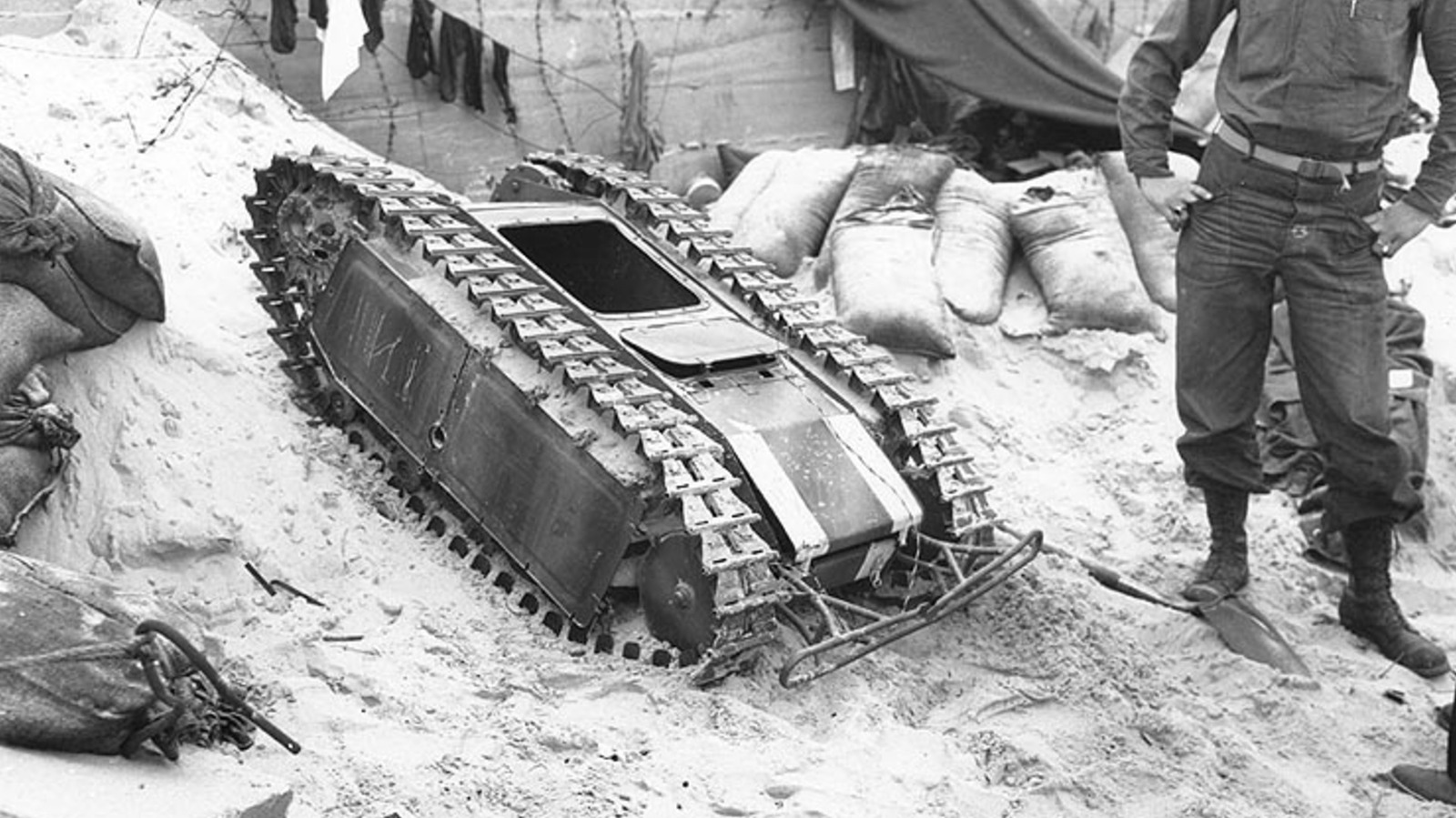
Германы Goliath гинжит мина кабелиар удирдуулдаг, тэсрэх бодис тээвэрлэсэн жижиг төхөөрөмж байлаа; хувилбараасаа хамааран 100–220 фунт тэсрэх бодистой байсан ч цагт дөрвөн милээс бага хурдтай, өртөг өндөр байв. Японы Fugo бөмбөлгөн бөмбөгийг устөрөгчөөр дүүргэж, шатаах болон тэсрэх цэнэг суурилуулан Номхон далайг дамнуулан АНУ руу илгээсэн бөгөөд ийм бөмбөлөг хэдэн мянгаараа хөөргөжээ. АНУ-ын зургаан иргэн ойд олдсон бөмбөг дэлбэрсний улмаас амиа алдсан ч бөмбөлгүүд ой, хотуудад их хэмжээний хохирол учруулаагүй бөгөөд химийн болон биологийн зэвсэг тээвэрлэсэн байж болзошгүйд АНУ анхаарал хандуулж байв.
Британийн Welrod гар буу дуу намсгагчийг гол төмөртөө нэгтгэсэн бөгөөд эхлээд .32 ACP, дараа нь 9 мм-ийн сум ашигладаг байв; нууц ажиллагаанд, ялангуяа харуул болон өндөр ач холбогдолтой байг ойроос устгахад зориулжээ. 1863 онд анх хөөргөсөн, найман хүнтэй CSS Hunley шумбагч завь 1864 оны хоёрдугаар сарын 17-нд USS Housatonic хөлгийг тэсрэх цэнэгээр живүүлсэн нь шумбагч дайсны хөлөг онгоцыг живүүлсэн анхны тохиолдол болсон ч өөрөө мөн живж, багийнхан амь үрэгдсэн байна. Америкийн Иргэний дайны үеийн Billinghurst Requa Battery нь дугуйт сууринд зэрэгцүүлэн байрлуулсан 25 ширхэг .52 калибрын бууны гол төмрөөс бүрдэж, минутанд 175 сум тавих чадалтай байсан ч тулаанд хязгаарлагдмал хэрэглэгдсэн.
Эртний Энэтхэгийн уян, ташуур мэт Urumi сэлэмний ир 60 инч хүртэл урт, зарим загвар нь бариулдаа 10-аас олон иртэй байжээ; ойрын зайд хэрэглэхэд үр дүнтэй ч хэрэглэгч өөрийгөө гэмтээх эрсдэлтэй байсан бөгөөд Каларипаятту тулааны урлагт өнөөдөр ч ашигладаг. Эртний Грекийн Мегара хотыг бүслэх үеэр, НТӨ 266 онд, давирхай түрхэж галласан гахайг Македоны Антигон II Гонатасын дайны заануудын өөдөөс тавьж, үргээсэн тухай тэмдэглэл бий. Заанууд ухрахдаа өөрийн цэргүүдийг гишгэлж байсан ч хожим зааныг гахайд дасган өсгөдөг болсноор энэ аргын үр нөлөө буурсан байж болох юм.
Дэлгэрэнгүйг эх сурвалжаас харах
Эх сурвалжийг нээх ↓
Whether it’s over land, resources, or a petty grudge, warfare has been an unfortunate fact of our existence for as long as we know, and throughout it all, weapons made the difference. While it began with pointy sticks and sharpened rocks, weapons have evolved over time to become more efficient and deadly. However, plenty of new additions to the battlefield also missedthe mark.
History is filled with all manner of strange and unusual means ofeliminating your enemies. Even ones that worked could end up dismissed as “weird,” in spite of their creators’ hopes.This is especially true of WWII;mankind’s largest conflict resulted in the creation of some truly odd weapons designed to capitalize on emerging threats and technology.
However, weird weapons aren’t unique to that one global conflict. Examples of humanity’s ingenuity and faith in the utterly ridiculous stretch back millennia. Each of these weapons was used in combat, either effectively or woefully inadequately, and all of them are incredibly weird.
Vespa 150 TAP
Tanks proved useful across the battlefields of WWII on every major front, and this didn’t escape the notice of the French. After the war, the French introduced the Vespa 150 TAP, essentially an anti-tank scooter. Adding mobility and anti-tank lethality to any conflict is ideal, but having that in the form of scooter seems pretty outlandish.
The so-called “Bazooka Scooter” was designed specifically for French paratroopers, who would use it to ride toward an enemy tank, fire the attached M20 75mm recoilless rifle, and carry on elsewhere. They’d drop alongside or near paratroopers and operation would require two people — person to drive, and another to carry the ammunition. Around 600 were produced between 1956 and 1959, and they saw combat in the French-Algerian War that concluded in 1962.
The Vespa 150 TAP had an effective range of around 21,000 feet, or 4 miles, and could penetrate 100mm of armor. Despite this, its primary use in combat was as an anti-fortification weapon and light vehicle support. Essentially, it was a cheap, fast, and easy means of getting a recoilless rifle into areas where it was otherwise difficult. Ultimately, it was successful, but wasn’t used in the manner for which it was designed.
Messerschmitt Me 163 Komet
Germany is credited with creating the first production fighter jet, the Messerschmitt Me 262 Schwalbe, which began operating in a limited capacity in 1944. Around that same time, it created another fast-moving aircraft, featuring a more unusual shape and design. The Messerschmitt Me 163 Komet was the onlya rocket-powered interceptor ever put into combat operations.
Fighter jets are fast, but rockets are another story, and the Komet was designed to get in the air quickly and close the distance with enemy aircraft before they could attack targets on the ground. In this manner, it worked as designed, boasting a top speed of 596 mph. For comparison, its typical target, the B-29 Superfortress, cruised along at just 366 mph. However, such a speed difference brings with it a risk overshooting your target, and that’s exactly what the Komet did.
The Komet was a little effective, having been credited with downing nine enemy aircraft, thanks to its two Mk.108 30mm cannons, but it wasn’t very maneuverable and had a tough time properly engaging its targets. And because it was rocket-powered, the Komet had only enough fuel for eight minutes of powered flight. Once it ran out, it would be forced to glide back down to its take-off point and start again after refueling, if possible.
The Windkanone
Defending oneself on the ground during WWII required a great deal of ammunition, as German anti-aircraft batteries fired an incredible amount of flak at approaching Allied bombers. While flak was often effective, the prevalence of aerial bombardment led to the development of different means of defending vital infrastructure. One of the most unusual devices created for this purpose was the Windkanone, also known as the Vortex or Wind Cannon.
As the name implies, the Windkanone used wind as its primary ammunition, and the idea revolved around sending a blast of compressed air consisting of a 2:1 ratio of hydrogen and oxygen at incoming aircraft. On paper, that sounds like a great idea, as it’s far cheaper than expending a great deal of ammunition, and disrupting a plane with a blast of wind seems feasible.
One Windkanone was produced after testing, and it was installed on a bridge over the River Elbe in 1945. It attempted to shoot down approaching Allied aircraft, but for it to work, a plane would have to fly incredibly low at altitudes, no higher than around 700 feet. Once in range, the wind “slug” would need to make contact, which proved impossible in each attempt. Ultimately, the Windkanone became one of many crazy military machines invented by Germany during WWII, and like many others, it didn’t work.
Anti-Tank Dogs
Humanity has used animals for military applications throughout history, including using horses and other large animals as mounts; Hannibal crossed the Alps with war elephants; and we’ve trained sea lions and dolphins for various purposes. During WWII, and in the years leading up to the conflict, the Soviet Union used dogs as an unusual and horrific means of taking on enemy tanks. So-called Anti-Tank Dogs were specially trained to seek out enemy tanks, crawl beneath their hulls, and carry explosives that would detonate.
Despite the horrific treatment of the dogs, the concept worked fairly well in several instances. Many of the dogs would do as they were trained, but like any weird weapon, it didn’t always go according to plan. The dogs were trained to identify enemy armor by smell, targeting diesel fumes. Unfortunately, German tanks used gasoline for fuel, so it wasn’t unheard of for a dog to instead sniff out a Soviet tank like the ones they were trained on.
The Soviets reportedly destroyed 300 enemy tanks using Anti-Tank Dogs, though there has never been any verification that this is true. The number is likely inflated, as the Soviets spent years, plenty of money, and a lot of dogs on the tactic and probably wanted to save face among the international community. Regardless, the Soviets and then the Russian Federation continued training dogs for anti-tank warfare until 1996.
The Krummlauf
One of the best concepts that wasn’t executed particularly well during WWII was the Krummlauf, a German StG 44 featuring a curved barrel. The idea was sound: create a gun that made it possible to shoot around corners or from covered positions. And it worked … for the most part. The Krummlauf was made in several angles, including 30, 45, 60, and 90 degrees, while the 30-degree option was the most prevalent.
The problem was that the barrel didn’t last long. Friction from the round caused the barrel to heat up, as is normal in a firearm, but it put more stress on the curved design. This resulted in a device that only functioned for around 300 rounds. Often, the bullets would fracture in the barrel and come out in pieces, which is okay for short distances, but terrible for ranged targets. It didn’t help that the StG 44 entered the war too late to do much for Germany.
While the Krummlauf wasn’t particularly effective in WWII, the concept has since evolved. A modern take on the design has been perfected in the Corner Shot CSM, a complex pistol attachment that does what the Krummlauf advertised. Still, while the Krummlauf was certainly weird, it had its uses and was employed by tank crews and other units on the battlefields of Europe in WWII.
Goliath Tracked Mines
While many people think that drone warfare is a relatively new concept, the practice dates back to the 19th century. Of course, the technology back then wasn’t as impressive as the array of drones you’ll find in military service today, but there were several used during WWII, and one of the weirdest was Germany’s Goliath Tracked Mine. The Allies called them “Beetle Tanks,” and they came in two different versions, one of which was electrically powered, while the other had an engine.
Depending on the model, they carried between 100 and 220 pounds of high-explosives. As you can see from the image, Goliath Tracked Mines had a low profile and tracks for movement. During WWII, Germany used them to drive beneath infrastructure like bridges as well as enemy tanks. Once they were in place, they would detonate. They were controlled via a control box connected by a long cable measuring 2,145 feet, which was used to steer and set off the onboard explosive.
While the design was solid, the technology of the era limited the success of Goliath Tracked Mines. They were slow, managing less than 4 mph, and they were expensive. While most were unsuccessful, the ones that reached targets and detonated proved the concept. There’s no denying the impact they had on the continued evolution of drone design.
Fugo Balloon Bomb
While it’s well known that Japan launched a sneak attack against Pearl Harbor on December 7, 1941, that wasn’t the only time American territory was targeted. Americans led by Lt. Col. Jimmy Doolittle attacked Tokyo, Japan, in April 1942 in response, causing little damage but striking a blow against the Empire of Japan. Unwilling to sit idle while its capital city was attacked, Japan developed the Fugo Balloon Bomb, which it sent in the thousands to the U.S. in response to the Doolittle Raid.
Japan’s Fugo Balloon Bombs were deployed toward the end of the war, and the rather simple devices were essentially large hydrogen balloons armed with incendiary bombs and high-explosive charges. The idea was to float them across the Pacific toward the U.S., where they’d devastate the American population through the terror they brought. The only problem for Japan was that the unguided balloons targeted a country with vast stretches of unpopulated land.
Unfortunately, six American picknickers died when they found one in the woods, and it exploded, so it inadvertently resulted in “enemy” casualties. Typically, American aircraft shot the balloons down before they caused any trouble. In the end, they neither sparked forest fires nor terrorized cities. That said, the U.S. took them seriously, as they could theoretically have been armed with chemical or biological weapons.
The Welrod
An unusual pistol used during WWII was the Welrod, a .32 ACP and later a 9mm gun that had an integrated suppressor built right into the barrel. Typically, suppressors aren’t integrated because they wear out, losing their effectiveness over time. That wasn’t a concern for the British when it came time to develop a pistol for covert forces and members of the French Resistance. The resulting Welrod was used in various locations in Europe.
While it looked weird, the Welrod wasn’t a bad weapon; far from it. Suppressors don’t eliminate the sound of gunfire as they do in the movies, but they do have a measurable reduction in decibels. The Welrod reduced the sound to around 73 decibels,barely more than the level of a speaking voice. A typical 9mm gun fires a round at an average of 160 decibels, so you can see how effective the built-in suppressor was.
Essentially, this was an assassination weapon meant to dispatch sentries and high-value targets, but as a pistol, it was primarily used at close range. While the Welrod was used in WWII, some surviving weapons were also used in the Falklands War and in Operation Desert Storm. There aren’t many left in the world today, but Welrods proved useful against a variety of enemy forces over the years.
CSS Hunley
Submarines have been around far longer than most people realize, as the first submersible vessel arrived in the 17th century. By the 19th century, technology advanced considerably, but the subs of the 1860s were hardly the massive nuclear-powered behemoths we have today. During the American Civil War, the Confederacy operated the H.L. Hunley, better known as the CSS Hunley, an eight-man boat first launched in 1863.
Before it even attempted combat operations, several accidents resulted in sinkings and the deaths of 13 crewmembers, including its inventor, Horace Hunley. Then, on February 17, 1864, it successfully struck the USS Housatonic. The Union sloop-of-war was part of a naval blockade, but the Hunley managed to sink it with a spar torpedo. This marked the first successful sinking of an enemy vessel by a submarine, but the crew didn’t celebrate their victory.
Instead, the Hunley sank alongside its target. It took 131 years to find the wreckage, and after it was discovered, the crew’s fate became clear. Everyone onboard was killed almost instantly upon striking the Housatonic. The Hunley is weird in several ways, though its self-defeating attack is an obvious design flaw. Despite the existence of steam-powered technology, the Hunley was powered by a hand crank, making it slow and difficult to navigate.
The Billinghurst Requa Battery
These days, machine guns can fire thousands of rounds a minute, but it wasn’t always like that. During the American Civil War, several weapons arose that helped develop weapons technology, but they weren’t what we’d consider a machine gun today. One such weapon was the Billinghurst Requa Battery, a rapid-fire weapon consisting of 25 .52 caliber rifle barrels lined up horizontally on a wheeled carriage.
The battery was effectively 25 rifle barrels that could be fired simultaneously, and because it could be reloaded quickly, it had a fire rate of 175 rounds per minute. That’s considerably faster than your standard-issue musket carried by Union personnel during the war — a trained soldier might fire off three rounds a minute. The battery didn’t operate like a musket, however, loaded by a long magazine consisting of 25 cartridge rounds.
The conical bullets weighed around one ounce, while the Minié ball, the Union’s primary infantry round, weighed 1.5 ounces. While moderately effective, the battery only saw limited use in combat during the Civil War. It was an interesting design that moved the needle forward regarding higher rate-of-fire weapons, but it sure looked strange.
Urumi
There are a lot of different types of swords used throughout history, beginning with rudimentary weapons made of arsenical copper dating back around 5,000 years. Most swords follow a similar form, but that’s not the case for the Urumi, a whip sword used in ancient India around 300 BCE, though its true origin remains a mystery. Urumi featured long, flexible blades that extended for up to 60 inches.Some examples featured more than 10 blades attached to a handle.
Urumi were made of steel infused with a small amount of phosphorus, making them thin, strong, and flexible, so they were often wrapped around the waist and worn. This made them easy to conceal and quickly use when needed, but anyone wielding one needed to be trained because a Urumi is one of those weapons that can seriously injure the user just as much as the person it’s used against. Urumi were important to the Indian martial artKalaripayattu.
The blades weren’t ideal for large-scale combat, and instead focused on fighting off enemies in close quarters. Unlike many of the other weapons on this list, Urumi were effective implements, though certainly weird.Kalaripayattu is still practiced today, and its adherents practice with Urumi. A practiced user can employ an Urumi to devastating effect, using flips and rolls as they whip the blade towards their opponent.
Incendiary Pigs
Rome wasn’t shy about using animals in warfare, and there are plenty of records of their use in the Colosseum. Rome also used war dogs and other animals, but one of it’s strangest attempts came in the form of incendiary pigs. At the time, Rome needed a means of combating elephants, which posed significant challenges to foot soldiers. At some point, someone in Rome realized that the elephants were frightened of pig squeals, which resulted in a plan.
To combat oncoming elephants, herds of pigs were coated with pitch, grease, or tar and set alight. They understandably freaked out and ran away from the people who set them on fire, taking them toward the approaching elephants. This happened several times in antiquity, though most notablyduring Siege of Megarain 266 BCE— a battle the Romans weren’t even involved in. The tactic saw the Megarians smear pigs with tar, light them on fire, and successfully drive the elephants of the Macedonian kingAntigonus II Gonatus away from the front lines, off in all directions.
One of the benefits of scaring the elephants was that they often trampled their own troops, killing many as they ran away. Eventually, war elephants were raised alongside pigs to ensure they didn’t become overly frightened in their presence, so the efficacy of incendiary pigs beyond their first few uses in combat is questionable. Still, there are multiple records of incendiary pigs used in battle, placing pigs among the many animals subjected to brutality in the name of war.

