Францын судлаачдын баг эртний Египетийн анхны пирамидыг барихад усны хүч ашигласан байх магадлалтай шинэ таамаглалыг дэвшүүллээ.
Францын материал судлаач Ксавье Ландрогоор ахлуулсан эрдэмтдийн баг PLOS ONE сэтгүүлд нийтлүүлсэн судалгаандаа Саккара дахь Жосерийн шатлалт пирамидыг барихад гидравлик өргөгч систем ашигласан байж болзошгүйг дурджээ. Тэдний таамаглалаар, усны хүчийг ашиглан хүнд жинтэй шохойн чулуун блокуудыг дээш өргөж, пирамидыг үе шаттайгаар өсгөн барьсан байх боломжтой аж. Энэхүү системд тухайн үеийн усны далан болон ус цэвэршүүлэх байгууламжийн үүрэг гүйцэтгэж байсан байж болох байгууламжуудыг ашигласан гэж үзэж байна.

Судлаачид пирамидын баруун талд байрлах “Gisr el-Mudir” хэмээх тэгш өнцөгт чулуун хашааг усны үерээс хамгаалах далан, харин пирамидын цогцолборыг тойрсон гүн шуудууг ус цэвэршүүлэх гурван үе шаттай систем байсан хэмээн тайлбарлажээ. Пирамидын доорх гүн босоо ам болон боржин чулуун хайрцгуудыг усны даралтыг тохируулах хавхлагын үүрэг гүйцэтгэж байсан гэж таамаглаж байгаа бөгөөд энэ нь пирамид баригдсан 2680 оны үед ашиглагдаж байсан байж болох дэвшилтэт технологийн нэг хэлбэр юм.

Гэсэн хэдий ч археологичид болон египет судлаачид энэхүү таамаглалд эргэлзээтэй хандаж байна. Тухайн талбайгаас гидравлик өргөгч төхөөрөмжтэй холбоотой бодит нотолгоо олдоогүй төдийгүй, судлаачдын багт мэргэжлийн археологичид дутагдалтай байгааг шүүмжлэгчид онцолж байна.

Тус багийнхан усны суваг болон пирамидын босоо амуудыг холбосон баримт одоогоор олдоогүй гэдгийг хүлээн зөвшөөрч байгаа юм. Ирээдүйн судалгаагаар “Gisr el-Mudir”-ээс геологийн дээж авч, уг байгууламж усыг хадгалах зориулалттай байсан эсэхийг тогтоох нь энэхүү таамаглалыг батлах эсвэл үгүйсгэх чухал алхам болно гэж эрдэмтэд үзэж байна.
Дэлгэрэнгүйг эх сурвалжаас харах
↓Эх сурвалжийг нээх ↓
Imagine a shaft 28 meters (92 feet) deep filling with water. A wooden float rises, pulling ropes over pulleys to lift a platform loaded with limestone. Drain the shaft, and the float drops while the stone climbs toward the next level of a growing pyramid.
It sounds improbable. Yet a team of French scientists argues that something similar helped build Egypt’s Step Pyramid of Djoser at Saqqara.
Their study in PLOS ONE proposes a hydraulic lift supplied by an ancient dam and a water-treatment system. Archaeologists remain skeptical, but the hypothesis draws on real structures whose purposes are still debated.
A 4,700-Year-Old Construction Mystery
Built around 2680 BC for King Djoser and traditionally credited to architect Imhotep, the six-tiered pyramid rises roughly 60 meters (200 feet). It was Egypt’s first pyramid and an extraordinary early monument of cut stone.
The researchers estimate that it contains more than 2.3 million limestone blocks, averaging 300 kilograms (660 pounds) apiece. Ramps, sledges, ropes and levers could have moved them, but the exact construction method remains uncertain.
Xavier Landreau, a materials scientist and founder of the research institute Paleotechnic, approached the puzzle through Saqqara’s ancient watercourses. His team, including hydrologists and geographers, asked where rainfall would have traveled across the plateau. Their research collaboration led them west of the pyramid.
Was a Mysterious Enclosure Actually a Dam?
There stands the Gisr el-Mudir, a rectangular stone enclosure roughly 360 by 620 meters (1,180 by 2,030 feet), with walls about 15 meters (50 feet) thick. Its original purpose is unknown. Suggested explanations range from a fortress to a ceremonial precinct.
Satellite imagery placed it across the route of the Abusir wadi, a seasonal stream draining approximately 15 square kilometers (6 square miles). Its layered stone, rubble, sand and silt reminded the researchers of Sadd el-Kafara, an ancient Egyptian dam.

They suggest Gisr el-Mudir operated as a check dam, slowing flash floods and trapping sediment. Their published terrain maps illustrate the proposed water route.
But a lifting mechanism would need relatively clean water. The team believes another unexplained structure could have supplied it.
A Treatment Plant Cut Into the Rock?
Djoser’s complex is surrounded by the Dry Moat, a bedrock trench about 3 kilometers (2 miles) long. Along its southern side, the Deep Trench plunges roughly 27 meters (89 feet) while measuring just 3 meters (10 feet) across.
Usually interpreted as a quarry or ritual space, its compartments resemble, to the researchers, a three-stage water-treatment system: a settling basin for sand, a stone-paved retention basin and a purification basin. Four wells might have provided access to stored water.
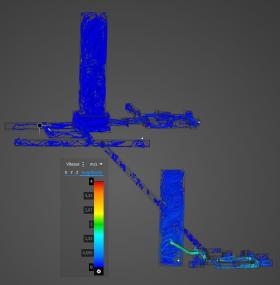
Only about 240 meters (790 feet) of the trench’s probable 410-meter length has been excavated. Later tombs obstruct the rest, complicating further investigation.
The team’s next question was how water could have reached the pyramid itself.
The Granite Box Beneath the Pyramid
Under the pyramid, a shaft descends about 28 meters and measures approximately 7 meters (23 feet) wide. A granite box at its base contains a heavy stone plug. A 200-meter (656-foot) tunnel connects it to another shaft and granite box to the south.
Traditionally regarded as Djoser’s burial chamber, the northern box might instead have functioned as a valve, the authors argue. Its roof joints were mortared, but its side and floor joints were open; grooves in the plug may have held ropes.

Release water into the shaft, the theory goes, and a floating platform could power a lifting arrangement. The pyramid would grow outward from its center, “in a volcano fashion,” as the study describes it. Diagrams in the paper show the proposed machinery.
The authors calculate an upper limit of 18 million cubic meters of water to raise every block from ground level. They estimate that Wadi Taflah to the south could have supplied 4 to 54 million cubic meters over a 20- to 30-year construction period. Ramps may still have handled the lower levels; the lift would operate when water was available.
Why Egyptologists Are Unconvinced
The problem is evidence. No hydraulic lifting equipment has been discovered at the site.
Cambridge geoarchaeologist Judith Bunbury has noted that Egyptians knew hydraulic technologies, but there is no evidence they used such a lift. Critics also question whether rainfall was sufficient and whether a complicated water-powered system would have been preferable to manual methods.
Archaeologist Julia Budka criticized the absence of archaeologists and Egyptologists from the research team. Egyptologist Colin Reader challenged the dam interpretation, drawing a published reply from Landreau and Guillaume Piton.
The authors acknowledge major gaps. No channel connecting the Deep Trench to the pyramid shafts has been found, and part of the northern shaft remains unexplored. They want geological samples from Gisr el-Mudir to test whether it ever held water.
One clue comes from 18th-century maps by French traveler Claude-Étienne Savary. The Wadi Taflah was reportedly “closed by an ancient King of Egypt,” according to a note cited in the study.
Perhaps a buried diversion channel will eventually emerge south of Saqqara. For now, the hydraulic lift remains a provocative theory, not an established explanation.
Enjoyed this article? Subscribe to our free newsletter for engaging stories, exclusive content, and the latest news.