Оросын тийрэлтэт хөдөлгүүрт дроны довтолгоо эрчимжихийн хэрээр Украин саатуулах дрон, хиймэл оюунд суурилсан зэвсэг болон хувийн хэвшлийн оролцоог нэмэгдүүлж байна.
Киевийн Днепр мөрний эрэг дагуу байрласан Украины агаарын довтолгооноос хамгаалах анги голын дагуу нисэн ирж, гүүр болон эрчим хүчний байгууламжид заналхийлж буй Оросын дроныг устгах үүрэгтэй. Гэвч Орос өвөл ойртох үед эрчим хүчний болон иргэний дэд бүтцэд цохилтоо нэмэгдүүлж, барууны түншүүдээс ирэх зэвсгийн нийлүүлэлт тогтворгүй байгаа нь пуужинг хэмнэх шаардлага үүсгэжээ.
Украины зэвсэгт хүчин пуужингийн оронд саатуулах дрон ашиглахыг дайны эхэн үеэс хөгжүүлсэн ч Орос 2024 оноос илүү хурдан тийрэлтэт хөдөлгүүрт дрон нэвтрүүлж, 2026 оны зун олноор ашиглаж эхэлсэн байна. Пропеллерт Shahed дрон цагт ойролцоогоор 180 километрийн хурдтай нисдэг бол тийрэлтэт хувилбар нь цагт 600 километрт хүрч, радарын илрүүлэлтээс зайлсхийх, чиглэлээ огцом өөрчлөх боломжтой. Цэргийн шинжээч Олександр Коваленкогийн тооцоогоор Орос сард 2,500–3,000 тийрэлтэт дрон, мөн Shahed болон Gerbera төрлийн дрон үйлдвэрлэж байна.
Украин өөрийн тийрэлтэт саатуулах дроныг бүтээсэн ч хөдөлгүүрийн хомсдол үйлдвэрлэлийг нь хязгаарлаж байгааг Одесса хотын агаарын довтолгооноос хамгаалах албаны төлөөлөгч хэлжээ. Зөөврийн зенит пуужингаар байг устгах хугацаа зарим тохиолдолд хэдхэн секунд байдаг тул ангиуд нэг байрлалд тав, арав биш, заримдаа ганцхан пуужинтай ажиллаж байна. Коваленкогийн мэдээлснээр саатуулах үзүүлэлт Киев орчимд 75 хувьд хүрдэг бол Одессад таван хувь хүртэл буурчээ.
Үүний зэрэгцээ Украин хиймэл оюун ухаанаар туслуулсан алсын удирдлагатай пулемётын цамхаг зэрэг хамгаалалтын шийдлийг нэвтрүүлж байна. Харьковт төвтэй Carmine Sky компанийн операторууд дэлгэцээр агаарын орчныг ажиглан, тус бүр гурван цамхгийг удирддаг бөгөөд систем нь дроныг илрүүлэх, онилолтыг засахад тусалдаг. Компанийн 70 орчим харилцагчийн 80 хувь нь хувийн хэвшлийнх бөгөөд түүний систем баллистик пуужингаас бусад агаарын олон төрлийн аюулаас хамгаалах боломжтой гэж компанийн тэргүүн Руслан Домбадзе мэдэгджээ.
Дэлгэрэнгүйг эх сурвалжаас харах
↓Эх сурвалжийг нээх ↓
Outskirts of Kyiv, Ukraine
|
Nov. 09, 2026, 1:57 p.m. ET
|
5 min read
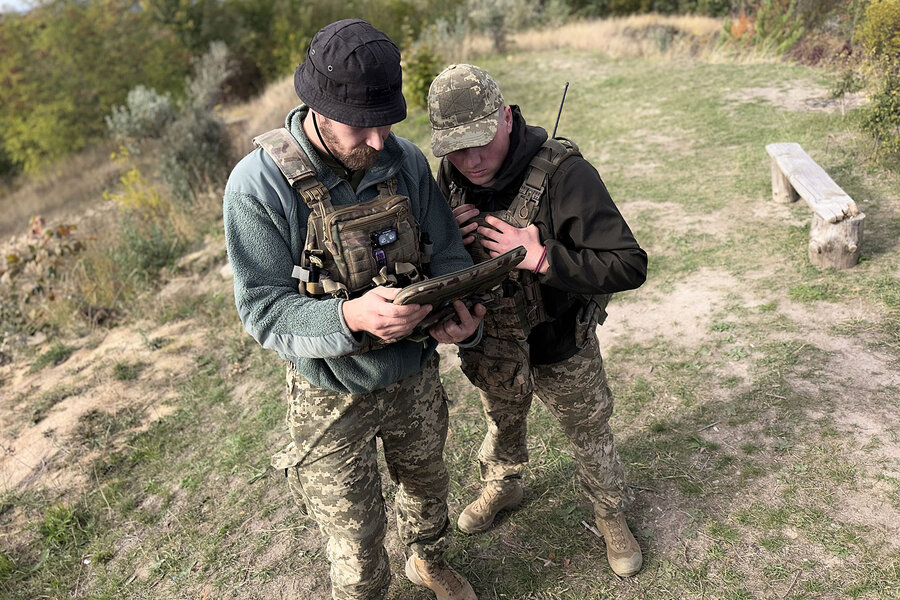
Outside his base, Oleksii takes a break from defending the Ukrainian capital to eat an apple from his mother’s garden. From his unit’s vantage point along the Dnieper River, he can shoot down Russian drones that use the waterway as an approach corridor against the bridges that span its banks.
He is good at his job, as a makeshift trophy kept in a sack inside the base attests: the crumpled remains of a jet-engine drone. He brought it down with a clean shot. “It felt routine,” says Oleksii, who like many Ukrainian service members, only gave his first name and his call sign, Tourist. “I was happy I didn’t waste the rocket.”
Oleksii’s three-person unit within the Antiaircraft Battalion Separate Presidential Brigade, and those like his, face one of Ukraine’s most daunting challenges: how to sustainably defend cities against an expanding and ever-evolving Russian drone arsenal, employed alongside devastating missile strikes. The job is getting harder, as Russia intensifies its attacks on Ukrainian power stations and civilian infrastructure ahead of winter’s approach. At the same time, supplies from Western partners are being delivered erratically and sometimes are of questionable quality, putting pressure on soldiers to use weapons sparingly.
Ukrainians are increasingly relying on their own ingenuity to bolster their efficiency and fill the gaps. That includes scaling up domestic production of interceptor drones and weapons assisted by artificial intelligence, and blurring the lines between civilian and military responsibility for defending the skies.
“There is a chain of AI-controlled turrets across the city,” says Vasyl, call sign Raccoon. He is the commander of Oleksii’s unit, which is responsible for defending a 10-kilometer (6.2-mile) stretch of the capital and its power stations. “If they cannot intercept the jet drone and it comes from our direction, then we have to be ready to intercept.”
Valentyn Ogirenko/Reuters
A Russian jet-powered drone hits one of Kyiv’s bridges, Oct. 2, 2026.
“We need to be 100% effective”
Early in the war, Ukraine developed interceptor drones as an alternative to using missiles, which were expensive and scarce. But Russia introduced faster, jet-powered attack drones in 2024, bringing the drone arms race to a new level. Few anticipated how quickly Russia would be able to scale up the new drones’ deployment; by summer 2026, they were being launched in overwhelming swarms.
Speed and altitude make jet-powered drones harder to intercept. While conventional Iranian-designed, propeller-driven Shahed drones fly around 180 kilometers per hour (110 mph), newer jet-powered variants can reach 600 kph (370 mph), putting them beyond the capabilities of most Ukrainian-made interceptor drones and mobile machine gun units.
When flying low, jet-powered drones can escape radar detection. At higher altitudes, they operate beyond the reach of shoulder-fired missiles and smaller antiaircraft systems. Their ability to rapidly change course compounds the challenge of bringing them down.
Ukraine has already developed its own jet-powered interceptor drones. But mass production, according to an Odesa-based Ukrainian air defense officer who spoke on condition of anonymity, is being held back by a critical shortage of engines. Ukraine, like Russia, relies heavily on Chinese-made components, but Beijing has restricted their sale.
Efrem Lukatsky/AP
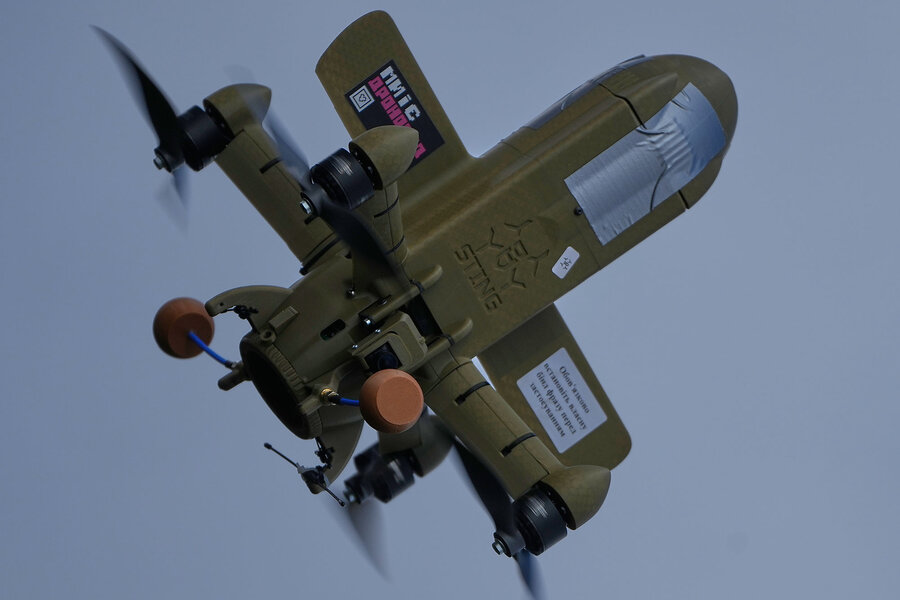
A Sting interceptor drone flies during drills in the Kyiv region, Ukraine, March 19, 2026.
That puts immense pressure on air defense teams to make sure that every shoulder-fired missile they fire at a drone hits its target. That’s not easy; with such weapons, they have as few as six seconds to intercept a cruise missile and under a minute to neutralize a jet-powered drone. “We need to be 100% effective in every shot that we take,” says the air defense officer. “Normally we would have five or 10 Stinger-type missiles at a position. Instead, we just have one.”
Russia, meanwhile, has dramatically expanded production of Iranian-designed Shahed drones at a sprawling industrial complex in Tatarstan. Military analyst Oleksandr Kovalenko says Russia currently produces between 2,500 and 3,000 jet drones a month, alongside 135 regular Shahed drones and Gerbera drones, which are widely used as decoys. “The big player and the big problem here is China,” he says. “China helps Russia solve all its technological and technical issues.”
Russia’s rapid drone output is testing whether Ukraine can develop defenses quickly and efficiently enough to keep pace. The pressure is particularly acute in Odesa and the surrounding Black Sea region, which defense specialists describe as a proving ground for new Russian drone technology.
Unlike Kyiv, where incoming drones can often be tracked as they cross other regions, Odesa has little warning of aircraft approaching from the sea. Interception rates are improving but remain uneven, says Mr. Kovalenko. They are as high as 75% around Kyiv and as low as 5% in Odesa, where a drone traveling over 800 kph (497 mph) was recently detected.
Air defense as a business
In a dimly lit basement in Kharkiv, a different kind of air defense monitoring is underway.
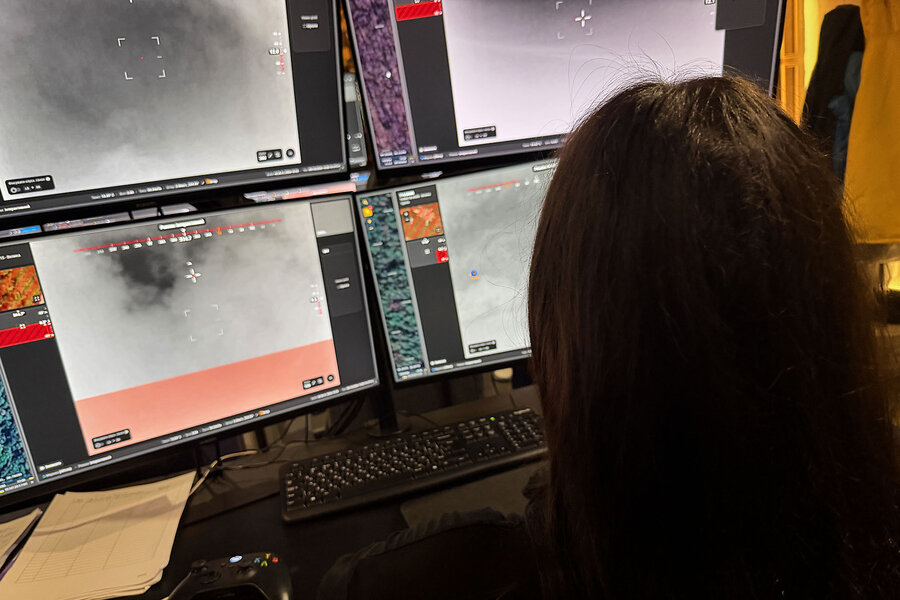
The underground headquarters of private air defense company Carmine Sky has the feel of a futuristic urban hideout. Young men and women sit before banks of screens, remotely scanning the skies across Ukraine. Each operator controls three gun turrets and is assisted by AI, which tracks incoming drones and helps correct gunner aim. They are part of a growing network of automated defenses designed to intercept Russian drones before they reach critical infrastructure.
Dominique Soguel
A woman monitors Russian incoming airborne attacks, ready to intercept them remotely with AI-assisted heavy machine gun turrets, in Kharkiv, Ukraine, Oct. 9, 2026.
Carmine Sky is run by Ruslan Dombadze, a Kharkiv native whose eclectic career has taken him from medicine to IT management to policing and military service. The future, Mr. Dombadze says, belongs to artificial intelligence, remote-controlled weapons, and private investment increasingly supplementing conventional military systems. The company cooperates with the government, but 80% of its 70 or so clients are in the private sector.
“Demand is high because of how the war is evolving,” says Mr. Dombadze. “The drone component is very high in this war, and it is only going up.”
Deepen your worldview
with Monitor Highlights.
Politics with respect
Get political stories with respectful analysis.
There‘s a world of new ideas in every
Books newsletter.
There‘s more to life, enrich yours with
Culture & Learning weekly.
Follow humanity‘s discoveries with
Science & Nature stories in your inbox.
Gain a spiritual perspective
from the stories in your inbox.
Want to understand the deeper impact of critical events? Learn the Monitor‘s insight.
Already a subscriber?Log in to hide ads.
He says the company’s systems can protect against almost every type of aerial threat short of ballistic missiles. And that, too, is a gap that other actors in the defense landscape hope to close with separate projects to develop their own version of Patriot missiles.
For Mr. Dombadze, the motivation is personal. He tested his business’s service by defending a 4-kilometer stretch of Kharkiv. That line has since grown to 22 kilometers. “My main driver is for all my family, friends, and all their loved ones to have a tomorrow,” he says. “We have lost too many people. I want my city to have a tomorrow.”

