
Монголын эзэнт гүрэн нь 22 сая орчим хавтгай дөрвөлжин километр нутаг дэвсгэрийг эзэлж байсан дэлхийн түүхэн дэх хамгийн том хуурай газрын эзэнт гүрэн байсан бөгөөд “Pax Mongolica” буюу Монголын энх тайван нь энэхүү асар том гүрний хүрээнд алс холын аялал жуулчлалыг аюулгүй болгож, улмаар олон соёл иргэншлийн хоорондох худалдаа, харилцааг хөгжүүлсэн үйл явцыг илэрхийлдэг.
Монголчууд анхнаасаа асар том эзэнт гүрэн байгуулах зорилго тавиагүй байв. Чингис хаан (хаанчилсан нь 1207-1227) 1210-аад оноос Хойд Хятадаас эхлэн аажмаар байлдан дагуулж, 1220 он гэхэд Төв Азийн ихэнх хэсгийг өөрийн мэдэлд оруулсан байна. Түүний залгамжлагчид байлдан дагуулалтыг үргэлжлүүлсээр 1274 он гэхэд эзэнт гүрнийг хамгийн өргөн уудам хэмжээнд нь хүргэжээ. Тухайн үед Чингис хааны удмын нэг гэр бүл Солонгосоос Украин хүртэлх Евразийн өргөн уудам нутгийг захирч, Хятад, Перс, Киевийн Русь, Аббасидын халифат зэрэг эртний болон олон янзын соёлыг нэгтгэж байв.
Монголчууд энэхүү өргөн уудам нутгийг туйлын харгис хэрцгий аргаар байлдан дагуулжээ. Дайны хөлд амиа алдсан хүмүүсийн тоог нарийн тогтоох боломжгүй ч түүхчид Төв Азийн хүчирхэг гүрэн болох Хорезмын эзэнт гүрнийг эзлэх явцад л 1.25 сая хүн амиа алдсан гэж үздэг. Багдадыг эзлэх үед 800,000 хүн алагдаж, монголчууд Исламын суртал номлолын төвийг устгасан байна. Мерв хотыг эзлэхдээ 150,000 номыг устгасан гэх мэдээ бий. Тэдний хэрэглэж байсан тактикууд нь маш харгис байсан бөгөөд хотын хамгаалалтын эхний давлагаанд олзлогдсон иргэдийг “хүний бамбай” болгон ашиглаж, хамгаалагчид нь хөрш зэргэлдээх болон төрөл садангаа буудахаас татгалзана гэдгийг мэдэж байв. Бүр байлдан дагуулсны дараа ч энгийн иргэд аюулгүй байгаагүй бөгөөд нэгэн удаа монгол захирагчид тариачдыг ургацаа хураахыг зөвшөөрөөд, хурааж дууссаны дараа нь тэднийг бүгдийг нь хөнөөсөн тохиолдол ч гарч байжээ.
Монголын эзэнт гүрэн асар том, хүчирхэг байсан ч удаан оршин тогтносонгүй. Хубилай хааны (хаанчилсан нь 1260-1294) үед харъяат хаад бие даасан байдалтай болж, Хятад болон Монгол дахь Юань улс, Төв Азийн Цагаадайн улс, Орос дахь Алтан Ордны улс, Иран дахь Ил хаант улс гэсэн дөрвөн жижиг улс болон салжээ.
Хэдийгээр сүйрлээр дүүрэн, богино настай эзэнт гүрэн байсан ч энэ нь соёл хоорондын солилцоог дэмжээгүй гэсэн үг биш юм. “Pax Mongolica” нь эзэнт гүрэн задарсны дараа ч үргэлжилсэн бөгөөд залгамжлагч улсууд нь нэгдмэл байдлыг хадгалж, худалдааны аюулгүй байдлыг хангах тал дээр хамтран ажилласаар байв. “Pax Mongolica”-гийн жинхэнэ төгсгөл 1350-иад онд Юань улс болон Ил хаант улс мөхсөнөөр ирсэн юм. Монголчууд засгийн эрхэнд гарсныхаа дараа бусад соёлыг устгах сонирхолгүй байсан нь чухал ач холбогдолтой байв. Ийнхүү зуу орчим жилийн турш “Pax Mongolica” нь олон газар нутаг, ард түмэн, соёлыг холбож, харилцаа холбоо, худалдаа, санаа бодлын солилцоог идэвхтэй өрнүүлжээ.
“Pax Mongolica”-гийн засаг захиргаа ба худалдаа
Хүмүүс монголын ордонд цуглардаг байсан ч монголчууд өөрийн эзэнт гүрэнд юу болж байгааг мэдэж байх тал дээр гаршсан байв. Тэнгэр баганадсан тал нутгаас гаралтай гэгддэг эдгээр “зэрлэгүүд” байлдан дагуулсан газар нутгаа захирахын тулд юу хийх хэрэгтэйгээ хурдан сурчээ. Чингис хаан Баруун Ся болон Алтан улсын (өнөөгийн Хойд Хятад) нутгийг эзэлснийхээ дараа тэднийг орхих бодолгүй байв. Тэрээр газар нутаг, ард түмнээ зохион байгуулалтад оруулж, татвараа цагт нь төлүүлэх, арми
Дэлгэрэнгүйг эх сурвалжаас харах
↓Эх сурвалжийг нээх ↓
The Mongol Empire was the largest land empire in world history, at about 22,000,000 square kilometers (850,000 square miles). The term Pax Mongolica (Mongol Peace) refers to the way this massive empire enabled safe long-distance travel, which in turn promoted trade and contact between many different cultures.
The Mongol conquerors did not start out with the aim of creating a vast empire. Instead, Genghis Khan (reign 1207-1227) gradually accumulated conquests, starting from Northern China in the 1210s and encompassing most of Central Asia by 1220. His successors continued to expand, pushing the empire to its greatest extent by 1274. At that time, a single family – the descendants of Genghis – ruled an empire stretching across Eurasia, from Korea to Ukraine, taking in cultures as ancient and varied as China, Persia, the Kievan Rus, and the Abbasid Caliphate.
The Pax Mongolica lasted beyond the collapse of the united Mongol Empire, especially when ensuring safe trade.
They conquered this vast area with extreme brutality. The full number of people killed in the campaigns is impossible to know, but historians estimate that 1.25 million people were killed in the conquest of the Khwarazmian Empire – then a great power in Central Asia – alone. Another 800,000 were killed in the conquest of Baghdad, where Mongol invaders also destroyed the centre of Islamic learning. Mongols destroyed another 150,000 books when they took Merv. Some of the tactics they used were extremely brutal, such as using captive populations as human shields, sending them in the first wave against city defences in the knowledge that the defenders would be reluctant to shoot at their neighbours and kin. Even once conquered, ordinary people were not safe: in at least one case, the new Mongol rulers encouraged peasants to grow their crops as normal, only to kill them once the harvest was done.
Although gigantic and powerful, the Mongol Empire did not last long. By the reign of Kublai Khan (reign 1260-1294), the various subordinate khans were already growing independent, forming smaller successor states: the Yuan Dynasty in China and Mongolia, the Chagatai Khanate in Central Asia, the Golden Horde in Russia, and the Ilkhanate in Iran.
A violently destructive and short-lived empire does not seem like it would encourage peaceful intercultural exchange. However, the Pax Mongolica lasted beyond the collapse of the united Mongol Empire, for the successor states still shared a sense of identity and were open to cooperation with one another, especially when ensuring safe trade. The real end of Pax Mongolica came when the Yuan Dynasty and Ilkhanate collapsed in the 1350s. More importantly, once the Mongols were firmly in power, they had no interest in wiping out other cultures. So, for around a hundred years, the Pax Mongolica knitted together many lands, peoples, and cultures, encouraging communication, trade, and the exchange of ideas.
Administration & Trade in the Pax Mongolica
People flocked to the Mongol courts, as we shall see, but the Mongols were also masters at keeping themselves informed of what was going on in their empire. First, these supposed barbarians from the steppes quickly learned what they needed to do to administer their conquered lands. Once Genghis Khan captured the lands of the Western Xia and Jin Dynasties – now in Northern China – he had no intention of giving them up. He knew he had to organise his lands and peoples, ensure that their taxes were paid on time and that they sent recruits to his armies. That meant establishing a bureaucracy, just like the one in China. So, he hired Yelu Chucai, an experienced administrator in the Chinese tradition. (Yelu Chucai is the first example of a non-Mongol recruited into a high office for his specialist skills, but there are many more later.)
His project was a great success, and Genghis’ son, Ögedei Khan (reign 1229-1241), massively expanded it. He also expanded the yam system. This was a kind of ‘pony express’ crossed with a truck stop: way stations where anyone with a pass could get a fresh horse or a bed and meal. The families who lived nearby kept the yam stations running instead of paying taxes, and patrols guarded the routes between them. The yam system reached its greatest extent and efficiency during the reign of Möngke Khan (reign 1251-1259) (Ögedei’s successor but one), and it did not stop running after the empire had divided into its four parts. It was said that a virgin carrying gold or gold urn filled with jewels could walk from one end of the empire to another without being molested. Perhaps an exaggeration, but the yam certainly let a message pass from one side of Asia, say Korea, to the other, say Persia, at unprecedented speed, with unprecedented reliability. These were excellent conditions for trade.
An Audience with Mongke Khan
Despite his reputation as a force of destruction, Genghis Khan took a particular interest in trade. He attracted merchants to his new capital (Karakorum) by deliberately paying higher prices and then, once it was well established as a trade hub, let the prices fall to normal levels. Genghis even started a war with the premier empire of Central Asia, Khwarazm, after they seized a caravan in which he had invested (1218). That war completely destroyed Khwarazm and probably killed over a million people.
Other Mongol notables, including women, formed investment partnerships called ortaghs with merchants. These merchants were mainly Muslim, another example of Mongols using talent wherever they found it, regardless of culture or religion. Such rich and powerful Mongols could give a paiza to their favoured merchants. A paiza let the bearer ignore tolls, and even use the yam system. That led to some extremely corrupt practices which all but destroyed the yam system, until Möngke successfully banned the abuses.
Möngke’s reign, and Kublai’s after him, were the golden age of the Eurasian caravan trade (roughly 1250-1300), but they set patterns that lasted long afterwards. For example, the famous blue-and-white Chinese porcelain was traditionally created with cobalt, and that became much easier to access as trade with the Middle East bloomed. Although blue-and-white porcelain was not invented under Mongol rule, the Yuan dynasty enabled production of such porcelain to boom, and so that is when it became so important in Chinese culture. Trade also profoundly impacted those outside the empire, especially in India and Southeast Asia, and even in Europe. While Europe had long imported silk, spices, and porcelain, these goods became much cheaper and more abundant.
Exchanging Ideas: Religion, Philosophy, & Weapons
Ideas flowed more easily, too. We have already seen how experts from different parts of the empire, with many different cultures and religions, were employed by Mongols. Consequently, their courts became places where people with widely different perspectives could exchange and debate. Kublai Khan’s cosmopolitan court hosted a Persian chief minister, a Tibetan lama, and the Venetian Marco Polo, alongside Nestorian Christian sherbet makers and many others. It was well known that Kublai Khan suffered from gout, so many doctors arrived at his court in hope of winning favour by curing him. During this time, the practice of acupuncture travelled from China to the Middle East, while medicine based on the Greek system developed by Galen travelled from the Middle East to China. Galenic medicine uses opium as a curative, so the Chinese began to cultivate opium, with profound consequences for Chinese culture and history. Meanwhile, cuisine was spreading, too. One dramatic example is how pasta from the Middle East became Chinese noodles.
Kublai Khan Statue 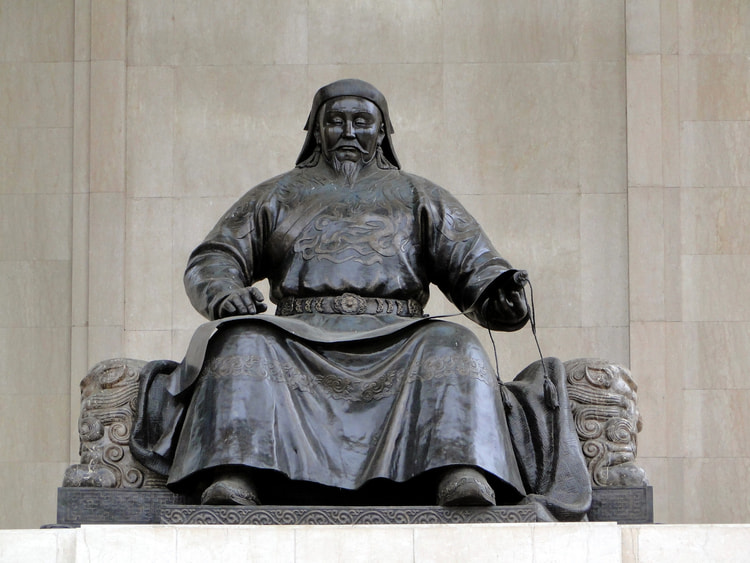
Some of the ideas that spread through the Pax Mongolica were more abstract, like religion. The Mongol Empire enabled the expansion of Islam in Central Asia, especially after the conversion of the Chagatai Khans in 1326, as well as into China. In addition, Mongol rule in China fostered certain kinds of Buddhism there and reintroduced Confucian learning to the north and Korea. Some philosophers also developed new ideas in response to the Mongol multiculturalism. Rashid al-Din Hamadani, a Persian official in the Ilkhanate, wrote a universal history, aspiring to create a single, unified account from the traditional histories from the Islamic world, Judaism, the Chinese canon (as well as others). The vast diversity of the Mongol Empire not only enabled Rashid al-Din to access texts and ask local experts from across Asia in order to write his book but also to make a leap of imagination. Traditionally, peoples kept their own histories divided from one another, so they thought of themselves as separate worlds. The universal history imagined people belonging to a single world, united in a single story. Many modern historians consider Rashid al-Din’s history the most useful single primary source about the whole era.
As we have seen, Mongol rulers tolerated the ideas and perspectives of non-Mongols, and even encouraged them when they thought they would be useful. Despite their interest in trade, administration, and religion, however, the most useful idea to a Mongol khan would always be a military one. Mongol warfare used the equipment, tactics, and organisational principles of the peoples of their empire to gain whatever advantage they could in war. For instance, Kublai Khan could easily import the counterweight trebuchet from his family’s conquests in the Middle East – where it was invented – to help him conquer the walled cities of the Song dynasty in southern China.
In the other direction, the Mongols probably brought gunpowder from China into the Islamic world. Some historians believe that there is evidence that the Mongols used gunpowder weapons in their wars against Islamic powers, and even against European Christians, but this is controversial. What is certain is that the earliest references to gunpowder weapons appear in the Middle East and Europe during the height of the Mongol Empire. Furthermore, the weapons seem to have suddenly appeared in those places in a mature form, rather than slowly developing. It is likely, then, that the influence of the Mongol Empire first brought gunpowder weapons to the attention of the Islamic and Christian powers. Gunpowder is just another way in which the enormous, powerful, and wealthy Mongol Empire influenced places far beyond its borders, and history far beyond its own span.

