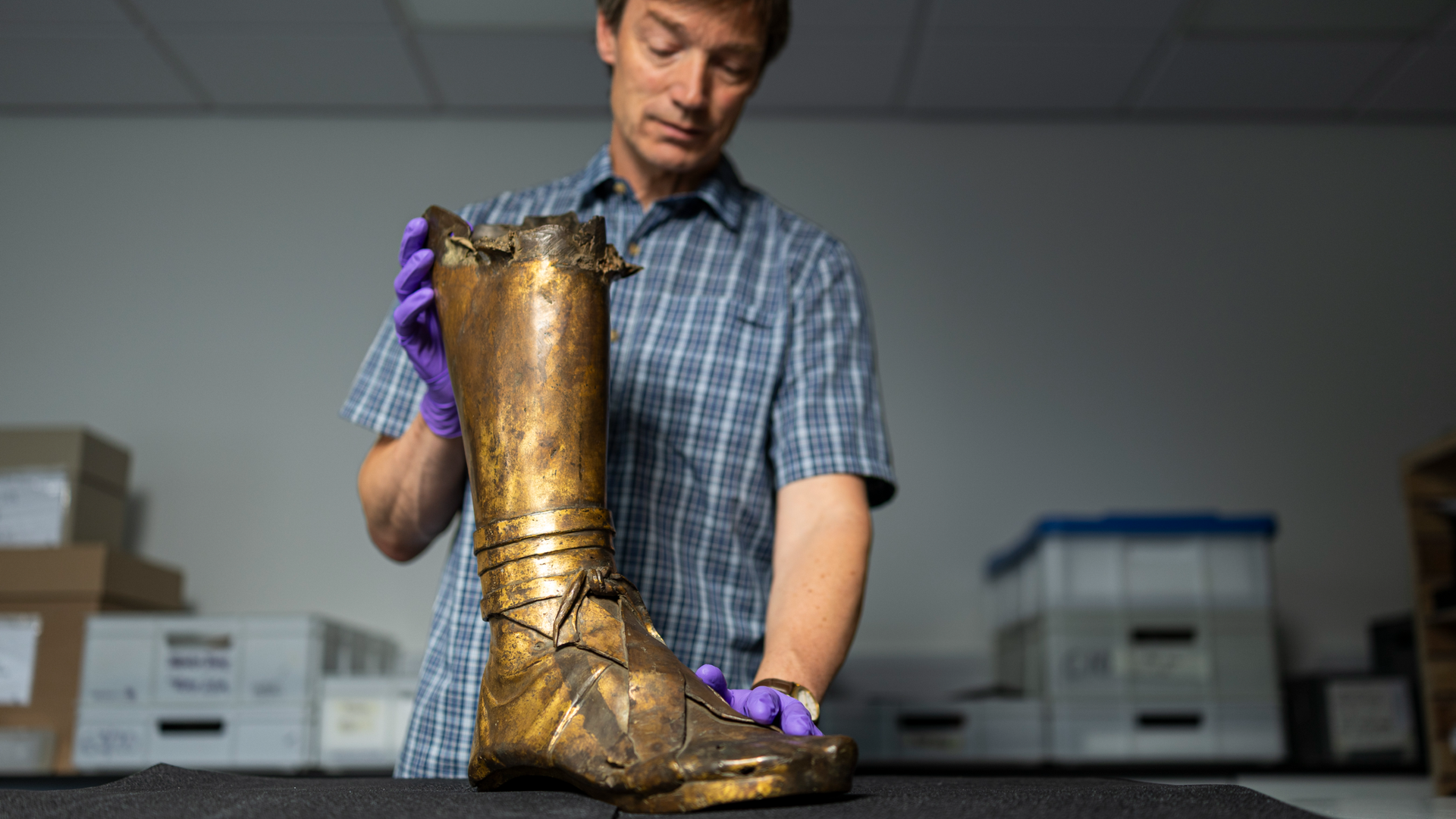
Археологичид Шотландын нутгаас 1800 гаруй жилийн настай эзэн хаан Антонин Пийн морьтой хөшөөний хэсгийг олж илрүүлэн, түүний анхны төрхийг сэргээн бүтээлээ.
1820 онд намгаас олдсон алтадмал хүрэл хөл нь Шотландын нутаг дэвсгэрээс олдсон Ромын эзэн хааны цорын ганц хөшөөний үлдэгдэл юм. МЭ 140 оны орчимд бүтээгдсэн энэхүү хөшөөг анх Ромын эзэнт гүрний хилийн дагуух цэргийн бэхлэлтэд байрлуулж байсан хэмээн судлаачид үзэж байна. Хөшөөний үлдэгдлийг нарийвчлан шинжлэхэд огтлох, эвдэх ул мөр илрээгүй нь Ромчууд Шотландаас ухрах үедээ хөшөөг гамтайгаар буулгаж авсныг гэрчилж байна.
Эзэн хаан Антонин Пий (МЭ 138-161) өөрийн өмнөх хаан Адрианы байгуулсан ханаас хойш, Шотландын өмнөд хэсэгт Антонин Пийн ханыг бариулж, эзэнт гүрний хил хязгаарыг тэлэх бодлого баримталж байжээ. Үндэсний музейн археологич Фрэзер Хантер хэлэхдээ, энэхүү олдвор нь Ромчууд Шотландыг эзлэх хоёр дахь оролдлогоо хэрхэн чухалчилж байсныг харуулж байна гэлээ.
Одоогоор хөшөөний үлдсэн хэсэг хаана байгаа нь тодорхойгүй байгаа бөгөөд олдсон хэсгийг 11 дүгээр сарын 14-нөөс эхлэн Шотландын үндэсний музейн “Ромын Шотланд: Эзэнт гүрний хязгаар дахь амьдрал” үзэсгэлэнд олон нийтэд дэлгэнэ.
Дэлгэрэнгүйг эх сурвалжаас харах
↓Эх сурвалжийг нээх ↓
All that remains of a larger-than-life statue of the Roman emperor Antoninus Pius once erected in Scotland is a lower right leg. Experts have now reconstructed what the entire sculpture looked like but are still unsure why it was carefully dismantled over 1,800 years ago.
The gold-covered bronze foot and calf, also known as the Milsington leg, was discovered in a bog in 1820, according to a Nov. 12 statement from National Museums Scotland. It is the only example of a monumental Roman emperor statue ever found in Scotland and was likely made around A.D. 140.
Initially, experts thought the bronze statue had been looted from York, England, which was founded by the Romans in A.D. 71 as the town of Eboracum. But as research into the Roman frontier advanced over the years, it became clear that equestrian statues were often set up in forts along the border of the Roman Empire.
This lower leg, experts now believe, originally came from an equestrian statue of Emperor Antoninus Pius that was similar to the famous statue of Marcus Aurelius in Rome.
Antoninus Pius was Roman emperor from A.D. 138 to 161, succeeding Hadrian, who had built an enormous wall to defend the northernmost limit of the Roman Empire. To add to Rome’s territory, Antoninus Pius directed the imperial governor of Roman Britain to move north, invade southern Scotland and build a second wall, called the Antonine Wall. But that wall was left undefended after Antoninus Pius died, and the Romans retreated from Scotland.
During that retreat, the Romans may have dismantled any valuable statues that they had set up, according to the statement. An examination of the Milsington leg ahead of a new exhibition showed that the bronze had no cut marks, suggesting it was removed carefully and not “brutally hacked off.”
“This contrasts with examples of statues being deliberately destroyed after a battle, when an emperor’s memory was condemned, or when they were chopped up for scrap,” according to National Museums Scotland.
With the Scottish provenance firmly established, National Museums Scotland curators were able to learn more about Antoninus Pius and his approach to imperial expansion.
“This really turns on its head our understanding of Rome’s second attempt at conquering Scotland,” Fraser Hunter, principal curator of prehistoric art and Roman archaeology at National Museums Scotland, said in the statement. “This was a big deal for the Emperor, something which was worth celebrating.”
But while the boot-clad bronze leg provides a glimpse into the monuments that may have graced southern Scotland nearly two millennia ago, it raises an important question for Hunter: Where is the rest of the statue?
The Milsington leg, the Inveresk Mithras altars and other Roman-period finds are on display beginning Nov. 14 in the exhibit “Roman Scotland: Life on the Edge of Empire” at the National Museum of Scotland.
From Augustus to Nero, see how much you know about ancient Rome’s famous leaders with our Roman emperor quiz!

