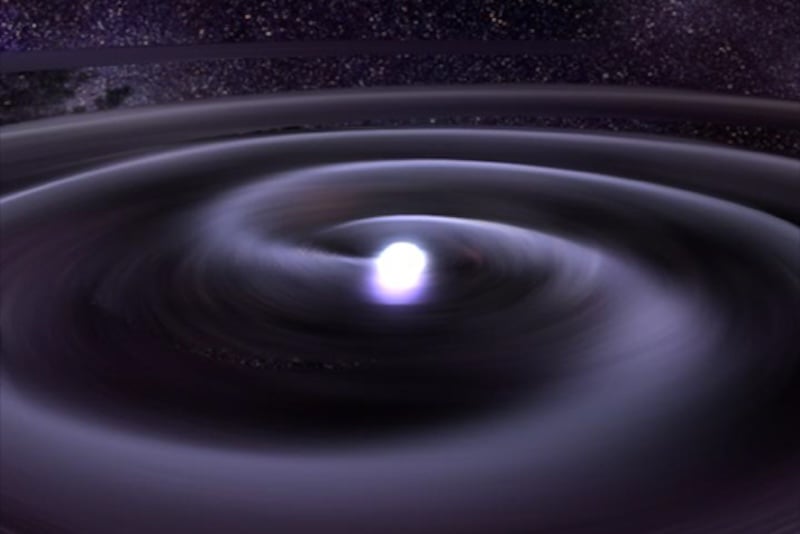
Эрдэмтэд таталцлын онолуудыг нэгтгэн, Дэлхий-Сарны системийн түрлэгийн хөдөлгөөнөөс таталцлын долгионы ул мөрийг илрүүлэх боломжтой загварыг боловсруулжээ.
1687 онд Исаак Ньютоны дэвшүүлсэн таталцлын онол олон зууны турш Дэлхийн түрлэгийн хөдөлгөөнийг тайлбарлах шинжлэх ухааны гол үндэс байсаар ирсэн. Гэвч Альберт Эйнштейний Харьцангуйн ерөнхий онол нь таталцлыг илүү динамик, орон зай-цаг хугацааны өөрчлөлт болох долгион хэлбэрээр тархдаг болохыг харуулсан юм. Freie Universität Berlin-ийн судлаач Мухиттин Женк Эсер Ньютоны түрлэгийн сонгодог загварыг таталцлын долгионы хөндлөн туйлшралтай нэгтгэсэн шинэ загварыг боловсруулжээ.
Таталцлын долгион нь хар нүх эсвэл нейтрон оддын мөргөлдөөн зэрэг асар том биетүүдийн харилцан үйлчлэлээс үүсдэг орон зай-цаг хугацааны хэлбэлзэл юм. Энэхүү судалгаа нь Дэлхий, Сар, Нарны харилцан үйлчлэлийн үр дүнд үүсэж болох илүү жижиг хэмжээний таталцлын долгионыг илрүүлэх онолын үндэс суурийг тавьж байна. Эсерын тайлбарласнаар, энэхүү загвар нь шинэ таталцлын нөлөөг нээх бус, харин таталцлын долгионыг илүү чиглэлтэйгээр хайх боломжийг олгож буй юм.
Судалгааны явцад хэмжилтийн алдаа, лавлагааны систем сонголт болон Нар, Сарны байршлын тооцооллын тодорхой бус байдлыг ялгаж салгах нь гол сорилт болсон байна. Гэсэн хэдий ч Дэлхий-Сарны системийн түрлэгийн нөлөөг маш нарийн тодорхойлж, хэмжих боломжтой тул энэ нь таталцлын долгионыг судлахад хамгийн тохиромжтой талбар гэж үзжээ. Ингэснээр Ньютоны таталцлын онолоос гажсан түрлэгийн хэв маягийг илрүүлэх тоон үндэслэл бүрдэж байна.
Дэлгэрэнгүйг эх сурвалжаас харах
Эх сурвалжийг нээх ↓
In 1687, Sir Isaac Newton released his magnum opus, Philosophiæ Naturalis Principia Mathematica (The Mathematical Principles of Natural Philosophy), in which he described his theories of motion and gravity. His theory of the latter accurately described the motion of the Earth’s tides, something that scientists had been wrestling with for centuries. For over three hundred years, Newton’s work remained scientific canon and the last word on gravity, until Albert Einstein introduced his Theory of General Relativity.
According to a recent study from the Freie Universität Berlin (FUB), some hints of General Relativity (GR) may be buried within Newton’s tidal theories. While the pull of the Sun and Moon and their influence on the tides can be predicted very accurately using Newtonian gravity, GR offers a fuller description that includes gravitational waves (GWs). The new study merges these two theories into a single model that could offer a new way to test our understanding of gravity.
The study was authored by Muhittin Cenk Eser, a mathematician in the Department of Mathematics and Computer Science at FUB. His work extends the classical model of lunar tides to include the cross polarization of gravitational waves, one of the key ways GWs can deform spacetime as they pass through. As he explained in a FUB press release:
Isaac Newton explains the tides extremely well. Albert Einstein shows us that gravity is also dynamic and that changes in spacetime can propagate as waves. Our work brings both perspectives together and asks what traces of this might be found in high-precision measurements.
GWs were originally predicted by Einstein’s Theory of General Relativity and refer to ripples in spacetime caused by the merger of massive objects. To date, thousands of GW events have been detected, the majority of which were caused by the merger of black holes or neutron stars. However, GWs can also result from smaller gravitational interactions, such as those produced by the interactions of the Earth, Moon, and Sun.
One issue addressed by Eser’s study is the difficulty of distinguishing possible additional signals from measurement errors, the choice of reference frame, and uncertainties in calculating the positions of the Sun and Moon. By identifying which influences must be accounted for, Eser shows how a signal could be isolated and the possible physical effects identified. The study therefore presents a quantitative basis for future studies of tidal patterns that deviate from what Newtonian Gravity predicts. Said Eser:
We are not claiming to have discovered a new gravitational effect. What we show is how one could look for it in a targeted way. The Earth–Moon system is particularly interesting for this because we can already describe and measure its tidal effects very precisely.
Further Reading: Freie Universität Berlin

