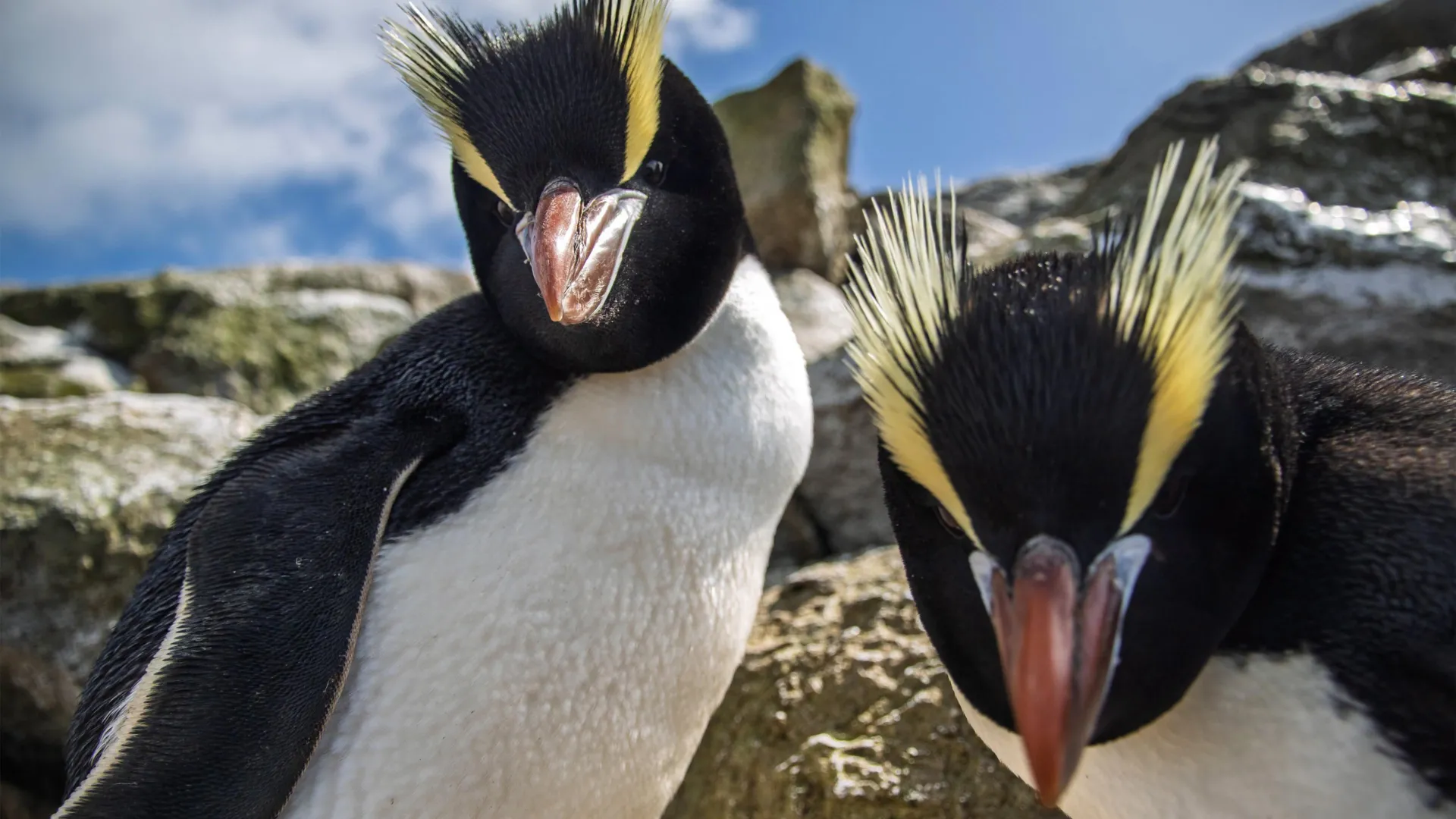
Судлаачид “Erect-crested” оцон шувууны хоёр өөр бүлгийн тоо толгой огт өөр чиг хандлагатай байгааг дрон ашиглан хийсэн судалгаагаар тогтоов.
Отагогийн их сургуулийн судлаачид Шинэ Зеландын “Erect-crested” оцон шувуудын популяцийн төлөв байдалд нарийвчилсан судалгаа хийлээ. 2022-2024 оны хооронд дрон ашиглан хийсэн уг судалгаагаар тус шувууд голчлон нутагладаг Баунти болон Антиподын арлууд дээрх тоо толгой эрс ялгаатай болох нь тогтоогдов. Баунти арлын оцон шувууны тоо сүүлийн 25 жилийн турш тогтвортой хадгалагдаж байгаа бол Антиподын арлууд дээрх тоо толгой 1995 оноос хойш 40 гаруй хувиар буурчээ.
Судлаач Томас Маттерны удирдсан багийнхан Баунти арал нь ердөө 50 га талбайтай хэдий ч Антиподын арлуудтай ижил буюу 27,800 орчим үржлийн хос оцон шувуутай болохыг илрүүлсэн нь өмнөх таамаглалыг эвдсэн байна. Уг үзэгдлийг судлаачид “Шрёдингерийн оцон шувуу” хэмээн нэрлэж байгаа бөгөөд энэ нь нэг зүйлийн популяцийн дотоод төлөв байдал хэрхэн эрс ялгаатай байж болохыг харуулсан парадокс юм.
Антиподын арлууд дээр оцон шувуудын тоо буурахад хэд хэдэн хүчин зүйл нөлөөлж байгааг эрдэмтэд тайлбарлав. Тухайлбал, оцон шувууны өндөг, дэгдээхийг иддэг “скуа” шувуудын дайралт нэмэгдсэн, уур амьсгалын өөрчлөлтөөс үүдэлтэй хүчтэй шуурганы улмаас үржлийн колониуд сүйдэж байгаа нь гол шалтгаан болж байна. Түүнчлэн, өөр нэг зүйл болох “Eastern Rockhopper” оцон шувуудын тоо толгой эрс цөөрснөөр махчин шувууд “Erect-crested” оцон шувуу руу илүүтэй анхаарах болсон байж болзошгүй гэж үзжээ.
Тус судалгааны багийнхан популяцийн тоо толгойг нэгтгэн дүгнэх нь нөхцөл байдлыг бодитоор харуулахгүй, харин ч аюулын түвшинг дутуу үнэлэхэд хүргэж болзошгүйг анхааруулав. Хэрэв хоёр арлын тоог нийлүүлэн тооцвол оцон шувууны хамгааллын зэрэглэл “Эрсдэлтэй” гэдгээс “Эмзэг” болж сайжрах эрсдэлтэй бөгөөд энэ нь бодит байдал дээр буурч буй популяцийн хамгааллыг сулруулах аюултай юм. Иймд цаашид хамгааллын арга хэмжээг тус тусдаа арлын нөхцөл байдалд үндэслэн төлөвлөх нь чухал болохыг судлаачид онцоллоо.
Дэлгэрэнгүйг эх сурвалжаас харах
↓Эх сурвалжийг нээх ↓
A new study from the University of Otago, Ōtākou Whakaihu Waka, has revealed a surprising divide in the fortunes of one of New Zealand’s least understood penguin species. Although Erect-crested penguins breed in just two remote island groups, their populations are experiencing dramatically different outcomes.
Published in PLOS ONE, the research found that one population has remained stable for at least 25 years, while the other has declined by more than 40 percent over the past three decades.
The study was led by Dr. Thomas Mattern of the Tawaki Project, which brings together scientists from the university’s Departments of Zoology and Marine Science. Researchers also collaborated with the Antarctic Research Trust and the Global Penguin Society.
Drone Surveys Reveal a Surprising Penguin Population Divide
Erect-crested penguins breed exclusively on the Bounty and Antipodes islands, two isolated island groups located approximately 800 kilometers southeast of New Zealand’s South Island.
To determine how many penguins remain, researchers conducted extensive drone surveys between 2022 and 2024. They photographed and counted every breeding colony across both island groups, producing the first comprehensive population survey of the entire species.
“The results overturn a long-standing assumption,” Dr. Mattern says.
“The tiny Bounty Islands, at just 50 hectares, were found to hold almost as many breeding pairs (about 27,800) as the Antipodes Islands (about 29,800), even though the latter is 40 times larger and historically considered the species’ stronghold.”
The difference in population trends was even more unexpected. Despite their small size, the Bounty Islands have maintained a relatively consistent number of breeding penguins for decades. Meanwhile, the much larger Antipodes Islands have experienced a substantial decline.
“Comparing the new counts with historical records going back to the mid-1990s, the Bounty Islands population has remained essentially unchanged for at least 25 years.
“The Antipodes Islands population, by contrast, has declined by more than 40 percent since 1995.”
Why Are Penguins Disappearing From the Antipodes Islands?
Researchers believe several overlapping pressures may explain why the two populations are heading in opposite directions. Natural predators, increasingly destructive storms, and differences in where the birds travel and feed could all be contributing.
One particularly troubling factor involves skuas, native subantarctic birds that prey on penguin eggs and chicks. As penguin colonies become smaller, the birds lose some of the protection that comes from nesting together in large numbers.
“As Antipodes colonies have shrunk over recent decades, the collective defense they once provided against native subantarctic bird, the skua, a natural predator of eggs and chicks, has weakened, allowing predation losses to increase and colonies to fragment further.”
Co-author Dr. Klemens Pütz of the Antarctic Research Trust suggests that changes involving another penguin species may have intensified this pressure.
Eastern Rockhopper penguins suffered a “catastrophically” severe population collapse during the second half of the 20th century. Similar declines occurred across their Southern Ocean breeding range, likely driven by warming ocean waters. Today, fewer than 1,000 breeding pairs remain on the Antipodes Islands.
“As Rockhoppers disappeared, skuas may have turned to Erect-crested penguin eggs and chicks instead,” Dr. Pütz says.
Stronger Storms and Different Migration Routes Add to the Threat
Predators are not the only challenge facing the Antipodes penguins. Increasingly powerful storms, consistent with wider climate trends across the Southern Ocean, have caused landslides that break up breeding colonies and leave the birds more vulnerable.
Differences in ocean habitats and seasonal movements may also help explain why the two populations have experienced such contrasting outcomes.
According to Dr. Mattern, penguins breeding on the Antipodes Islands migrate considerable distances into the Antarctic Polar Frontal Zone when the breeding season ends. In contrast, birds from the Bounty Islands remain closer to their nesting grounds, where the surrounding waters are more sheltered and may offer more abundant food.
These differences could leave the two populations exposed to very different environmental pressures, despite belonging to the same species.
The Strange Paradox of Schrödinger’s Penguin
The researchers have named this unusual situation “Schrödinger’s Penguin,” drawing inspiration from the famous physics thought experiment involving a cat inside a sealed box.
In that experiment, the cat is imagined to be both alive and dead until the box is opened and its condition is observed. But Dr. Mattern explains that the penguin discovery turns the familiar concept around.
“With Schrödinger’s cat, opening the box settles the question one way or the other.
“With Erect-crested penguins, it’s the opposite. From a distance, without proper surveys, everyone assumed there was a single answer for the whole species.
“Once we actually opened the metaphorical box and looked, we found there wasn’t one state at all, but two: stable on the Bounty Islands, declining on the Antipodes Islands.”
In other words, looking at the species as a whole can conceal what is happening within individual populations. Only by examining both island groups separately did researchers uncover how dramatically their circumstances differ.
A Hidden Conservation Crisis for Endangered Penguins
The Erect-crested penguin is currently one of only four penguin species worldwide classified as “Endangered” on the International Union for Conservation of Nature Red List. Another New Zealand penguin, the hoiho/yellow-eyed penguin, shares that designation.
However, the two species have received very different levels of attention. While the plight of the hoiho has attracted ongoing public interest and conservation efforts, the Erect-crested penguin has remained relatively overlooked.
Dr. Mattern explains that the species’ current conservation classification relies on population estimates from the 1970s that were considerably inflated. When the new survey results are considered, the “Endangered” designation remains broadly appropriate for the declining Antipodes population, but not for the stable Bounty Islands population.
This creates a difficult conservation dilemma. If the two populations are combined into a single assessment, the species’ overall threat classification could actually improve, even though one population continues to decline sharply.
“Averaged across both populations, the global ranking would actually improve to “Vulnerable,” masking the severity of the Antipodes decline, and downplaying how exposed the Bounty Islands, likely the species’ last secure stronghold, are to industrial fishing.”
The researchers warn that a more favorable overall classification could create a misleading impression of security. Although the Bounty Islands population remains stable, it may still face significant threats, particularly from industrial fishing activity.
“A single, ostensibly improved threat ranking is like putting the lid back on Schrödinger’s box, trading a convenient illusion for the stronger protection the Bounty Islands population actually needs,” Dr. Mattern says.
The findings highlight why conservation efforts must account for the circumstances of individual populations rather than relying exclusively on a species’ global status. For Erect-crested penguins, recognizing the differences between the two island groups could be essential to protecting their future.
The study received funding from the Vontobel Foundation (Switzerland) through the Antarctic Research Trust and from the Global Penguin Society. The research was carried out under permits issued by the New Zealand Department of Conservation.

