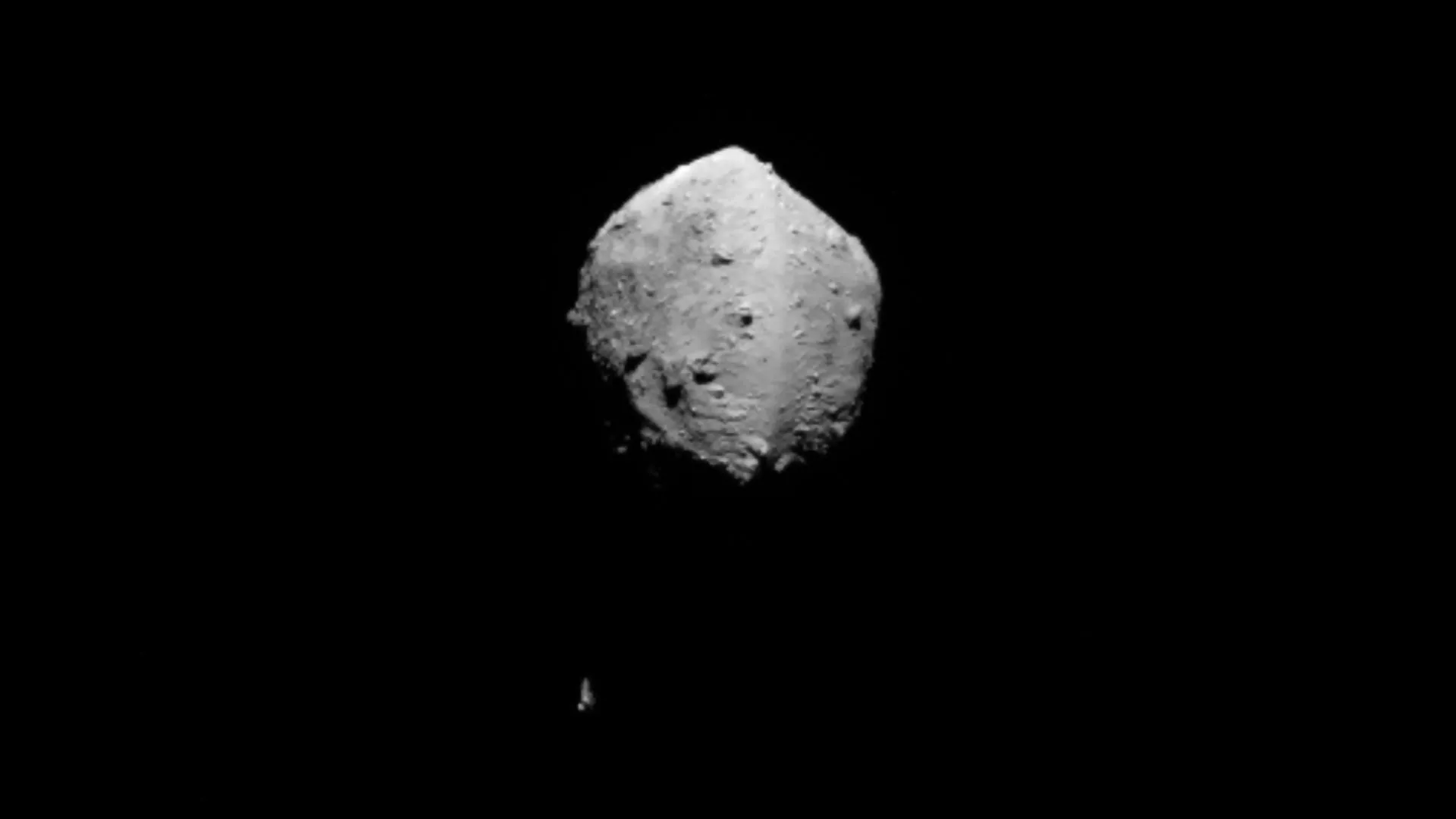
Европын сансрын агентлагийн Hera хөлөг Didymos астероидын системийн анхны ойрын зургийг авч, астероидын гадаргуугийн бүтэц болон мөргөлдөөний ул мөрийг судлах судалгааг эхлүүллээ.
2022 оны есдүгээр сарын 26-нд NASA-гийн DART хөлөг Didymos системийн жижиг астероид болох Dimorphos-той санаатайгаар мөргөлдсөн билээ. Hera хөлөг 60 км-ийн зайнаас хар цагаан камераар авсан шинэ зурагтаа Didymos-ын өмнө нь нарийвчлан харагдаагүй талыг дүрсэлжээ. Судлаачид астероидын гадаргуу дээрх хад чулуу, тогоо болон ховил бүхий хээ нь мөргөлдөөний үр дүнд үүссэн байж болзошгүй гэж таамаглаж байна.
Hera төслийн ахлах судлаач Патрик Мишель болон ESA-гийн эрдэмтэн Майкл Күпперс нарын тайлбарласнаар, DART-ын мөргөлдөөний улмаас Dimorphos-оос ялгарсан их хэмжээний материал 1 км орчим зайг туулан Didymos руу шилжсэн байх магадлалтай. Энэхүү таамаглалыг батлах нь Hera хөлгийн судалгааны гол зорилгын нэг юм. Эрдэмтэд астероидын гадаргуу дээрх онцлог шинжүүдийг системтэйгээр зураглаж, мөргөлдөөн хэрхэн нөлөөлснийг тогтоохоор ажиллаж байна.
DART-ын туршилт нь хүний үйл ажиллагаагаар астероидын тойрог замыг өөрчилж болдгийг баталсан сансар судлалын түүхэн үйл явдал болсон юм. 580 кг жинтэй DART хөлөг 6.1 км/с хурдтайгаар мөргөлдсөний үр дүнд Dimorphos-ын тойрог замын хугацаа 33 минут орчмоор багассан нь эрдэмтдийн таамаглаж байснаас илүү өндөр үзүүлэлт байв. Энэхүү кинетик мөргөлдөөний арга нь ирээдүйд Дэлхий рүү чиглэсэн аюултай астероидыг өөрчлөх боломжит хамгаалалтын техник болох юм.
Дэлхийгээс 196.8 сая км зайд орших энэхүү системд хүрсэн Hera хөлөг ирэх арваннэгдүгээр сарын 25-нд Didymos болон Dimorphos-ын нарийвчилсан зургуудыг олон нийтэд танилцуулахаар төлөвлөж байна. Энэхүү мэдээлэл нь астероидын мөргөлдөөний физик үйл явцыг ойлгох болон гариг хоорондын хамгаалалтын технологийг боловсронгуй болгоход чухал ач холбогдолтой юм.
Дэлгэрэнгүйг эх сурвалжаас харах
↓Эх сурвалжийг нээх ↓
The European Space Agency’s (ESA) Hera spacecraft has captured its first close-up image of the Didymos asteroid system, offering scientists a surprising new perspective on the site of NASA’s historic asteroid deflection experiment.
On September 26, 2022, NASA’s DART spacecraft deliberately crashed into Dimorphos, the smaller of the two asteroids in the system. Hera’s latest image provides a look at its larger companion, Didymos, from a side that scientists had not previously seen in such detail.
The image was taken from a distance of 60 km using Hera’s monochromatic Asteroid Framing Camera, which captures images in black and white. Although most of Dimorphos, which measures 151 m across, is concealed in shadow, the much larger Didymos, with a diameter of 780 m, is clearly visible.
A Surprisingly Different Side of Asteroid Didymos
“The first thing we said was wow!” observes Hera Principal Investigator Patrick Michel, Director of Research at CNRS / Observatoire de la Côte d’Azur. “This is the other side of Didymos from the one that DART’s camera showed us shortly before impact, so this feels like looking at a whole new world.
“This side of Didymos has the same central ridge along its equator that we saw before, but otherwise appears very different, with multiple boulders and craters and what look like patterns of grooves or ridges.”
The newly revealed terrain raises intriguing questions about how the asteroid’s surface developed and whether NASA’s collision with Dimorphos may have left traces on its larger neighbor.
When DART struck Dimorphos, the impact sent material flying into space. Scientists believe some of that debris may have traveled across the roughly 1 km separating the two asteroids and reached Didymos. Determining whether this material contributed to the features now visible on its surface will be an important part of Hera’s investigation.
ESA’s Hera mission scientist Michael Kueppers adds: “Since we expect a lot of impact-ejected material to have made it across the approximately 1 km of space from Dimorphos to Didymos, it may be that some of these characteristics originate from this transport of material, and we have exciting work ahead of us to sort it out. We look forward to seeing much more of both bodies and systemically mapping all the changes we identify.”
NASA’s DART Mission Changed an Asteroid’s Orbit
Although Dimorphos is largely obscured in Hera’s new image, it holds a remarkable place in space exploration history. It became the first object in the Solar System to have its orbit measurably altered by human activity.
NASA achieved this milestone by sending the 580 kg DART spacecraft into Dimorphos at approximately 6.1 km/s. The collision reduced the time the smaller asteroid takes to complete an orbit around Didymos by about 33 minutes, give or take a minute. That change was substantially greater than scientists had anticipated.
The experiment demonstrated that striking an asteroid with a spacecraft can change its motion through space. This approach, known as kinetic impact deflection, could potentially be used to redirect a dangerous asteroid before it reaches Earth.
Hera Begins Its Investigation of NASA’s Asteroid Impact
After a two-year journey, Hera has reached the double asteroid system, located 196.8 million km from Earth. The spacecraft is now preparing for a detailed ‘crash site investigation’ to examine the consequences of NASA’s groundbreaking experiment.
While DART demonstrated that an asteroid’s orbit could be changed through a deliberate collision, Hera will help scientists understand the physical processes behind the result. By examining both asteroids and documenting their characteristics, researchers hope to improve their ability to predict how future asteroid deflection attempts might work.
The findings could help transform kinetic impact deflection from a successful one-time demonstration into a dependable, repeatable planetary defense technique. Such a capability could prove critical if an asteroid were ever discovered on a collision course with Earth.
“Seeing this image is a hugely exciting moment for the whole Hera family,” comments Hera mission manager Ian Carnelli. “It has taken years of hard work and dedication to reach this point – but we’re motivated to know that the adventure is only beginning!”
The mission’s next major reveal is scheduled for November 25, when detailed images of both Didymos and Dimorphos will be unveiled, giving scientists and the public a closer look at the asteroids involved in humanity’s first successful asteroid deflection experiment.

