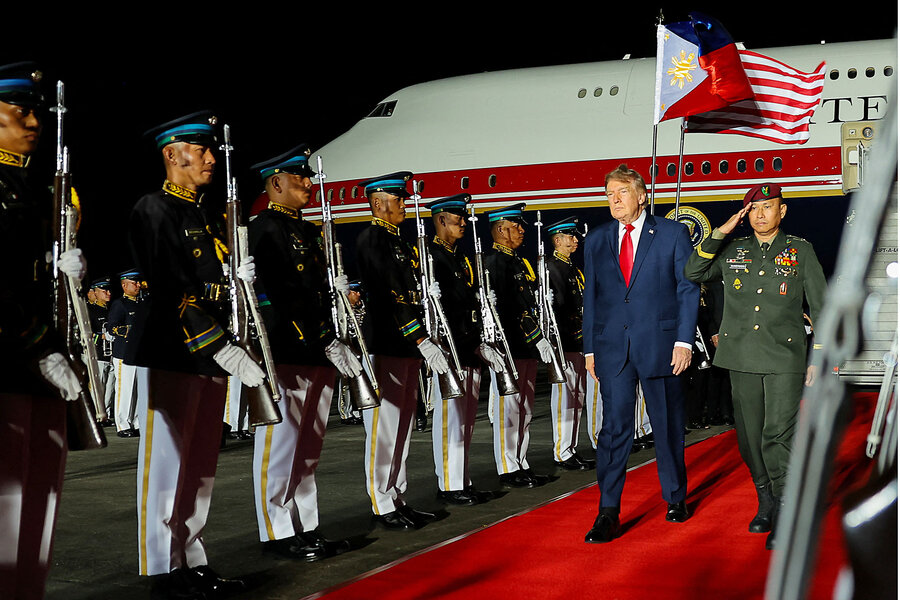
Манила Бээжингийн Өмнөд Хятадын тэнгис дэх дарамт нэмэгдэж буй үед АНУ-ын дэмжлэгийг баталгаажуулахыг зорьж байна.
АНУ-ын Ерөнхийлөгч Дональд Трамп мягмар гарагт Манилад газардаж, АНУ болон Филиппиний далбааг даллан хоёр орны эв нэгдлийг илэрхийлэв. Хятад улс Филиппиний уламжлалт загас агнуурын бүс болох Скарборогийн шүрэн арал орчимд эргийн хамгаалалтын хөлөг онгоцны эргүүлээ нэмэгдүүлж, хоёр улсын зөрчил хурцдаад байна. Филиппиний тэнгисийн цэргийн мэдээлснээр, Хятадын эргийн хамгаалалтынхан усан буу, цэргийн зориулалтын лазер ашиглах, хөлөг мөргөх, нэг далайчныг модон бороохойгоор цохих зэрэг үйлдэл гаргажээ.
Хоёр улс Өмнөд Хятадын тэнгист давхцсан эзэмшлийн нэхэмжлэлтэй бөгөөд үүнд Филиппиний НҮБ-ын Далайн эрх зүйн конвенцоор тогтоосон 200 далайн милийн эдийн засгийн онцгой бүс багтдаг. 2016 оны арбитрын шүүх Хятадын нэхэмжлэл болон Филиппиний усан дахь зарим үйл ажиллагааг хууль бус гэж үзсэн ч Бээжин шийдвэрийг хүлээн зөвшөөрөөгүй. Мэргэжилтнүүдийн үзэж буйгаар, Маркос, Трамп нарын уулзалтаар тагнуулын мэдээлэл солилцох, кибер аюулгүй байдал, цэргийн командлалын тогтолцооны чиглэлээр хамтын ажиллагааг өргөжүүлэх асуудлыг хэлэлцэнэ.
АНУ, Филиппиний цэргийн хамтын ажиллагаа сүүлийн үед нэмэгдсэн бөгөөд хоёр тал Өмнөд Хятадын тэнгист ажиллах бэлэн байдлыг сайжруулах хамтарсан ажлын хэсэг байгуулж, эргүүл хийжээ. Гэвч Вашингтоны 1951 оны Харилцан батлан хамгаалах гэрээний үүрэг хүчинтэй хэвээр ч Трампын засаг захиргааны үндэсний аюулгүй байдлын стратегид Филиппинийг хамгаалах “төмөр мэт бат” амлалт тусгагдаагүй нь Манилад болгоомжлол төрүүлж байна. Шинжээчдийн анхааруулснаар, энэ нь холбоотны харилцаанд ан цав байна гэж Бээжинд ойлгогдох эрсдэлтэй.
Филиппиний иргэдийн 86 хувь нь Хятадтай үүссэн газар нутгийн маргаанд санаа зовниж байгаа бөгөөд олонх нь АНУ-ыг илүү найдвартай түнш гэж үздэг судалгаа гарчээ. Үүний зэрэгцээ Ираны дайн, газрын тосны нийлүүлэлтийн саатлаас үүдсэн инфляц, импортын түлшнээс хамааралтай эдийн засгийн өсөлтийн сааралт, ган гачиг иргэдийн амьжиргаанд дарамт болж байна. Иргэний нийгмийн төлөөлөгчдийн хэлснээр, Маркос Трампаас Филиппиний экспортод ногдуулсан 19 хувийн тарифыг бууруулах, түлшийг боломжийн үнээр авахад туслахыг хүсэх шаардлагатай.
Дэлгэрэнгүйг эх сурвалжаас харах
↓Эх сурвалжийг нээх ↓
Shenzhen, China; and Manila, Philippines
|
Nov. 17, 2026, 3:55 p.m. ET
|
5 min read
President Donald Trump pumped his fist and waved United States and Philippines flags as he disembarked from Air Force One in Manila on Tuesday – a gesture of solidarity that many Filipinos welcome at a vulnerable moment for the archipelago.
The U.S. treaty ally faces mounting pressure from China in the South China Sea – an increasingly dangerous hot spot that risks upsetting a fragile stability between Washington and Beijing.
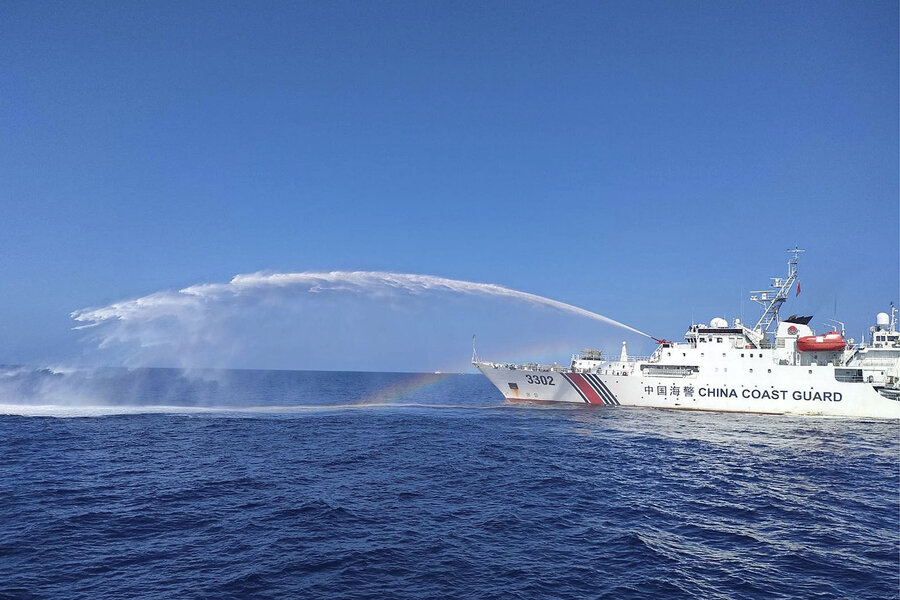
China has vastly expanded its Coast Guard patrols, most recently near Scarborough Shoal, traditional fishing grounds for the Philippines. Clashes with Filipino vessels have also become more violent. China’s Coast Guard has seriously wounded Filipino personnel by firing water cannons and military-grade lasers in their direction, deliberately ramming their ships, and attacking at least one sailor with a wooden baton, according to Philippine Navy reports.
China’s use of force aims to challenge the U.S.-Philippines alliance while asserting Chinese control over the territory, part of a vast swath of the South China Sea that Beijing claims as its own – illegally, according to an international tribunal.
“U.S. resolve is really put to the test” by Beijing’s assaults on Filipinos, says Andrew Chubb, a Chinese foreign policy fellow at the Asia Society Policy Institute’s Center for China Analysis.
Apart from China’s territorial threats, Filipinos are also confronting severe economic headwinds. The Iran war and oil blockages have unleashed inflation and slowed growth in a country highly dependent on imported fuel. Meanwhile, the El Niño climate is damaging crops with intense heat and dry spells expected to last until mid-2027.
Security feels more precarious to Orlan Barisco, a street vendor in Manila and father of four, who worries tensions in the South China Sea could escalate. “I’m afraid there will be a war,” he says.
Lorela U. Sandoval
Every night, Orlan Barisco sells street food like siomai (pork dumplings) and baga (fried cow or pork lungs on a stick) along Tolentino Street in Sampaloc, in Manila, Philippines.
Still, Mr. Barisco says seeing U.S. soldiers and ships arriving in the Philippines reassures him that the U.S.-Philippines alliance is still solid. So does Mr. Trump’s visit. “He is our friend,” he says with a smile.
Defense cooperation is growing – but rhetoric lags
For President Ferdinand Marcos, known across the archipelago as Bongbong, Mr. Trump’s visit is in itself a diplomatic coup of sorts, experts say. Mr. Trump has only attended two previous summits of theAssociation of Southeast Asian Nations, and the first one was also in Manila, in 2017.
“Getting him again to Manila is a win,” says Gregory Poling, director of the Southeast Asia Program at the Center for Strategic and International Studies. “It shows that the Philippines is viewed uniquely positively by the Trump administration among all the Indo-Pacific partners.”
Planned talks between Messrs. Marcos and Trump will reportedly include announcements on new defense initiatives – covering intelligence-sharing, cybersecurity, and military command systems – to strengthen the Philippines’ security.
Defense cooperation between the U.S. and Philippines is growing.

Eloisa Lopez/AP
Philippine President Ferdinand Marcos Jr., left, and first lady Louise Araneta-Marcos, react as they welcome guests ahead of the Gala Dinner at the 49th ASEAN Summit at the Philippine International Convention Center in Pasay City, Metro Manila, Philippines, Monday, Nov. 16, 2026.
A year ago, they formed a joint task force to increase readiness to operate in the South China Sea, and in May, for the first time, a U.S. Coast Guard vessel joined Philippine forces for a joint patrol. They sailed near Scarborough Shoal in a “show of resolve” toward China, according to the U.S. Naval Institute. This summer, the Pentagon stepped up that partnership by deploying four U.S. Coast Guard cutters to the Philippines.
“The operational side has been up, up, up,” says Mr. Poling.
But what’s been missing from Mr. Trump – causing concern in Manila – is “the rhetorical side,” he says.
U.S. officials have reiterated the American commitment to the Philippines under their 1951 Mutual Defense Treaty, which legally binds both countries to respond to an armed attack on the other. But the Trump administration’s national security strategy omits mention of the “iron-clad” commitment to the Philippines that was contained in the Biden administration strategy.
The danger is that China will view this as “a seam in the alliance that it can pick at,” says Mr. Poling.
“Security starts at the dinner table”
For its part, China’s rhetoric toward the U.S. ally is increasingly shrill. Last month, the Philippines’ Department of Foreign Affairs summoned Jing Quan,Chinese ambassador to the Philippines, for remarking that China could “easily win” a war against the Philippines.
Restraining China is something Leonardo Cuaresma, a lifelong fisherman in the Philippine city of Masinloc, is eager to see. Mr. Cuaresma used to fish regularly around Scarborough Shoal – but now rarely does. China’s harassment is making it hard if not impossible for Filipino fishermen to cast their nets in many traditional fishing grounds, he says, and the catch has slowly declined.
Philippine Coast Guard/AP/File
In this photo provided by the Philippine Coast Guard, a Chinese Coast Guard ship, right, uses its water cannons on a Philippine Bureau of Fisheries and Aquatic Resources (BFAR) vessel, as it approaches Scarborough Shoal in the disputed South China Sea, on Dec. 9, 2023.
China and the Philippines have overlapping claims in the South China Sea, including the Philippines’ 200-nautical-mile-wide exclusive economic zone as defined by the 1982 United Nations Convention of the Law of the Sea (UNCLOS).
A 2016 arbitration ruling by an UNCLOS tribunal found that China’s claims, land reclamation, and other activities in Philippine waters were unlawful. But China has refused to abide by the ruling, rejecting it as “null and void.” And hundreds of diplomatic protests filed by the Philippines government against China’s incursions have so far proved futile.
Mr. Cuaresma says the UNCLOS tribunal ruling needs “teeth, or power.” And that power comes from the U.S. He says Mr. Marcos should ask Mr. Trump to commit the full force of the U.S. military when the Philippines gets bullied again by China, or if a conflict arises.
“Whoever violates the law should have a corresponding punishment,” he says.
Recent surveys show that the vast majority of people in the Philippines – 86% – are concerned about territorial disputes with China. Most have unfavorable views of China, which many view as a threat.
“It’s like being bullied in our own backyard, whenever we see news about Coast Guards getting hit with water cannons,” says Anna Bunag, a homemaker in Quezon City. China is blocking Filipino fishermen “who just want to make a living,” she says.
Far more Filipinos view the U.S. as a reliable partner than China. And they are more confident in Mr. Trump than in Chinese leader Xi Jinping to “do the right thing” in world affairs, according to a Pew Research Center survey released in July.
“It helps people to feel safe, knowing the U.S. is a strong ally,” says Ms. Bunag.
Still, trust in the U.S. has declined for some Filipinos. Several Filipino progressives and civil society groups have staged protests in recent days in Manila – saying Mr. Trump is not welcome.
Analysts say the Philippines’ economic troubles – and resulting popular hardship – could be to blame.
Deepen your worldview
with Monitor Highlights.
Politics with respect
Get political stories with respectful analysis.
There‘s a world of new ideas in every
Books newsletter.
There‘s more to life, enrich yours with
Culture & Learning weekly.
Follow humanity‘s discoveries with
Science & Nature stories in your inbox.
Gain a spiritual perspective
from the stories in your inbox.
Want to understand the deeper impact of critical events? Learn the Monitor‘s insight.
Already a subscriber?Log in to hide ads.
“For Filipinos, security starts at the dinner table,” with affordable rice, says Natalie Pulvinar, executive director of the Center for People Empowerment in Governance, in Quezon City. Inflation, driven by the oil shock from the Iran war, is the number one concern, she said in emailed responses to questions.
“Marcos should ask [Trump] for help where Filipinos are hurting most … lowering the 19% tariff on our exports and helping secure affordable fuel.”

