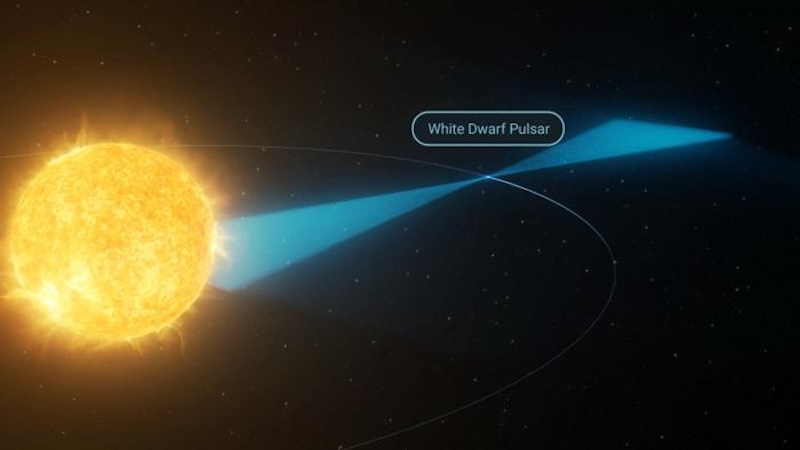
Найман минут тутам давтагдах радио дохио нар төст од, цагаан одойгоос бүрдэх хос системээс ирж байна.
Австралийн International Centre for Radio Astronomy Research-ийн судлаачид GPM J071507-114153 хэмээх хос одны системийг радио дохионы эх үүсвэр гэж тогтоожээ. Тус системийн нэг од нь цагаан одой, нөгөө нь Нартай төстэй од бөгөөд дохио найман минут тутамд давтагддаг.
Энэ систем нь радио импульс нь минут, цагаар тасалдан асаж унтардаг урт үет радио эх үүсвэрүүдийн бүлэгт багтана. Ийм эх үүсвэрийг анх 2021 онд илрүүлснээс хойш арав орчим нь олдсон бөгөөд хэд хэдэн системд цагаан одой байдаг ч дохиог аль од гаргаж байгааг өмнө нь тогтоогоогүй байв. Судлаачид Pawsey Supercomputing Research Centre-д 100 гаруй цагийн радио өгөгдөл боловсруулж, импульс цагаан одойн орчмоос, эсвэл цагаан одойгоос өөрөөс нь гарч байгааг тогтоожээ.
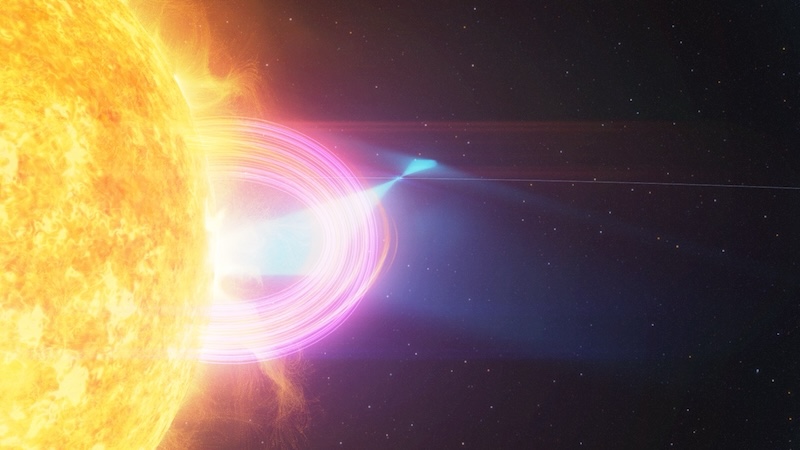
Энэ нь нар төст одтой хосолсон урт үет радио эх үүсвэр анх удаа батлагдсан тохиолдол юм. Цагаан одойн радио импульс түүний хамтрагч одны агаар мандлаар нэвтрэхдээ одны идэвхжлийг, тухайлбал плазмын том нум хэлбэртэй дэлбэрэлтийг илрүүлэх боломж олгосон байна. Ийм үзэгдлийг 5,000 гэрлийн жилийн цаанаас радио долгионоор ажиглажээ.
Судлаачид системийг Murchison Widefield Array дурангаар Австралиас харагдах Сүүн замыг бүхэлд нь хамарсан судалгааны үеэр илрүүлсэн байна. Ажлын үр дүнг 2026 оны арваннэгдүгээр сарын 12-нд Nature Astronomy сэтгүүлд нийтэлжээ. Судалгааны ахлагч Сэм МакСвини ирээдүйд Square Kilometre Array Observatory-ийн дурангууд бүрэн ашиглалтад орсноор ийм системүүдийг олноор илрүүлж, дохиог нь илүү нарийвчлан судлах боломжтой гэж үзэж байна.
Дэлгэрэнгүйг эх сурвалжаас харах
Эх сурвалжийг нээх ↓
- Astronomers have traced the source of some mysterious radio signals. The signals originate from an unusual pair of stars.
- The binary system, called GPM J071507-11415, consists of a white dwarf star and sun-like star.
- The signals come from the white dwarf star and repeat every 8 minutes.
Are you a moon-watcher? Then you’ll love EarthSky’s 2027 lunarcalendar, too! Order yours today.
Mysterious radio signals originate from unusual binary star system
Astronomers say they’ve determined the source of a mysterious radio signal that repeats every eight minutes.
No, this regular pulse isn’t coming from some technologically advanced alien race. Scientists at the International Centre for Radio Astronomy Research (ICRAR) in Australia say the unusual radio signal is originating from a binary pair of stars, where one is a white dwarf and the other is a sun-like star. The white dwarf spins every eight minutes, emitting the radio signals.
And this binary system — GPM J071507-114153 — is rare. Most systems that emit such pulses have red dwarf stars in them. This is the first confirmed case of a regular-radio-signal-producing binary system that contains a white dwarf and a sun-like star.
The researchers published their peer-reviewed results in Nature Astronomy on November 12, 2026.
Long-period transients
Star systems like GPM J071507-114153 are part of a larger grouping called long-period transients (LPTs). These are systems that emit radio pulses that switch on and off over periods ranging from minutes to hours.
Astronomers found the first one in 2021, and about a dozen since then. Several of them contain a white dwarf star. But astronomers didn’t know which star in these binaries was actually emitting the radio signals.
This is the first time that the second star in an LPT binary has been confirmed to be a sun-like star. And the researchers were able to pinpoint the source of the radio signals as close to the white dwarf, or the white dwarf itself. This came after processing more than 100 hours of radio data at the Pawsey Supercomputing Research Centre.
Sam McSweeney at the Square Kilometre Array Observatory (SKAO) is the lead author of the new study. He said:
This is the first time the pulses are clear enough to see the white dwarf moving in its orbit around its companion, so we know that the pulsations are coming from a region close to the white dwarf, or possibly even from the white dwarf itself.
Mysterious radio signals reveal stellar activity
The radio pulses from the white dwarf enabled the researchers to detect eruptions on the sun-like star, just like those we see on our sun. Co-author Natasha Hurley-Walker at ICRAR said:
As a bonus, we also saw the white dwarf moving behind a region with a strong magnetic field, most likely a ‘stellar prominence’, which is a large loop of plasma erupting from a star’s surface.
It’s amazing that by using radio wavelengths we can detect the storms on a star over 5,000 light-years away.
Telescopic survey yields unusual binary star system
The researchers discovered the GPM J071507-114153 star system as part of a large survey using the Murchison Widefield Array (MWA). It scanned the entire Milky Way Galaxy that is visible from Australia.
The researchers are confident that astronomers will find more binary systems like GPM J071507-11415. McSweeney said:
If we are already making such discoveries with precursor telescopes, just imagine how many more star systems we will be able to find, and what a beautifully detailed view of their signals we will have, once the SKAO telescopes are completely built.
Bottom line: Astronomers have discovered that a rare binary star system is the source of mysterious radio signals that repeat every 8 minutes.
Source: A long-period transient with a Sun-like companion
Read more: Analyzing binary stars with AI brings new insights
Read more: 3D map of a million binary stars

