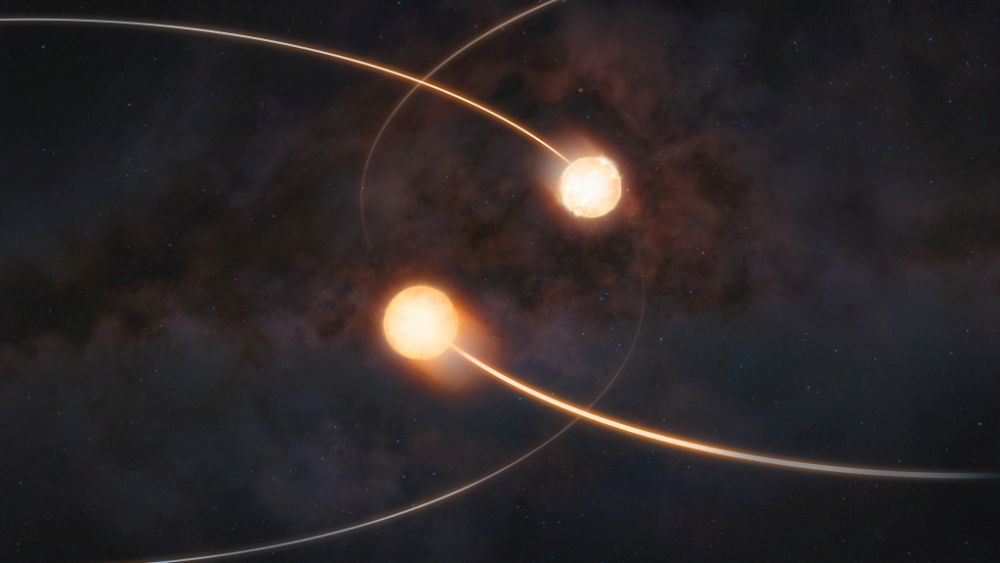
Одон орон судлаачид радио долгионы хүчтэй цацаргалт бүхий DG CVn хос оддын системийн тойрог зам болон массыг анх удаа маш өндөр нарийвчлалтайгаар хэмжлээ.
Дэлхийгээс 59 гэрлийн жилийн зайд орших DG CVn хос оддын систем нь залуу, идэвхтэй улаан одой оддоос бүрддэг. Эдгээр оддын эргэлтийн хурд өндөр байдаг нь хүчтэй соронзон орон болон идэвхтэй дөл үүсгэх шалтгаан болдог бөгөөд үүний нэг нь Complex Periodic Variable (CPV) ангиллын од юм. Одон орон судлаачид 2023-2025 оны хооронд National Science Foundation-ийн Very Long Baseline Array (VLBA) сүлжээг ашиглан 18 жилийн турш цуглуулсан ажиглалтын мэдээлэлд дүн шинжилгээ хийжээ.
VLBI (Very Long Baseline Interferometry) технологийг ашигласнаар одод хоорондоо хэт ойрхон байрлах үед ч тэдний байрлал болон хөдөлгөөнийг нарийн тодорхойлох боломж бүрдсэн байна. Судалгааны багийнхан оддын таталцлын улмаас үүсэх “ганхах” хөдөлгөөнийг ажиглаж, DG CVn A болон DG CVn B оддын массыг 0.16 хувийн алдаатайгаар тогтоожээ. Энэхүү амжилт нь CPV ангиллын од агуулсан хос системийн массыг анх удаа тодорхойлсон тохиолдол болж байна.
Эдгээр оддын тойрог замын хугацаа 4.511 жил бөгөөд тэд зууван хэлбэрийн тойрог замаар эргэлддэг. Энэхүү нарийвчилсан хэмжилт нь тухайн систем дэх экзопланетуудын оршин тогтнох боломж болон гариг үүсэлтийн хязгаарыг ойлгоход чухал ач холбогдолтой юм. Судлаачдын тооцоолсноор, ийм ойрхон хос оддын системд гариг тогтвортой оршихын тулд тодорхой хугацааны хязгаарлалттай байх шаардлагатай аж.
Ирээдүйд Square Kilometre Array (SKA) болон Next Generation Very Large Array (ngVLA) зэрэг хүчирхэг радио телескопуудыг VLBI сүлжээнд нэгтгэснээр илүү алслагдсан одод болон тэднийг тойрон эргэх гаригуудыг илрүүлэх боломж нэмэгдэнэ хэмээн эрдэмтэд үзэж байна.
Дэлгэрэнгүйг эх сурвалжаас харах
Эх сурвалжийг нээх ↓
About 59 light years away, a binary pair of red dwarfs are orbiting a common center of gravity. Unlike stars like our Sun, which are relatively radio-quiet, red dwarfs (M dwarfs) can produce strong radio emissions. A team of astronomers used that to their advantage to take precision measurements of a binary pair of M dwarfs about 59 million light years from Earth. They determined the stars’ orbits and masses with uncommon accuracy.
One fundamental fact about low and intermediate mass stars, including M dwarfs, is that they rotate more rapidly when they’re younger. Stars inherit angular momentum from their formation in gas clouds, and since M dwarfs are so small, that momentum is concentrated, making them spin rapidly. They eventually slow down, but this initial rapid rotation makes them very active.
The fast rotation generates powerful magnetic dynamos, and young M dwarfs exhibit very large sunspots and more frequent, powerful stellar flares.
One subset of young M dwarfs is even more extreme. They’re called Complex Periodic Variable (CPV) stars, and they’re very young, between about 10 and 100 million years old. They’re M dwarfs that display complex, periodical optical light curves with sharp drops rather than smooth drops found in most stellar light curves. Their drops aren’t simple; there can be multiple dips and peaks during a single rotation. Astrophysicists call their light curves multi-harmonic, and the patterns repeat across multiple rotations.
This image shows CPV light curves for three typical CPV stars found by TESS. Notice the sharp drops in the curves rather than typical smooth drops found in other stellar light curves. Image Credit: Bouma et al. 2023. AnJ
The binary system in this research is named DG CVn, and one of them is a CPV star. Though CPV stars have complex light curves generated by their youthful, rapid rotation, their youthfulness also means they’re radio loud. In fact, since both of these stars are young M dwarfs, they’re both radio loud. That helped the researchers measure them with such accuracy.
The measurments of DG CVn are in new research in Astronomy and Astrophysics titled “Accurate dynamical mass and orbit determination of the M dwarf binary DG CVn using astrometric very long baseline interferometry.” The lead author is Paul VLBI , a network system engineer at the Joint Institute for Very Long Baseline Interferometry ERIC (JIVE), and a Leiden Observatory PhD student. It’s noteworthy that this is the first mass measurement of a system with a CPV star.
“We present the first dynamical mass measurement of a binary containing a CPV star.” – Boven et al. 2026.
The astronomers’ results are based on observations that spanned 18 years. Observations with the National Science Foundation’s Very Long Baseline Array (VLBA) between 2023 and 2025 were especially important in their precise results. The VLBA is a system of 10 radiotelescopes across the USA, each one measuring 25 meters. The 10 dishes work as an interferometer, and the VLBA has the longest baseline in the world, up to 8,611 km long.
“Astrometry through very long baseline interferometry (VLBI) allows the monitoring of radio-loud stars and the detection of any reflex motion due to stellar or substellar companions,” the authors write. Reflex motion is the characteristic gravitational wobble induced in a star when a companion tugs on it.
That wobble is often used to detect unseeable exoplanets orbiting stars. Even a small planet can make its star wobble, and that’s at the heart of the radial velocity method of detecting exoplanet. The DG CVn system was actually found when astronomers were searching for exoplanets with the radial velocity method. But the system exhibited a more powerful and complex wobble than an exoplanet would.
“We were really lucky to hear about this object when we had developed tools with which we could explain these motions,” said Boven. “But the real surprise came when we also detected the second radio-loud dwarf in the observations we did to confirm our model. It really allowed us to measure the system very precisely.”
Measuring reflex motion accurately with the VLBI let the astronomers track the stars’ paths, including the tiny wobbles, which in turn let them understand the mass of the stars with extreme precision.
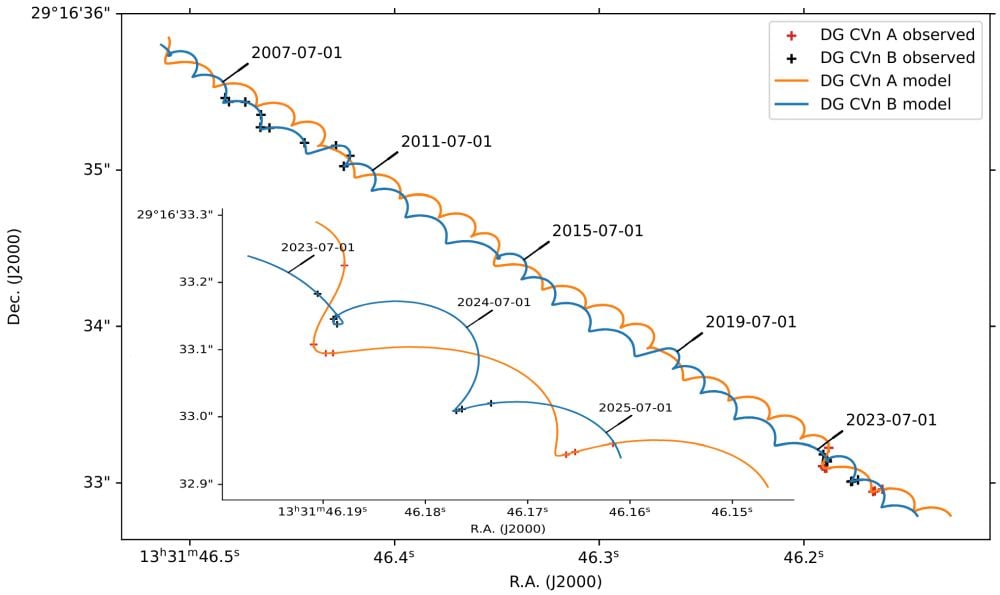 This figure from the research shows the VLBI detections of both members of DG CVn, and their modeled motion across the sky. The dates mark the predicted positions of DG CVn B over time. The inset image shows recent observations when both sources were detected. Image Credit: Boven et al. 2026. A&A.
“In our recent observations, we reliably detected both binary components,” the authors write. “A unique and accurate determination of the 1647.647 ± 0.027 day orbit, with a parallax distance of 18.1851 ± 0.0033 pc (about 59 light years), is presented. The dynamical masses were estimated with a precision of 0.16% from the sampled posteriors.”
The pair of stars orbit each other every 4.511 years on an elongated elliptical orbit. When they’re closest to one another, they’re only separated by 0.59 astronomical units. DG CVn A is the more massive of the pair with 0.39 solar masses, while DG CVn B has 0.36 solar masses. The pair is close enough to measure their distance with parallax, which gives accurate measurements.
The red dwarfs and their radio emissions are central to this work. The stars are simply too close together from this distance to be separated in optical observations. But the VLBA can pinpoint their locations with extreme accuracy. All of this work let the researchers characterize the system in clear detail, following the motions of both stars through the sky separately.
“DG CVn is a beautiful example of what precise radio astrometry can reveal,” said Jay Blanchard, NSF National Radio Astronomy Observatory astronomer and study co-author. “By following these two stars over many years, we can see their orbital motion directly and use that motion to determine properties that would otherwise be extremely difficult to measure.”
These accurate measurements also tell astronomers about their planetary systems. Planets form in protoplanetary disks around stars, and since these stars are so close together, that limits the size of their disks. Smaller disks mean smaller planets, so that limits the size of any exoplanets in the system. It’s also extremely unlikely that any long-period planets are orbiting either star.
According to the researchers’ estimates, an exoplanet in orbit around one of the stars could only be in a stable orbit if its orbital period was less than approximately 23 days. For a circumbinary planet orbiting both stars, the orbital period would have to be at least about 36 years. These approximations are also important, because they can refine the understanding of how exoplanets can form and survive in binary star systems.
Gaia’s Data Release 4 is due in a couple of weeks, and it will include binary star parameters for the mission’s complete survey. But that data alone won’t be able to differentiate between binaries where both are low mass stars, and binaries where one might be a massive planet. But the VLBI will be able to address that. “Astrometric follow-up of selected detections with VLBI can help to differentiate between binary star systems and reflex motion due to large exoplanets (or even both),” the authors write.
“We have presented a complete binary orbital solution with high accuracy based on VLBI astrometry of a binary that is difficult to resolve for optical telescopes on the ground or in orbit,” the authors write. “The absolute astrometry provided by VLBI allowed the individual dynamical masses to be determined with high accuracy. These results show that VLBI is well suited for studying the orbits of radio-loud stars.”
The results also show how powerful the combination of archival observations and new observations can be. “The value of combining archival and recent VLBI astrometric observations has been demonstrated. It resulted in a highly accurate determination of the system composition, orbit, position, and distance,” the authors write. “We present the first dynamical mass measurement of a binary containing a CPV star.”
The VLBI network of radio dishes is about to have a growth spurt when the Square Kilometre Array and the Next Generation Very Large Array come online. That will improve the system’s reach and precision.
“In the future, we hope to make measurements precise enough to detect planets in orbit around such radio-loud dwarfs,” said Huib van Langevelde, chief scientist a the Joint Institute for Very Long Baseline Interferometry and Leiden Observatory professor. “We think that when the ngVLA and the SKA become part of the VLBI network, we can do even more precise measurements, for many more, more distant stars.”

