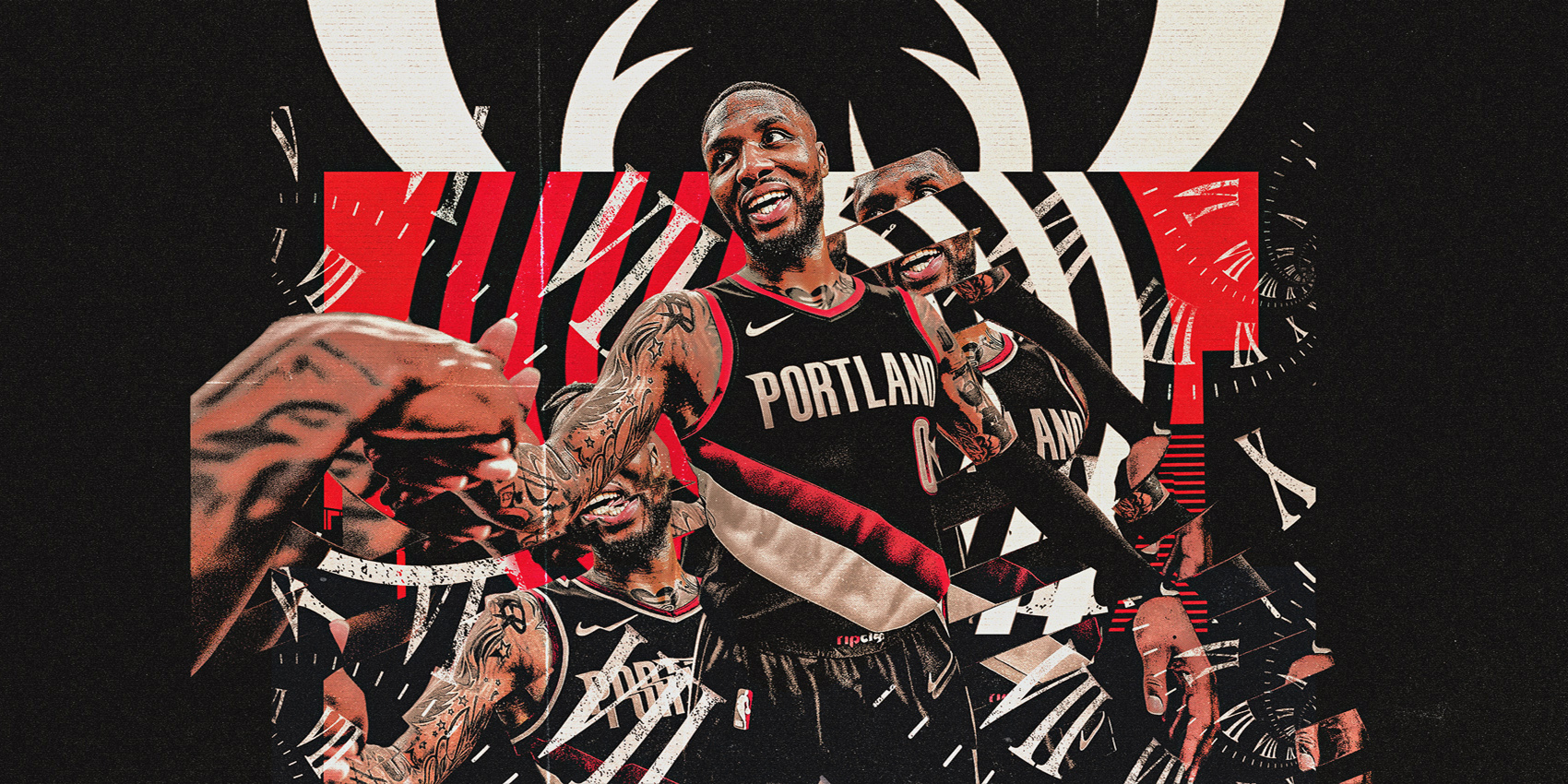
Ахиллын шөрмөсний хүнд гэмтлийн дараа талбайд эргэн ирсэн Дэмиан Лиллард хуучин түвшиндээ хүрэхийн төлөө хичээж, багийнхаа амжилтад чухал хувь нэмэр оруулж байна
2025 оны NBA-ийн плэй-оффын эхний шатанд Ахиллын шөрмөсөө гэмтээсэн Дэмиан Лиллард бүтэн улирлыг нөхөн сэргээлтэд зарцуулсны эцэст Портленд Трэйл Блэйзерсэд эргэн ирлээ. Тэрээр 18 сарын хугацаанд талбайд гараагүй ч, эргэн ирснээсээ хойш 14 тоглолтод оролцоод байна. Одоогийн байдлаар Лиллард тоглолт бүрт дунджаар 29.1 минут талбайд гарч, 20.1 оноо, 4.4 дамжуулалт, 3.0 самбараас бөмбөг авалт гүйцэтгэн, гурван онооны шидэлтээ 39.6 хувийн амжилттай гүйцэтгэж байна.
Портленд Трэйл Блэйзерс пүрэв гарагийн байдлаар 9-5 гэсэн үзүүлэлттэйгээр Өрнөд бүсийн зургаадугаар байрт бичигдэж, лигийн шилдэг найман довтолгоо, есдүгээр хамгаалалтын үзүүлэлтийг үзүүлж байна. Энэ улиралд багийн ахлах дасгалжуулагч Мика Нори Лиллард, Жа Морант, Дени Авдия нарын тоглолтыг нэгтгэн оновчтой систем боловсруулсан бөгөөд тэдний хамт талбайд гарсан 66 минутад баг 125.9 оноо авчээ. Гэвч Жа Морант шөрмөсний гэмтэл авсны улмаас багийн гарааны бүрэлдэхүүнд өөрчлөлт орж, Сиди Сиссоко, Донован Клинган, Тоумани Камара нар хамгаалалтын тал дээр өндөр үр дүнтэй тоглолтыг үзүүлж байна.
Лиллард урьдын адил багийн гол цөм байхаа больж, илүү нэмэлт хүчин зүйл болон тоглох болжээ. Тэрээр ашиглалтын хувь нь 2014-2015 оны улирлаас хойш хамгийн доогуур түвшинд буурсан ч, өөрийн үүргээ амжилттай биелүүлж байна. Лиллард талбайд байх үед багийн довтолгоо илүү үр дүнтэй болж, Дени Авдиягийн довтолгооны боломж нээгдэж байгаа нь багийн амжилтад эергээр нөлөөлж байна. Лиллард өөрөө үүнийг багийн ачааллыг тэнцвэржүүлж, илүү тогтвортой тоглох арга зам хэмээн тодорхойлжээ.
Дэлгэрэнгүй эх сурвалжийг харах
Эх сурвалжийг нээх ↓
The fear, when we saw Damian Lillard sitting there with a thousand-yard stare after falling to the ground early in Game 4 of the Milwaukee Bucks’ first-round series against the Indiana Pacers in the 2025 NBA playoffs, was that we might never see him again.
A ruptured Achilles tendon has altered, if not derailed, plenty of NBA careers. What would it do to a small guard with more than 35,000 NBA minutes on his odometer who was entering his mid-30s?
What if that — that false step, that unsatisfying whimper of a finish to his time in Milwaukee, an era that felt like an error almost from the moment it started — was the last time we’d ever see Lillard looking like what he’d been for the previous 13 years: among the most dangerous shooters of all time, a generational scoring threat from the second he crossed half-court, one of the 75 greatest players in the league’s history?
An awful lot’s happened since then: the shocking waive-and-stretch that ended Lillard’s time in Milwaukee (and, more or less, Giannis Antetokounmpo’s time there); his subsequent re-signing with the Portland Trail Blazers, the home he never really seemed to want to leave; an entire season spent rehabilitating and recovering, in hopes of giving himself a shot at becoming himself once again.
“All the time off I had, I had to take advantage of it,” Lillard recently told NBC. “Not just look at how far out I was and just try to chill or whatever. I had to make sure that every day counted. I was diligent in the process of my rehab, and then when I got back on the court, the weight room, making sure I was balanced on both legs. And then, once it got back to just hooping, that was the easy part — it was just a matter of shaking off the rust.”
Fourteen games into his first action in 18 months, Lillard still hasn’t totally shaken it all off and returned to the level that made him a nine-time All-Star and seven-time All-NBA selection. Entering Thursday’s matchup against a Bucks team that now looks very different from the one for which he last played, he’s averaging 20.1 points, 4.4 assists and 3.0 rebounds in 29.1 minutes per game, and shooting 39.6% from 3-point range — all at or near career lows. He’s driving to the basket less frequently than he has since 2013; just 15% of his field goal attempts are coming at the rim, far and away the lowest share of his career. Nearly 60% of his shots, conversely, are coming from 3-point land — by far the largest share of his life in the NBA.
He’s had nights to forget in the early going, like scoring nine points on 3-for-13 shooting in a blowout loss to the Memphis Grizzlies, or finishing with nine on 2-for-15 shooting in Monday’s loss to the Minnesota Timberwolves. Those two single-digit performances, by the way, are already as many as Dame has had in any whole season since 2014.
Dame’s also had moments to remember, though. Like dropping 25 points with a half-dozen 3-pointers in 24 minutes on the Phoenix Suns in Portland’s season opener, his first live action in 543 days …
… or knocking down a side-step dagger in the right corner to hand the Los Angeles Lakers one of just three losses they’ve suffered on the season …
… or punctuating a 13-point third quarter against the Oklahoma City Thunder with a vintage, swashbuckling just-inside-the-logo buzzer-beating pull-up triple over the outstretched arms of 7-foot-3 rookie Aday Mara:
“I knew he was gonna shoot,” Blazers two-way guard Chris Youngblood told Conor Bergin of Blazer’s Edge after the win over OKC. “I was like, ‘If this goes in, this crowd is about to go crazy.’”
Even amid the fits-and-starts with his finishing, Lillard has helped give Portland fans plenty to go crazy about in a pleasantly surprising start to the season — one in which he’s been a lot more than just a nice story.
The Blazers enter Thursday at 9-5, in sixth place in the Western Conference, with the NBA’s No. 8 offense and No. 9 defense, according to Cleaning the Glass. (The last time the Blazers ended a season in the top 10 on both ends of the floor: 2014-15.) They’ve taken down Luka Dončić’s Lakers in L.A. and Nikola Jokić’s Nuggets in Denver, swept a two-game baseball series from Shai Gilgeous-Alexander’s Thunder at Moda Center, and looked like a team capable of building on last season’s return to the playoffs, ownershipmisadventures and personnelshuffling be damned.
Dame’s done it in part by working his way into a new normal — one in which he’s no longer the sun around whom the entire organization orbits, but rather one component of a constellation in which All-Star forward Deni Avdija often shines brightest.
Heading into the season, one of the main questions hanging over the Blazers was how first-year head coach Micah Nori would craft an offensive ecosystem that kept everything copacetic despite introducing two decorated All-Star on-ball playmakers (a returning Lillard, an incoming Ja Morant) alongside Avdija, who rose to prominence and helped return Portland to the postseason by becoming the league’s highest-volume driver and establishing new career highs in usage, shot attempts, touches and time of possession. The early returns were positive: The Blazers are plus-19 in 66 minutes with Avdija, Lillard and Morant sharing the floor, scoring a scorching 125.9 points per 100 possessions in their minutes with both Dame and Ja taking a smaller slice of the total offensive pie.
The overarching experiment got paused when Morant went down with a hamstring strain, leading Nori to shuffle his starting lineup — first by sliding fourth-year guard Scoot Henderson into Morant’s spot, and then, with Scoot struggling, swapping in 6-foot-6 forward Sidy Cissoko for a bigger, more defensively sound look. Portland’s allowing just 106.5 points-per-100 with Cissoko on the court alongside ace defensive center Donovan Clingan and swingman Toumani Camara — a near-best-in-the-league level of point prevention.
Removing one ball-handler from the mix has somewhat reduced the need for offensive sacrifice, but Lillard has continued to keep up his end of the bargain. He is finishing 27.7% of Portland’s offensive possessions with a shot attempt, foul drawn or turnover — his lowest usage rate since 2014-15, when he was setting up LaMarcus Aldridge. His on-ball percentage — literally the share of his floor time that he has the ball in his hands — is the second-lowest of his career.
Dame has never averaged fewer touches or a lower time of possession, spent less time operating in the pick-and-roll, or spent more time lurking as a catch-and-shoot threat option. Just under 19% of the offensive possessions Lillard has finished this season have come while spotting up away from the primary action, according to Synergy Sports Technology’s tracking data — more than twice as much as in 2022-23, the final year of his first stint in the Pacific Northwest.
“Being on this team and having less responsibility than I had before, I don’t have to make every play,” Lillard told Sean Highkin of the Rose Garden Report. “I don’t have to score every basket. I just came into this season mostly focused on how I could impact winning. I know that at the end of games, I’m gonna have to make shots and make plays and make free throws. But over the course of a game, I think the load is just lighter.”
Deploying Lillard as a different sort of threat in a smaller-scale role has proven useful to the overall offensive operation for the Blazers, who are scoring like a top-five offense with Dame on the floor — and like a near-top-10 unit when he’s on the floor without Avdija, which were minutes in which Portland’s offense died last season.
Last season, even with Avdija ascending as a downhill menace, primary playmaker and point-producing weapon, the Blazers finished the season just 20th in offensive efficiency, due partly to struggles with ball security (dead last in the NBA in offensive turnover rate, with 90 more live-ball turnovers than any other team in the league), shot-making (27th in team 3-point accuracy, 29th from midrange, 21st in overall effective field goal percentage) and half-court execution (just 29th in points per half-court possession). The arrival of Lillard has helped: Portland has turned the ball over less frequently, generated a higher share of its shots from 3-point land, shot better in the midrange, and scored more efficiently in the half-court with Dame on the floor this season.
Even with Lillard not quite at the peak of his shot-making powers, his presence opens things up for the rest of the offense. With him on the floor, nearly 53% of Avdija’s 2-point baskets have come via assist — 20 percentage points higher than when Dame sits. The driving lanes that were so often so congested last season are open a bit wider with defenses needing to account for Lillard, who ranks eighth in the NBA’s gravity metric — a stat aiming to quantify “how much a player pulls defenders towards them […] how much attention they draw compared to what the spacing on the floor predicts” — just south of one high-volume superstar scorer in a ball-handling timeshare (Donovan Mitchell) and two designated sharpshooters playing off high-usage primary creators (Klay Thompson, Duncan Robinson).
That company feels illustrative of the space Lillard currently finds himself occupying: not peripheral, still vital, but more of a complement than a centerpiece. (He still can shift into primary mode, though; on Tuesday, with Avdija sidelined by a sore left foot, Dame scored a team-high 25 points with five assists against the Timberwolves, pushing the NBA’s No. 1 defense to the brink in a game that Portland nearly, and perhaps should have, won.)
Plenty of superstars over the years have struggled to find comfort moving into that space. Perhaps due to the time away, though, Lillard seems to be navigating the shift fairly smoothly.
“Obviously, for the sake of rhythm and timing, you want to be on the ball sometimes, which I am,” Lillard recently told Sam Amick of The Athletic. “But I think it just lessens the load of having to sometimes beat two guys, or get into the paint and do too much when we’ve got so many guys that can do that. I can space the floor, give guys space, and also catch and attack on the second side. It’s been a process, kind of finding the spots, and it’s becoming more natural. But it’s been great as far as how I feel physically, how I’m able to play late in games, the effort and energy I’m able to give defensively throughout games. And I think it’s a more sustainable way for us to handle the game.”
Eighteen months ago, we wondered if we’d ever see Dame look like Dame again. While the jury’s still out on that, what he’s been so far — in terms of his combination of scoring and shooting efficiency, and by metrics like win shares per 48 minutes, box plus-minus, value over replacement player and player efficiency rating — nets out to something like a top-20 guard in the league. Just a month after coming back from one of the most devastating injuries an NBA player can suffer, that’s not nothing … and, with a little more time, a little bit of luck and a lot more hard work, it’s also not where Lillard’s return is going to stop.
“This early in the season, I still feel like I’m getting it back completely — just that rhythm, and taking bumps, and moving at the pace of the league,” Lillard told NBC. “But I’m feeling better and better. […] I’ve just got to keep it rolling, and keep doing what I’m doing.”

