АНУ-ын насанд хүрэгчдийн мэдээлэлд хийсэн судалгаагаар анхны болон сүүлийн илчлэгтэй хүнсээ хэрэглэх цаг нас баралтын үзүүлэлттэй хамааралтай байжээ.
Судлаачид АНУ-ын Үндэсний эрүүл мэнд, хоол тэжээлийн судалгаанд 1999–2018 онд хамрагдсан 40-өөс дээш насны 31,044 хүний мэдээлэлд дүн шинжилгээ хийжээ. Оролцогчид өмнөх 24 цагт идэж, уусан зүйлс болон хэрэглэсэн цагаа мэдээлсэн бөгөөд өглөөний 04:00 цагаас хойш хэрэглэсэн илчлэгтэй хүнс, ундааг “эхний хоол” гэж тооцсон байна. Судалгааг European Journal of Clinical Nutrition сэтгүүлд нийтэлжээ.
Мэдээллийг 2019 оны эцэс хүртэлх нас баралтын бүртгэлтэй тулгахад, медиан 8.6 жилийн хугацаанд 7,129 хүн нас барсны 2,259 нь зүрх судасны шалтгаантай байв. Нас, тамхи таталт, хөдөлгөөний идэвх, хоолны чанар, биеийн жингийн индекс, илчлэгийн хэрэглээ, орлого болон өмнөх өвчнийг харгалзан үзсэний дараа ч эхний хоолоо хожуу идэх тусам бүх шалтгаант нас баралтын эрсдэл өсөх хамаарал ажиглагджээ. Өглөөний 07:00–08:00 цагт эхний хоолоо иддэг хүмүүстэй харьцуулахад 08:00–10:00 цагт иддэг хүмүүсийн эрсдэл 10, 10:00–12:00 цагт иддэг хүмүүсийнх 19, үдээс хойш иддэг хүмүүсийнх 29 хувиар өндөр байв.
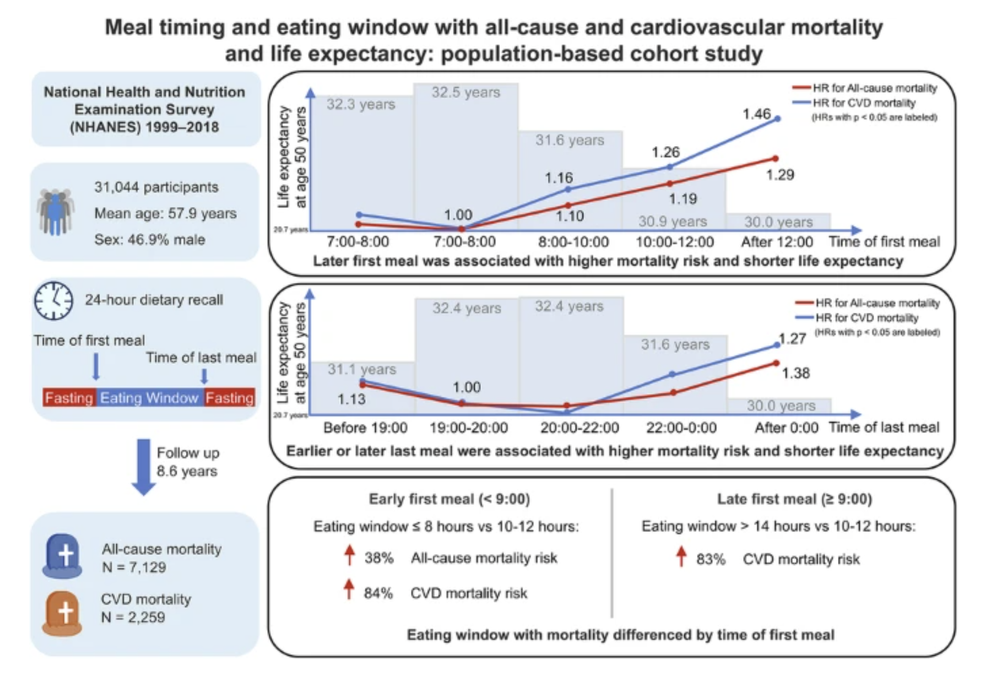
Үдээс хойш анх хооллосон хүмүүсийн зүрх судасны шалтгаант нас баралтын эрсдэл 07:00–08:00 цагт иддэг бүлгээс 46 хувиар өндөр байсан бөгөөд 50 настайд тооцсон дундаж наслалт 2.46 жилээр богино байжээ. Харин сүүлийн хоолны цагтай холбоотой хамаарал U хэлбэртэй байсан: 19:00 цагаас өмнө идэх нь бүх шалтгаант нас баралтын эрсдэл 13 хувиар өндөртэй, шөнө дундаас хойш идэх нь 27 хувиар өндөртэй холбоотой байв. Тооцоолсон эрсдэл 20:00 цагийн орчимд хамгийн бага байсан ч 20:00 цагаас шөнө дунд хүртэл хооллосон хүмүүсийн эрсдэл 19:00–20:00 цагт идсэн бүлгээс мэдэгдэхүйц өндөр байгаагүй; шөнө дундаас хойш иддэг бүлгийн 50 настай үеийн тооцоолсон дундаж наслалт 2.35 жилээр богино байжээ.

Эхний хоолны цагийг тооцсоны дараа өдрийн хооллох цонхны урт нас баралттай нийт оролцогчдын хэмжээнд тогтвортой хамаарал үзүүлээгүй бөгөөд энэ холбоо хооллож эхэлсэн цагаас шалтгаалан өөр байв. Судалгааг ахалсан Хуажун шинжлэх ухаан, технологийн их сургуулийн хоол тэжээлийн судлаач Жилэй Шань оройтож хооллох нь биеийн цагийн хэмнэл, бодисын солилцоонд нөлөөлж болзошгүйг хэлсэн ч хэт эрт оройн хоол идэх нь хуваарь, өвчин эсвэл бага илчлэгийн хэрэглээг илтгэж болохыг тэмдэглэжээ. Амьтны судалгаанд жин нэмэх, элгэнд өөх хуримтлагдах, тархинаас бусад эрхтний биологийн цаг алдагдах зэрэг боломжит механизмыг дурдсан боловч эдгээр нь хүний нас баралтын хамаарлыг тайлбарладаг эсэх тодорхойгүй; 2026 оны санамсаргүй хяналтат туршилтуудын дүнгээр өдрийн эрт дуусах хооллох цонх бодисын солилцооны үзүүлэлтүүдэд илүү сайн нөлөөтэй байсан ч амьд үлдэх хугацааг судлаагүй байна.
Судалгаа ажиглалтын загвартай тул хооллох цаг нас баралтыг шууд үүсгэдэг гэж дүгнэх боломжгүй. Хоолны цагийн мэдээлэл үндсэндээ судалгааны эхэнд авсан нэг өдрийн дурсамжид тулгуурласан бөгөөд нойр, өдөр тутмын идэвх, хүний биологийн цаг болон хэмжээгүй бусад хүчин зүйл үр дүнд нөлөөлсөн байж болно; оройтож хооллох нь эрүүл мэнд муудах, нойр муу байх, ээлжийн ажил эсвэл нийгэм-эдийн засгийн нөхцөлтэй холбоотой байж болзошгүй. Шань судалгааны энэ үр дүнд үндэслэн хооллох хуваариа эрс өөрчлөх шаардлагагүй, харин тогтмол хооллож, унтах хэвшлээ хадгалан, эхний хоолоо өдөр хэт оройтуулах болон шөнө байнга хооллохоос зайлсхийж, хоолны чанар, амьдралын хэв маягт анхаарах нь зүйтэй гэж тайлбарлажээ.
Дэлгэрэнгүйг эх сурвалжаас харах
↓Эх сурвалжийг нээх ↓
Most breakfast advice focuses on what to put on your plate.
But a large study of US adults suggests the clock may deserve attention, too: The time you consume your first and last calories of the day could be linked to how long you live.
The findings show an association, not proof that changing the clock changes a person’s fate. Still, they add to evidence that health may depend not only on what we eat, but when.
Earlier studies have linked skipping breakfast and late-night eating with poorer health, but the risks associated with specific times remained unclear.
Researchers therefore analyzed data from 31,044 adults aged 40 and older in the US National Health and Nutrition Examination Survey between 1999 and 2018.
Participants reported everything they ate or drank in the previous 24 hours, including the time of each item.
The study, published in theEuropean Journal of Clinical Nutrition, defined any calorie-containing food or drink consumed after 4 am as the ‘first meal,’ meaning it was not necessarily a conventional sit-down breakfast.
The final caloric intake became the last meal, and the time between them became the eating window.
The team linked these records to deaths registered through the end of 2019.
During a median follow-up of 8.6 years, 7,129 participants died, including 2,259 from cardiovascular causes.
The analysis accounted for factors including age, smoking, physical activity, diet quality, body mass index, energy intake, income, and existing disease.
A pattern emerged as the first meal moved later.
Compared with eating between 7 and 8 am, a first meal between 8 and 10 am was associated with a 10 percent higher risk of death from any cause. The difference rose to 19 percent between 10 am and noon, and 29 percent after noon.
Cardiovascular mortality followed a similar trajectory.
Eating for the first time after noon was associated with a 46 percent higher risk of cardiovascular death than eating between 7 and 8 am. At age 50, the group with later first meals also had an estimated life expectancy 2.46 years shorter on average.
The day’s final meal produced a more surprising result.
Rather than risk simply rising with each later hour, the relationship was U-shaped. Compared with finishing between 7 and 8 pm, eating before 7 pm was associated with a 13 percent higher risk of death from any cause.
Meanwhile, eating after midnight was associated with a 27 percent higher risk of death from any cause, and it was linked to an estimated life expectancy 2.35 years shorter at age 50.
The lowest modeled risk was around 8 pm.
“However, this does not mean that 7-8 pm is a universally optimal dinner time for everyone,” senior author Zhilei Shan, a nutrition scientist from Huazhong University of Science and Technology, told ScienceAlert.
Finishing eating between 8 pm and midnight was not linked to a significantly higher mortality risk than finishing between 7 and 8 pm.
Very late eating may disrupt circadian rhythms and metabolism, Shan explained. But a very early last meal could reflect schedules, illness, or lower energy intake.
Early eaters tended to be older, eat less often, and have more existing illness, so the clock may reveal something about their health rather than cause it.
The eating window added another complication.
Once first-meal timing was considered, its length showed no consistent relationship with mortality across the whole sample. Instead, its association varied according to when eating began.
That adds nuance to concerns aboutvery short eating windows: Counting fasting hours alone may miss part of the picture.
“Meal timing is an important cue for peripheral circadian rhythms,” Shan said.
“A later first meal or late-night eating may contribute to circadian misalignment and metabolic disturbances, including impaired lipid and glucose metabolism.”
Animal studies point to possible pathways involving weight gain, liver fat accumulation, disrupted clocks in organs outside the brain, and altered fat absorption.
Whether these mechanisms explain mortality patterns in humans remains unknown.
A 2026 analysis of randomized trials found that eating windows ending earlier in the day improved metabolic markers more than later windows, though those trials measured outcomes such as blood sugar and weight, not survival.
Reverse causation is also possible. Late eating may be a consequence or marker of poor health, poor sleep, shift work, or socioeconomic circumstances.
A previous study of older adults similarly found thatbreakfast shifted later as health problems accumulated.
“Therefore, later eating should be interpreted as a potential risk marker, and possibly a modifiable behavior, rather than definitive evidence of a direct causal effect,” Shan said.
Related: Scientists Identified 10 Healthy Diets Linked to Slower Biological Aging
The study’s biggest limitations follow from its observational design. Meal timing was primarily captured by a single 24-hour recall at the start, which may not represent years of habitual eating.
Chronotype, detailed sleep patterns, activity timing, and other unmeasured factors could still influence the results despite extensive adjustments and sensitivity analyses.
“Based on these findings alone, people should not make extreme changes to their eating schedules,” Shan said.
“A practical interpretation is to maintain regular eating and sleeping routines, avoid routinely delaying the first meal until very late in the day, and avoid frequent late-night eating, while also prioritizing overall dietary quality and lifestyle.”
The study was published in theEuropean Journal of Clinical Nutrition.
This article was fact-checked by Rebecca Dyer and edited by Rebecca Dyer. While we pride ourselves on our process, we are only human. If you spot a mistake, please let us know.

