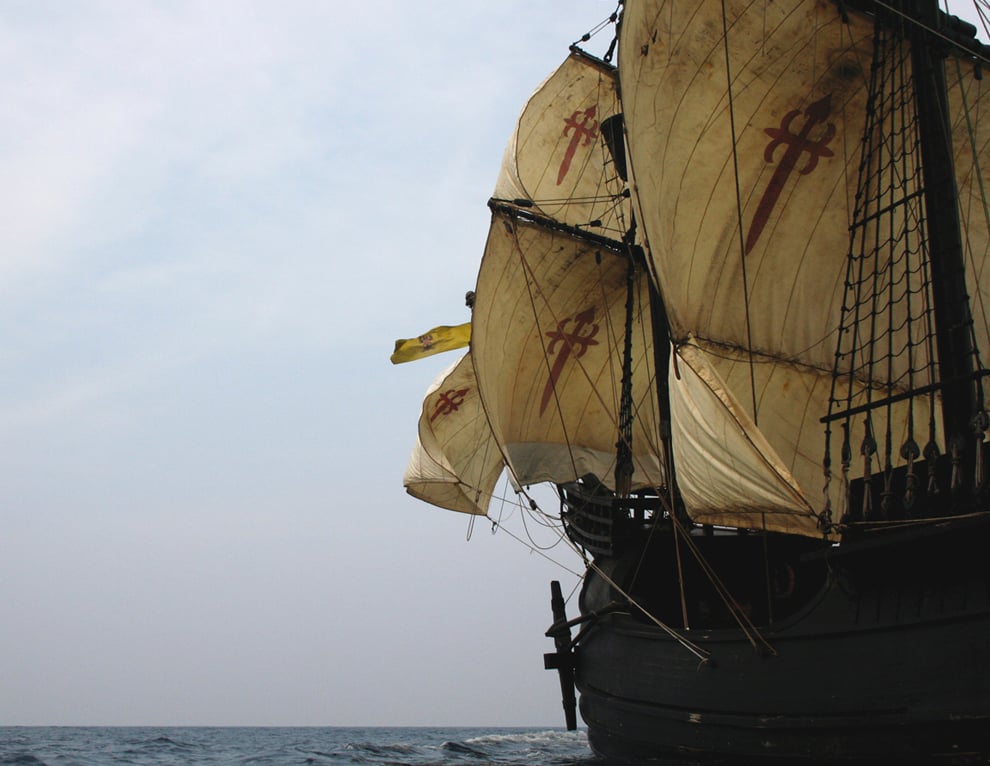
Сансрын салбарын бизнес эрхлэгчид ашиг орлогоо нэмэгдүүлж, сансрын эдийн засгийг бодитой болгохын тулд түүхэн дэх худалдааны амжилттай загваруудаас суралцах шаардлагатай байна.
Өнөөдөр сансрын аялал жуулчлал, үйлдвэрлэл, ашигт малтмалын олборлолт зэрэг салбар хөгжиж байгаа хэдий ч эдгээр нь эдийн засгийн хувьд хараахан үр ашигтай болоогүй байна. Түүхийн туршлагаас харахад томоохон нээлт, бүтээн байгуулалт нь ашгийн төлөөх эрэл хайгуултай нягт холбоотой байдаг. XVI зуунд Португал, Испани зэрэг улс орнууд Торгоны замын зуучлагчдыг тойрч, халуун ногооны худалдааг далайгаар дамжуулан хөгжүүлснээр эдийн засгийн үлэмж ашиг олж байсан нь үүний тод жишээ юм.
Халуун ногоо нь хөнгөн жинтэй, үнэ цэнэтэй, удаан хадгалагдах боломжтой байсан тул далайн тээвэрт нэн тохиромжтой ачаа болж байв. Тухайлбал, 1515 онд Лиссабонд буусан халуун ногооны ачаа 700 хувийн ашиг авчирч байсан бол 1520 онд Португалийн хаант улсын нийт орлогын 40 хувийг зөвхөн энэ худалдаа бүрдүүлж байжээ. Фердинанд Магеллан зэрэг аялагчид барууныг чиглэн далайн шинэ зам нээснээр худалдааны хэлхээ холбоог бүрмөсөн өөрчилсөн нь сансрын салбарынхны хувьд ч сургамжтай үйл явдал юм.
Сансрын салбарын мэргэжилтэн, доктор Пит Уордены үзэж байгаагаар сансрын дэд бүтэц, тээвэрлэлтийг хөгжүүлэхэд арилжааны тогтвортой шалтгаан хэрэгтэй байна. Ойрын 50 жилд шинжлэх ухааны судалгааг роботын тусламжтайгаар явуулах нь илүү үр дүнтэй бөгөөд NASA нь судалгаа, технологийн хөгжүүлэлтэд түлхүү анхаарч, хувийн хэвшлийнхэнд сансрын нислэгийн системийг ажиллуулах үүргийг шилжүүлэх шаардлагатай. Хэрэв сар, Ангараг гараг эсвэл астероидуудаас ашигт малтмал олборлох нь эдийн засгийн хувьд бодитой болж чадвал сансрын эдийн засаг жинхэнэ утгаараа хөгжих боломж бүрдэнэ.
Дэлгэрэнгүйг эх сурвалжаас харах
Эх сурвалжийг нээх ↓
Despite all the hype about a new space economy, humanity has yet to reap much benefit offered by the prospect of offworld mining, manufacturing, or space tourism.
But historical precedent dictates that ventures into the unknown need to be driven by commerce to achieve profitability. Such was the case five centuries ago, when most of Western Europe was agog over the importation of precious spices from East Asia.
Spices such as cloves which today can be found in holiday ham and gingerbread cookies were a primary driver for the Portuguese and the Spanish to look for an alternative route to the fabled Spice Islands. That is, somewhere East of the subcontinent of India.
The idea was to circumvent the Silk Road from and drive the spice trade from overland camel caravans to large cargo-holding ships.
For centuries, camels had enabled trickles of spices such as cloves, nutmeg, and ginger to make their way into the kitchens of the high and mighty, be they landed gentry or royalty.
Cloves originally grew in the volcanic soils of only a handful of small islands in the northern Moluccas archipelago, author Lewis Dartnell notes in his 2019 book “Origins: How the Earth Shaped Human History.” And the nutmeg tree appeared on only nine pinprick-sized islands — the Bandas-further south, Dartnell writes.
Dried nutmeg. Credit: Wikipedia
But as early as the late 15th century and the Age of Columbus, middlemen had run up the cost of these rare spices to such a degree that Portugal and Spain, in particular, were in competition for a sea route to the Moluccas. That is, the Moluccan archipelago in what is now Indonesia.
The idea was to travel point to point by sea and weed out a multitude of middlemen along the long Silk Road — mostly stretching overland from the Black Sea and Mediterranean through northern India to China.
Thus, Portuguese explorer Ferdinand Magellan had a novel idea.
Magellan, born into a family of minor nobility and modest possessions, had somehow convinced Spain’s King Charles V that it was possible to reach the eastern riches by traveling west, author Romeu Gaspar writes in his 2026 book “The Revolution of Magellan: How 500-Year-Old Rocket Science Changed the World.”
And even though Magellan tragically lost his life en route at least a remainder of his crew did circumnavigate the globe. In the process, they forever changed the course of history, commerce, and human exploration.
Spices Were The Ideal Cargo
Dried spices were a lightweight, high-value, reasonably imperishable product with which to stuff a ship’s hold on long voyages, John Keay writes in his 2005 book “The Spice Route: A History.” The profits were huge; in 1515, the return on such cargo docked at Lisbon was 700 per cent, Keay notes.
A Spice Boom
By 1520, the income from Portugal’s spice trade provided 40 percent of the Crown’s total revenue, Dartnell writes in his book. Spices eventually became so prized that in 1677, the Dutch swapped the island of Manhattan for the nutmeg-rich island of Run Palau, he notes.
A 21st century analogy to such commercial exploration might be if by the end of this century, space entrepreneurs were able to extract and then process rare minerals from the Moon or Mars or even accessible Main Belt asteroids. And then in a cost-efficient manner, reap the profits by bringing them back to Earth. Or at least low-Earth orbit.
To that end, NASA Apollo 17 astronaut and geologist Harrison Jack Schmitt has long argued for Helium-3 mining on the Moon. But until someone fulfills the economics of making cislunar Space profitable human exploration of our solar system is likely to lag. That’s because throughout history, scientific innovation usually goes hand in hand with someone’s quest for a large profit margin.
A durable commercial reason for people to work in space could give human space science the transportation and infrastructure it needs, Ret. U.S. Brigadier Gen. Pete Worden, an astrophysicist, chairman of the Breakthrough Prize Foundation, and Laureate Professor at the University of Arizona in Tucson, told me via email.
Our Short-Term Space Future
Within the next fifty years at least, the future of scientific space exploration is arguably best served by robotic means rather than astronauts.
I’d rely heavily on robots for science and give commercial companies a larger role in developing and operating human spaceflight systems, Worden, who directed NASA Ames Research Center from 2006 to 2015, told me via email. NASA should return to its roots in the National Advisory Committee for Aeronautics (NACA) by emphasizing research and technology development that industry and scientists can build on, he says.
Routine human sorties beyond low-earth orbit are key.
If commercial space transportation becomes routine, agencies such as the National Science Foundation (NSF) could support research that uses it, Worden argues.
Meanwhile, we are left with space programs that for decades have been hampered by both politics and economics and as a result, have limped along in fits and starts.
Over the past 30 years, NASA’s plans for the Moon and Mars have had to survive changes in administrations, budgets, and priorities, says Worden. When a program needs agreement from too many people, it becomes harder to take sensible risks, he says.
The Bottom Line?
If humanity can ever succeed in making forays beyond low Earth orbit that are commercially viable in the same way the 16th Century spice trade was profitable, then this new ocean of space-time could be ours for the taking.
Sources:
Origins: How the Earth Shaped Human History
The Revolution of Magellan: How 500-Year-Old Rocket Science Changed the World

