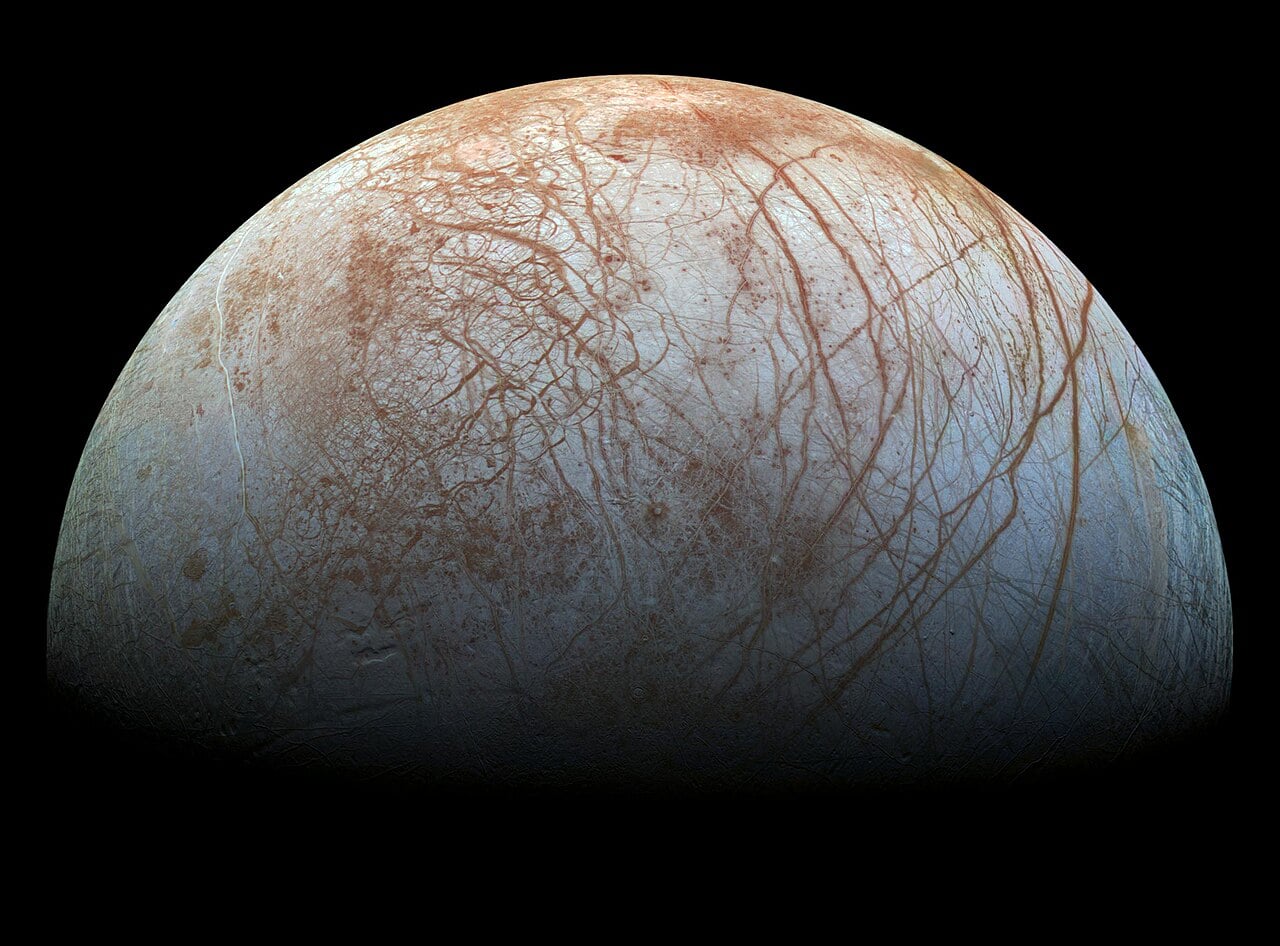
Бархасбадь гарагийн дагуул Европагийн натрийн үүл нь бусад хүчин зүйлээс үл хамааран тогтвортой байгаа нь түүнийг дотоод далайтай холбоотой болохыг гэрчилж байна.
Бархасбадь гарагийн дагуул Европагийн мөсөн гадаргуугийн доор далай оршдог байж болзошгүй гэсэн таамаглалыг олон арван жилийн турш судалж ирсэн. W.M. Keck Observatory-ийн судлаачид сүүлийн хорь гаруй жилийн ажиглалтын мэдээлэлд дүн шинжилгээ хийснээр, сарны эргэн тойрон дахь натрийн үүл Бархасбадийн хүрээлэн буй орчны динамик хүчнүүд болон ойролцоох галт уулт Ио дагуулын нөлөөнд авталгүй, гайхалтай тогтвортой байгааг илрүүлжээ. Энэхүү судалгааг Бостоны их сургуулийн судлаачид тэргүүлж, үр дүнг Journal of Geophysical Research: Space Physics сэтгүүлд нийтэлсэн байна.
Судлаачид Keck-ийн High Resolution Echelle Spectrometer (HIRES) багажийг ашиглан натрийн үүлний тархалтыг нарийвчлан зураглажээ. Мөсөн гадаргуугийн өндөр ойлтын улмаас үүсдэг хүндрэлийг даван туулахын тулд багийнхан Европаг Бархасбадийн сүүдэрт байх үед нь ажиглаж, гадаргуугийн нарны гэрлийн тусгалыг хязгаарласан байна. 2022 оны есдүгээр сарын 29-нд NASA-гийн Juno сансрын хөлөг Европагийн ард өнгөрөх үед хийсэн ажиглалт нь натрийн үүлийг орон нутгийн плазмын орчинтой харьцуулан судлах ховор боломжийг олгожээ.
Энэхүү судалгаа нь натрийн үүл нь Ио дагуулын галт уулнаас бус, харин Европагийн өөрийнх нь давстай уснаас үүдэлтэй болохыг харуулж байна. Эрдэмтэд одоо Hubble Space Telescope ашиглан Европагийн агаар мандалд магни байгаа эсэхийг хайж байгаа бөгөөд энэ нь далайн давсны найрлагыг тодорхойлоход нэмэлт нотолгоо болох юм. NASA-гийн Europa Clipper болон ESA-гийн JUICE номлолууд нь энэхүү мөсөн ертөнцийн гадаргуу болон дотоод давхаргын хоорондох бодисын солилцоог илүү нарийвчлан судлахаар замдаа гарчээ.
Дэлгэрэнгүйг эх сурвалжаас харах
Эх сурвалжийг нээх ↓
Jupiter’s moon Europa has been fascinating astronomers and astrobiologists for decades. Ever since the Voyager probes passed through the system in 1979, scientists have theorized that an ocean lies beneath its icy crust. Further observations bolstered this theory, revealing surface plumes caused by warm water pushed up through vents in the crust (cryovolcanism). They’ve also found fascinating chemistry on the moon’s surface, and an enormous, diffuse cloud of sodium surrounding it.
And now, observations by the W.K. Keck Observatory in Hawai’i have revealed something new and very surprising. That sodium cloud has remained remarkably stable after more than two decades of observations despite the dynamic and powerful forces that characterize Jupiter’s environment. In a recent study led by Boston University, an interdisciplinary team of researchers compared sodium measurements high above Europa with observations of sodium clouds very close to the surface.
Their results, reported in the Journal of Geophysical Research: Space Physics, provide the first connection between the two, giving scientists a more complete view of the moon’s environment. This, in turn, gives scientists a sneak peek at the ocean beneath Europa’s surface. The team’s observations relied on two decades of observations using Keck’s High Resolution Echelle Spectrometer (HIRES) instrument, allowing them to map the sodium cloud’s distribution and how it responds to changing conditions in the system.
Europa’s sodium cloud is oblong-shaped, elongated in the east-west direction, and measures over 46,800 km (29,095 mi) in diameter, or about 30 times Europa’s radius. Sodium is of particular interest to planetary scientists because it is a constituent of sodium chloride (salt), a key ingredient in Earth’s oceans. Based on the latest fossil evidence, scientists theorize that life first emerged approximately 4 billion years ago in Earth’s primordial oceans around hydrothermal vents.
Based on multiple lines of evidence, astrogeologists also believe that similar vents exist inside Europa at the core-mantle boundary. Understanding the origin and distribution of sodium around Europa can help researchers learn more about the materials on the moon’s surface and potentially subsurface. Emma Lovett, a graduate student at Boston University and lead author on the study, explained in a W.M. Keck Observatory release:
We don’t know a lot about Europa’s hidden ocean and icy surface, but its atmosphere offers a window into this potentially habitable world. The whereabouts of life beyond Earth might be closer than we ever imagined.
However, studying sodium close to the moon’s surface presents many challenges. Foremost among these is the highly reflective nature of Europa’s surface ice, which can overwhelm the faint signal emitted by nearby gas. To overcome this problem, the team used the HIRES instrument’s high-resolution, long-slit configuration to measure the sodium’s distinctive spectral fingerprint. They also observed Europa as it passed through Jupiter’s shadow, ensuring that there was no direct sunlight reflecting off the surface to interfere with the signals they detected.
By changing the instrument’s orientation at multiple locations, the team mapped the sodium cloud rather than measuring its spectra at any single point. Lastly, they combined new observations with archival data Keck obtained in 1999 to see how the cloud changes over time. Surprisingly, they found that the cloud has remained stable despite changes in Jupiter’s plasma environment and the influence of the neighboring volcanic moon Io, which spews sodium into space. Said Carl Schmidt, a researcher at Queen’s University Belfast and Boston University:
The neighboring volcanic moon Io sprays sodium around the Jupiter system, and we’ve often wondered if Io paints Europa’s surface. The stable sodium abundance in these Keck data shows that Europa is indifferent to Io’s volcanic activity. What we observe originates in Europa’s saltwater and not in Io’s volcanoes.
Radiation from Jupiter can break apart molecules on Europa’s surface. This can free oxygen, which could percolate in brines through the surface into the ocean under the ice. Credit: NASA/JPL-Caltech
A particularly beneficial observation occured on September 29th, 2022, when NASA’s Juno spacecraft passed behind the moon relative to the team’s perspective. For the past ten years, Juno has studied Jupiter’s atmosphere, magnetosphere, and plasma environment. So on this occasion, the team had the chance to study the sodium cloud alongside measurements of the local plasma cloud. This enabled the team to examine the sodium cloud across a range of conditions and to test the effects of Jupiter’s magnetosphere and Io’s volcanic activity.
While most astrobiology missions are currently searching for evidence for past life on Mars, Europa is the next target in the search for extraterrestrial life. Right now, NASA’s Europa Clipper mission and the ESA’s JUpiter ICy Moons Explorer (JUICE) are en route to the system to study this icy moon. Because Europa is not a terrestrial planet but an “Ocean World,” it offers major opportunities to study potentially habitable environments beyond Earth. In particular, scientists want to see how water and other materials are transferred between the surface and the interior.
While no direct evidence of organic molecules has been detected on the surface, research strongly indicates the moon has the key chemical ingredients and pathways to form them. And while the sodium cloud does not provide a direct measurement of Europa’s ocean, understanding its origin and behavior helps scientists understand the moon’s chemical environment. Building on their momentum, the team is currently using the Hubble Space Telescope to look for magnesium in Europa’s atmosphere, another possible element in Europa’s ocean salts. As Lovett summarized:
These observations help us refine our models of Europa’s atmosphere, testing what releases sodium and how radiation pressure shapes its distribution. We’re also looking for magnesium, which has been tentatively detected on Europa’s surface but not yet in its atmosphere. Finding it could provide another important clue to the salts present on this intriguing ocean world.
Further Reading: W.M. Keck Observatory, JGR Space Physics

