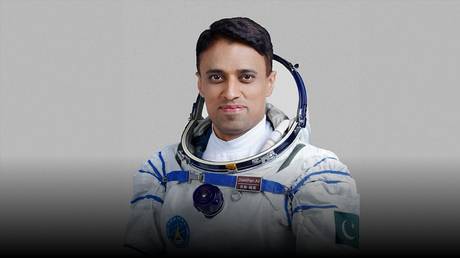
Пакистаны агаарын цэргийн хүчний нисгэгч Зишан Али Хятадын “Шэньжоу-24” сансрын хөлгөөр “Тяньгун” станц руу нисэх анхны гадаадын иргэн болох гэж байна.
Лхагва гарагт хөөрөх “Шэньжоу-24” хөлөг нь Хятадын баруун хойд хэсэгт байрлах Жиуцюань хиймэл дагуул хөөргөх төвөөс Long March-2F пуужингаар хөөрөх юм. 40 настай Зишан Али нь багийн ахлагч Тан Хунбо болон нислэгийн инженер Ву И нартай хамт сансарт ажиллах бөгөөд ачааны мэргэжилтний хувиар 5-10 хоногийн турш туршилт судалгаа хийнэ. Тэрээр Бээжинд долоон сарын турш бэлтгэл сургуулилт хийхийн зэрэгцээ хятад хэл, соёлтой танилцсан байна.
A proud moment for Pakistan! 🇵🇰
We congratulate Pakistani astronaut Muhammad Zeeshan Ali on his selection as a payload specialist for China’s Shenzhou-24 mission, marking a historic milestone in space exploration. This achievement underscores the immense potential of Pakistan’s human talent and the enduring Pakistan-China friendship.
🇵🇰🤝🇨🇳
— Ministry of Foreign Affairs – Pakistan (@ForeignOfficePk) November 24, 2026
Зишан Али энэхүү нислэг нь зөвхөн өөрийнх нь амжилт бус, Пакистан улсын нэрийг сансрын уудманд гаргаж буй чухал үйл явдал болохыг онцолжээ. Хятад болон Пакистан улсууд 1990-ээд оноос хойш сансрын салбарт хамтран ажиллаж ирсэн бөгөөд 2028 он гэхэд Хятадын сарны мисст Пакистаны бүтээсэн роботыг илгээхээр төлөвлөж байгаа юм.
“Тяньгун” сансрын станц нь 2022 оны сүүлээс хойш бүрэн ашиглалтад орсон бөгөөд НАСА-гийн Олон улсын сансрын станцыг (ISS) 2030 онд ашиглалтаас гаргасны дараа олон улсын томоохон төв болох зорилттой байна. Шинжээчдийн үзэж буйгаар Хятад улс энэхүү алхмаараа дамжуулан сансрын салбар дахь нөлөөгөө бэхжүүлж, зөөлөн хүчний бодлогоо идэвхтэй хэрэгжүүлж байна.
Дэлгэрэнгүйг эх сурвалжаас харах
↓Эх сурвалжийг нээх ↓
Zeeshan Ali will be the first foreign astronaut to fly the Shenzhou-24 to the Tiangong space station
A Pakistani pilot is set to become the first foreign national associated with a Chinese space mission when the Shenzhou-24 flight blasts off on Wednesday.
Zeeshan Ali, a 40-year-old air force pilot, will also be the first Pakistani in orbit as he heads to the Tiangong space station, Reuters reported.
Ali will join Chinese commander Tang Hongbo and flight engineer Wu Yi on board the Shenzhou spacecraft, where he will be a payload specialist. He will conduct experiments on the space station for five to ten days.
The spacecraft will be launched on a Long March-2F rocket at 8:18 AM (00:18 GMT) from the Jiuquan Satellite Launch Center in northwest China, according to the report.
Ali has been doing preparatory training for the space mission for seven months in Beijing, while also learning the Chinese language, songs and poetry, and dabbling in calligraphy and table tennis.
A proud moment for Pakistan! 🇵🇰
We congratulate Pakistani astronaut Muhammad Zeeshan Ali on his selection as a payload specialist for China’s Shenzhou-24 mission, marking a historic milestone in space exploration. This achievement underscores the immense potential of Pakistan’s human talent and the enduring Pakistan-China friendship.
🇵🇰🤝🇨🇳
— Ministry of Foreign Affairs – Pakistan (@ForeignOfficePk) November 24, 2026
“I’m not flying for myself. I carry the name of Pakistan on my shoulder,” Ali was quoted as saying to reporters.
China has been collaborating with Pakistan on space since the early 1990s. Beijing has launched Pakistani satellites, and a Pakistani-built rover is slated to fly on a Chinese lunar mission by 2028.
“China has always been very good at using space for soft power outreach,” Victoria Samson, chief director of US-based Space Security and Stability at the Secure World Foundation, told Reuters.
Though Ali will only have a brief stay on the space station, considering that Chinese astronauts stay up to six months, it will be a boost to Pakistan’s space ambitions.
Tiangong, or Celestial Palace in Chinese, has been fully operational since late 2022 and is equipped to host up to six astronauts during handovers when an arriving three-person crew overlaps with the departing crew.
Beijing envisages Tiangong space station as an international space hub, as the NASA-led International Space Station (ISS) is scheduled to be retired by 2030.

