
Нарны аймгийн бусад гарагаас эрс ялгаатай тэнхлэгийн хазайлт нь Тэнгэрийн вангийн улирлыг туйлын урт, агаар мандлыг нь хувьсамтгай болгодог.
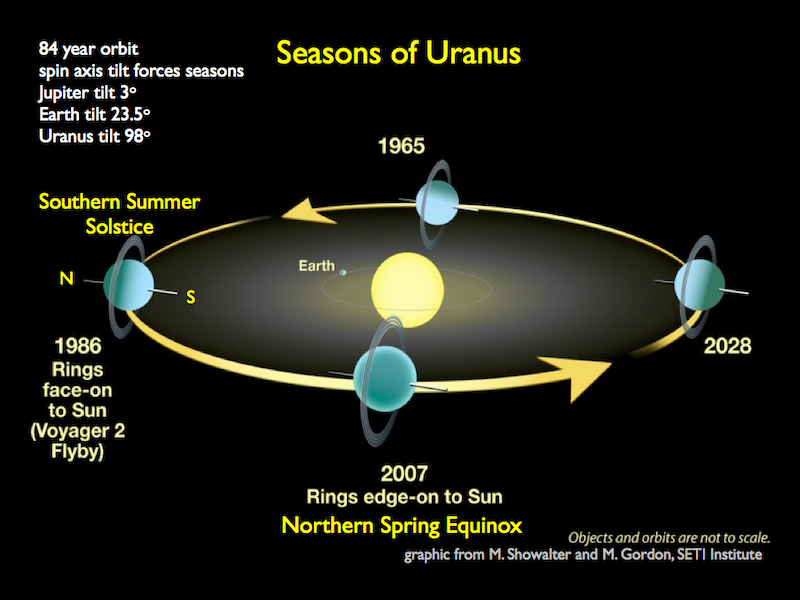
Тэнгэрийн вангийн эргэлтийн тэнхлэг тойрог замын хавтгайтайгаа харьцуулахад 98 градус хазайсан байдаг бол Дэлхийнх 23.5 градусын хазайлттай. Нарнаас ойролцоогоор 2.9 тэрбум км зайд орших энэ гараг нарыг нэг бүтэн тойроход Дэлхийн 84 жил шаардагддаг тул дөрвөн улирал тус бүр 21 жил үргэлжилнэ. Тойрог зам нь бараг дугуй учраас улирлын өөрчлөлтийг Нарнаас холдох, ойртох нь бус, тэнхлэгийн хазайлт нь голлон тодорхойлдог.
Зуны улиралд нэг туйл болон түүний хагас бөмбөрцгийн ихэнх хэсэг 21 жилийн турш нарны гэрэлд тасралтгүй байх бол эсрэг талын хагас бөмбөрцөг мөн хугацаанд харанхуйд автана. Харин хавар, намрын тэнцлийн үеэр нарны гэрэл экваторын бүсэд тусаж, гарагийн өргөн хэсэгт өдөр, шөнө ойролцоогоор 17 цаг 14 минут тутамд солигдоно.
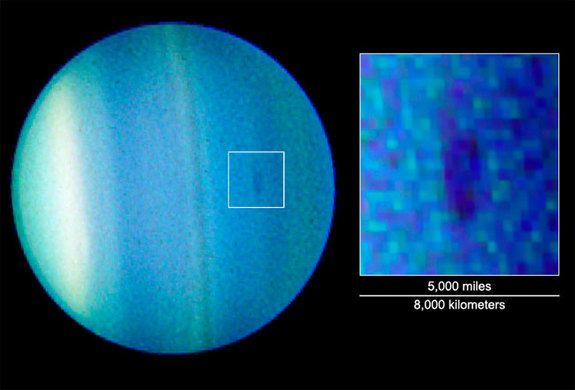
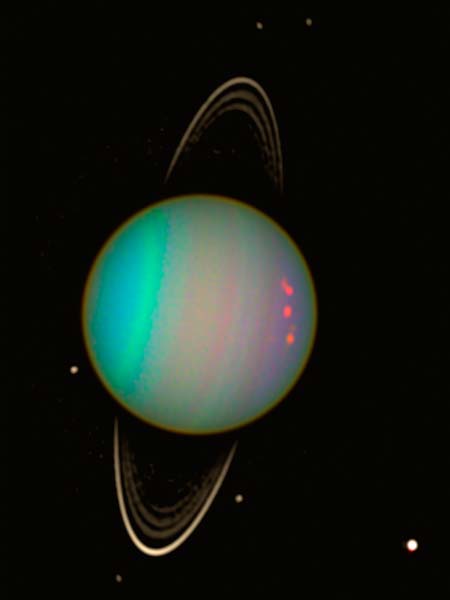
Voyager 2 сансрын хөлөг 1986 онд Тэнгэрийн вангийн өмнөд хагас бөмбөрцгийн зун тус гарагийн дэргэдүүр нисэхэд гараг хөх, бараг онцлоггүй харагдаж байв. 2007 онд өмнөд хагас бөмбөрцгийн намрын тэнцэл болж, нарны гэрэл экваторт тусах үед дэлхий болон сансарт байрлах дурангууд үүл, агаар мандлын бүслүүрийн өөрчлөлт, тод толбуудыг ажигласан. Нарны гэрэл олон жилийн дараа зарим өргөрөгт хүрснээр агаар мандалд Хойд Америктай дүйх хэмжээтэй, ойролцоогоор −184°C хүйтэн аварга шуургууд үүссэн бөгөөд ажиглагчид мөн харанхуй толбыг хэдэн жилийн турш даган судалжээ.
Дэлгэрэнгүйг эх сурвалжаас харах
Эх сурвалжийг нээх ↓
Strange seasons of Uranus
Uranus has bizarre seasons, at least from our earthly perspective. That’s because Uranus spins nearly sideways compared to the plane of its orbit around the sun.
Mercury, Venus, Earth, Mars, Jupiter, Saturn and Neptune all spin roughly in line with their orbits around our star. Compared to these elegant, upright-spinning worlds, Uranus seems almost as if it’s rolling around the sun.
Consider that Earth’s axis is tilted 23.5 degrees with respect to the plane of our orbit around the sun. Uranus’s axis is tilted at a whopping 98 degrees! So Uranus is tilted nearly sideways to the plane of the solar system, or the flat sheet of space in which nearly all the planets and moons orbit.
And, speaking of its orbit, Uranus orbits 1.8 billion miles (2.9 billion km) from the sun. Therefore, Uranus takes a long time to orbit the sun once. Its year is 84 Earth-years long. That makes each of its four seasons 21 years long. That’s another reason we on Earth think of Uranus’ seasons as strange.
Like Earth, Uranus has a nearly circular orbit, so it always remains at roughly the same distance from the sun. Unlike Mars — whose orbit is more elliptical than that of Earth or Uranus — Uranus’ distance from the sun isn’t a factor in its seasonal change.
Instead, as on Earth, the planet’s tilt is what gives Uranus its four seasons.
Extreme tilt means extreme seasons
So think about how Uranus’ tilt affects its seasons, in contrast to earthly seasons. Here’s one difference. Earth’s tilt means our north and south polar regions have a midnight sun in summer and a long polar night in winter. Since Earth’s axis tilt is relatively small, those dark and bright times at Earth’s poles affect a relatively small part of our planet.
But the tilt of Uranus’ spin axis — 98 degrees — is huge. As a result, in summer, one pole of Uranus plus a large section of that pole’s hemisphere faces the sun continuously for 21 years. Meanwhile, the other half of Uranus — the winter half — is in darkness for 21 years. That’s a long polar night, and a long midnight sun!
Bizarre spring and fall on Uranus
Spring and fall on Uranus are equally bizarre. Around the equinoxes on Uranus, sunlight strikes the equatorial region of the planet. During those seasons, the length of a day on Uranus plays an important role in its climate. Uranus spins on its axis about every 17 hours, 14 minutes. So its day-night cycle lasts that long.
So, for much of the planet’s spring and fall, a large percentage of the planet has day and night about every 17 hours. It’s quite a contrast to the summer and winter seasons when half the planet is either in darkness or daylight.

What we see from Earth and spacecraft
The extreme seasonal changes cause dramatic shifts in Uranus’ cloud patterns. Earth- and space-based observatories have observed this change over decades of Uranus-watching. The Voyager 2 spacecraft is the only craft from Earth that has ever flown past Uranus. That was in 1986. Voyager 2 encountered this world during its southern hemisphere summer. The spacecraft saw Uranus as blue and featureless.
In the years since Voyager 2’s flyby of Uranus, astronomical observing technologies have become more powerful. As Uranus moved in its 84-year orbit around the sun, we’ve seen the seasons on Uranus change.
Since the Voyager 2 observations, Uranus has emerged from the grip of its decades-long winter/summer season. Its southern hemisphere autumn equinox occurred in 2007; that’s when the sun was shining above Uranus’ equator. Sunlight reached some latitudes for the first time in years. Light and warmth in the atmosphere triggered gigantic storms comparable in size to North America (but with temperatures of -300 Fahrenheit/-184 Celsius), visible as bright spots in the planet’s atmosphere.
Following seasons of Uranus from Earth
Around that time, Earth- and space-based telescopes revealed more clouds in the atmosphere of Uranus. Bands encircling the planet changed in size and brightness as sunlight struck parts of the planet for the first time in decades. Plus, a dark spot appeared – and more bright spots – which observers were able to follow for years.
What more will we see in the decades and years ahead as Uranus moves toward the long winter/summer portion of its orbit once more?
Bottom line: Uranus is tilted massively compared to the rest of the solar system’s planets. That causes extreme seasons, and great atmospheric shifts through its year.
Read more: Uranus at opposition on November 25, 2026
Read more: Uranus discovered by accident in 1781

