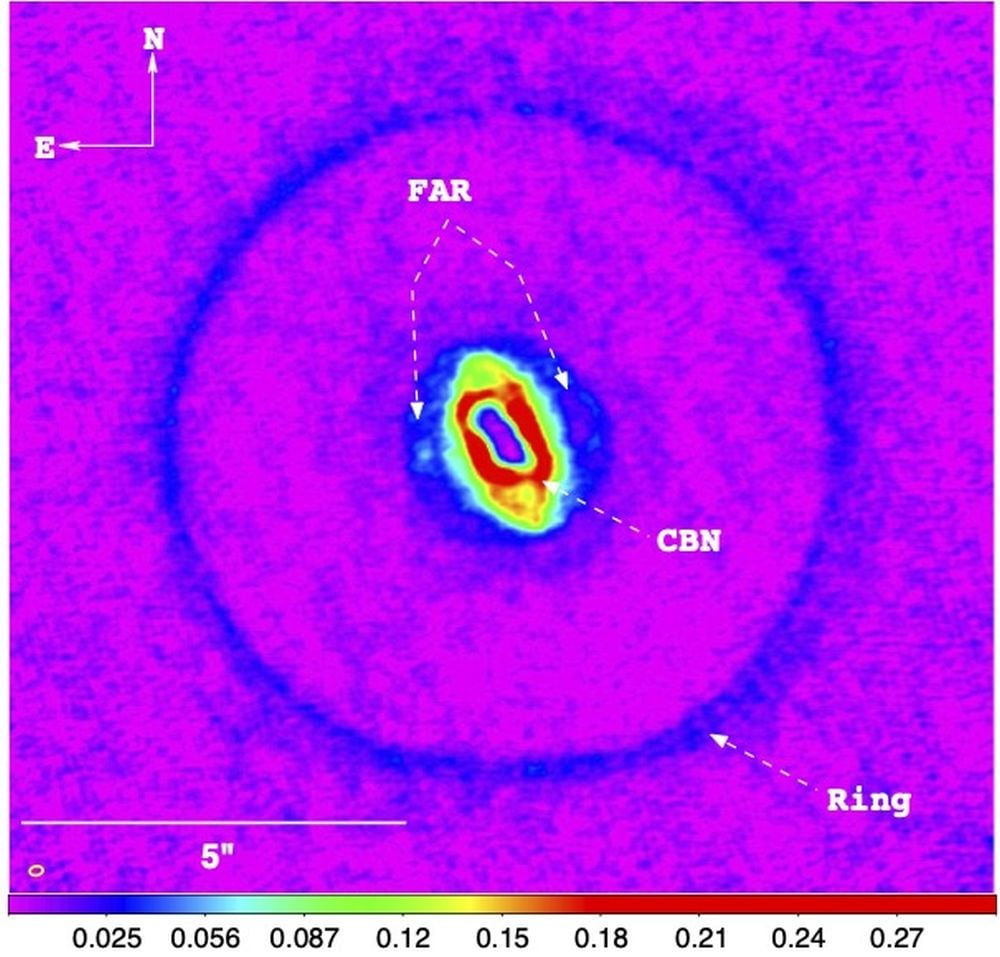
Одон орон судлаачид мөхөж буй одны дулааны сүүлчийн импульсийг анх удаагаа хийн бүтцэд царцсан байдалтайгаар ажиглаж чадлаа.
Наран шиг масстай одууд хувьслынхаа төгсгөлд улаан аварга болон хувирч, улмаар гариган мананцар үүсгэдэг. Энэхүү шилжилтийн үе шатанд одууд дулааны импульс ялгаруулж, материалуудаа сансар огторгуйд цацдаг бөгөөд үүнийг бодитоор ажиглах нь маш хүндрэлтэй байдаг. NASA-гийн Тийрэлтэт хөдөлгөөний лабораторийн эрдэмтэн Рагхвендра Сахайгаар ахлуулсан баг ALMA телескопыг ашиглан 12,000 гэрлийн жилийн зайд орших IRAS 06530–0213 нэртэй гариган мананцарын өмнөх үе шатанд буй одны “цөмийн зүрхний цохилт”-ыг бүртгэж авчээ.
The Astrophysical Journal сэтгүүлд нийтлэгдсэн судалгаагаар, тус одны эргэн тойронд ажиглагдсан өргөн дугуй цагираг нь ойролцоогоор 6,500 жилийн өмнөх дулааны сүүлчийн импульсийн үр дүн болохыг тогтоожээ. Мөн одны төв хэсэгт байрлах хоёр туйлт мананцар болон цагирагт бүтэц нь тус од ердөө 700 орчим жилийн өмнө хувьслын дараагийн үе шат руугаа шилжсэнийг гэрчилж байна. Энэхүү богино хугацааны үйл явц нь одны амьдралын мөчлөгийн хувьд маш ховор тохиолдолд тооцогддог.
Судлаачид тус мананцарын бүтэц дэх нарийн ширхэгт нуман хэлбэрүүд нь хос одны нөлөөтэй байж болзошгүй гэж таамаглаж байгаа ч, хос одны гол шинж тэмдэг болох нягт тоосонцрын диск олдсонгүй. Түүнчлэн, тус объектын химийн найрлагад 13C, 17O болон 15N изотопууд илэрсэн нь ердийн цөмийн синтезийн онолтой зөрчилдөж байгаа юм. Эдгээр хачирхалтай үзэгдлүүд нь одны хувьслын тухай бидний өнөөгийн ойлголт илүү төвөгтэй болохыг харуулж байна.
Дэлгэрэнгүйг эх сурвалжаас харах
Эх сурвалжийг нээх ↓
Stars transition through different stages as they evolve. Sun-like stars with low to intermediate masses (about 0.8 to 8 solar masses) begin as main-sequence stars, then transition sequentially to red giants, asymptotic giant branch (AGB) stars, then post-AGB stars. By the end, they leave behind only a planetary nebula. Each of those transitions are detailed and complicated, and astrophysicists crave a more complete understanding of them.
Stars in their AGB phase have an important job. They spread heavy elements into the surrounding interstellar medium (ISM) and those elements are taken up in subsequent star and planet formation. As they transition from AGB phase to post-AGB phase, they experience thermal pulses that expel material. These events are like brief snapshots in the long life of a star, and catching one in the act is challenging.
Astronomers working with the Atacama Large Millimeter Array (ALMA) have caught a star after what seems to be its final thermal pulse, leaving behing a planetary nebula. This is a rare opportunity to study this transition in detail.
“We’ve caught, for the first time, a star’s final nuclear heartbeat, frozen in gas.” – Raghvendra Sahai, NASA/JPL.
Their observations are in new research titled “The Last Gasps of a Dying Star: ALMA Observations of the Preplanetary Nebula IRAS 06530–0213.” It’s published in The Astrophysical Journal, and the lead author is Raghvendra Sahai, senior research scientist at NASA’s Jet Propulsion Laboratory.
IRAS 06530–0213 is a preplanetary nebula (PPN) about 12,000 light years away. Astronomers have been watching it for years as it takes shape. They know that the preplanetary nebula phase is a critical evolutionary stage in a star’s transition from the asymptotic giant branch (AGB) stage to the planetary nebula (PN) stage. PPN structures contain critical insights that aren’t available in any other way.
“These data show the presence of an extended circular ring—first evidence of the last thermal pulse preceding the post-asymptotic giant branch (AGB) phase in a carbon star—and a central bipolar nebula (CBN) and torus,” the authors write. The outer ring came from the last thermal pulse about 6500 years ago, and is the first direct evidence of this type of thermal pulse that’s emitted before a star like this begins its final phase.
This snapshot is all about the mass-loss stars experience as they die, and the authors explain that the AGB progenitor’s mass-loss rate “decreased immediately after the thermal pulse, then rose again just before the post-AGB phase.”
The mass-loss dropped off for about 2,000 years, then for about 1,000 years after that, it rose again. The filamentary structures around around the CBN are evidence of the star emitting a thick and lumpy shell of gas. An hourglass-shaped nebula with a torus is inside the filamentary arc region.
This ALMA image of IRAS 06530 show the PPN’s structure. The outer molecular ring is from its progenitor star’s final thermal pulse. The CBN is the central bipolar nebula, and the FAR is the filamentary arc region. The FAR is evidence of the progenitor’s mass loss rate dropping immediately after the thermal pulse, then rising again just before the star’s post-AGB phase. Image Credit: ALMA (ESO/NAOJ/NRAO); Sahai et al. (2026)
Based on the expansion ages of the torus and the CBN, Sahai and his co-researchers determined that the progenitor star transitioned to a post-AGB star around only 700 yrs ago, maybe a little less than that. That is a remarkably short amount of time to have lapsed since its transition, considering stellar ages.
In 2003 it was first identified as a carbon-rich PPN, and its envelope expansion velocity was measured. Subsequent research identified its s-process enrichment, where elements heavier than iron are synthesized. Then in 2025, this paper identified the PPN’s spherical halo and central barrel-shaped torus.
Luck might not describe these most recent observations, because those prior observations were the primer, but good fortune might. The kind of good fortune that finds its way to people who spend their lives watching stars.
“Most of us think of stars as unchanging points of light, but this is a real-time snapshot of a star’s death throes,” said lead author Sahai, author and co-author of more than 140 published papers. “It’s the brief, violent transition between a bloated red giant and a glowing planetary nebula, frozen mid-action.”
There is something puzzling in this PPN and its filamentary arc region that still needs an explanation. “The arc stuctures are likely part of a 3D Archimedean spiral structure generally attributed to the presence of a binary companion,” the authors write.
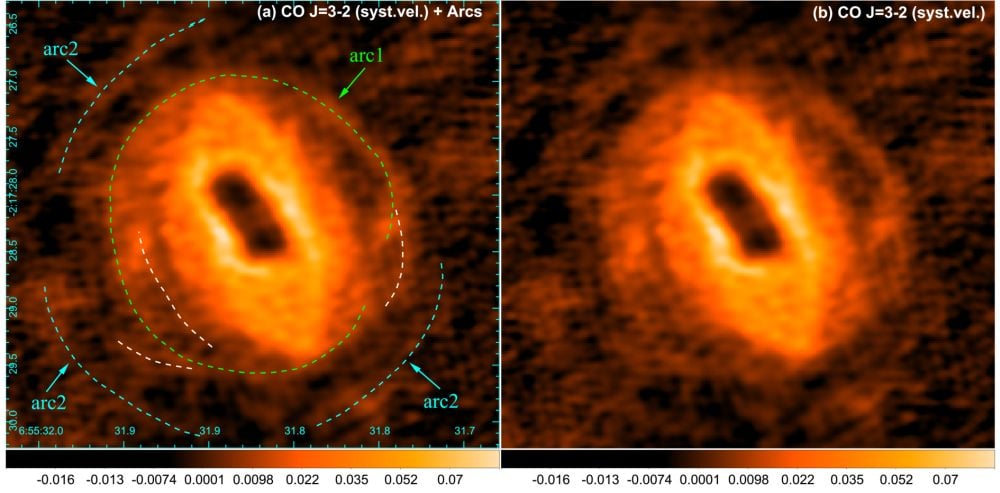 This image shows the central region of IRAS 06530, showing filamentary arc structures with dashed green, cyan, and white arcs. These arcs are typical signatures of a binary companion, but the researchers didn’t fine one. Image Credit: ALMA (ESO/NAOJ/NRAO); Sahai et al. (2026)
Dying stars with companions not only have spiral structures, but they’re normally found inside compact dust disks. The disks are evidence of mass-transfer with a close binary companion. The mass-transfer is usually the cause of the hourglass-shapes. But the researchers didn’t find a dusty disk, the usual signature of a companion.
“However, we do not find a compact continuum source at the location of IRAS 06530’s central star, such as that associated with the compact dusty disks typically found in disk-prominent post-AGB objects known to have binary companions,” the researchers explain.
“Dying stars so often have hidden companions that reshape their ejected material into intricate, bipolar or multipolar forms instead of simple spheres,” said Sahai. “IRAS 06530 shows that the story is more complicated than the tidy explanation we’ve been using.”
IRAS 06530 also has a chemical composition that’s challenging to understand. It’s significantly enriched in 13C, 17O, and modestly enriched in 15N.
“Compared with solar values, the torus of IRAS 06530 appears to be significantly (modestly) enriched in 13C and 17O (15N), as well—a pattern of rare-isotope enrichment inconsistent with standard nucleosynthesis models,” the authors write.
¹³C and ¹⁷O are expected, but ¹⁵N isn’t. It should be destroyed and depleted to solar levels. Again, a binary companion could be one explanation for this anomaly, and future observations might find one. It’s also possible that atypical bursts of nuclear burning are responsible, but that’s beyond the scope of this work.
Finding the first direct evidence of a dying star’s thermal pulse, something indicated by theory, is the kind of progress astrophysicists hope to make.
“It’s essentially a physical snapshot of an event that, until now, we’ve mostly inferred from theoretical models,” said Sahai. “We’ve caught, for the first time, a star’s final nuclear heartbeat, frozen in gas.”

