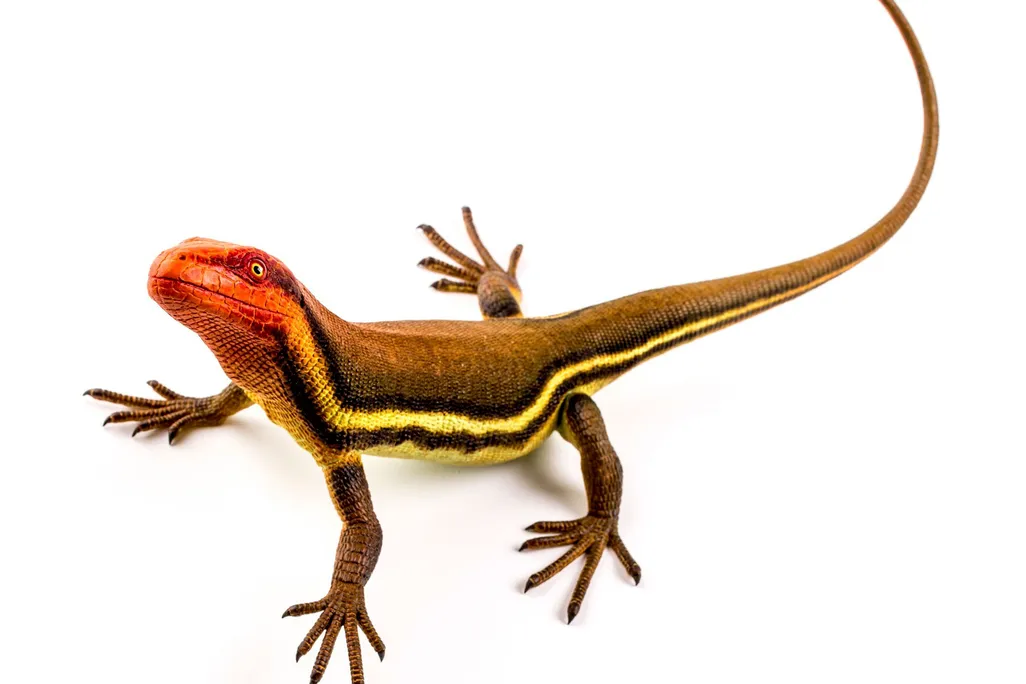
Канадын Нова Скотиа мужийн Жоггинс хадан цохионоос олдсон 315 сая жилийн настай чулуужсан олдвор нь мөлхөгчдийн анхны төлөөлөл биш байж болзошгүйг шинэ судалгаа харууллаа.
1859 онд геологич Уильям Доусон далайн эрэг дээрх чулуужсан модны хонгил дотроос 20 орчим сантиметр урттай, гүрвэл төст жижиг амьтны яс олсон нь Hylonomus lyelli хэмээн нэрлэгдэх болсон юм. ЮНЕСКО-гийн Дэлхийн өвийн жагсаалтад багтдаг Жоггинс хадан цохио нь нүүрстөрөгчийн галавын үеийн олон зуун төрлийн олдвор агуулдгаараа шинжлэх ухаанд чухал ач холбогдолтой. Энэхүү эртний ой модны хонгил нь амьтдын хувьд үхлийн хавх болж, улмаар голын тунадасаар хучигдан өнөөг хүртэл хадгалагдсан гэж үздэг.
Олон арван жилийн турш Hylonomus lyelli-г хуурай газар амьдарч байсан хамгийн анхны мөлхөгч гэж үзэн сурах бичигт тэмдэглэж ирсэн. Гэвч 2025 онд Peer Community Journal сэтгүүлд нийтлэгдсэн шинжилгээгээр уг амьтныг жинхэнэ мөлхөгчдийн бүлэгт хамаарах магадлал ердөө 15 хувьтай болохыг тогтоожээ. Хэрэв энэхүү дүгнэлт батлагдвал, уг амьтан нь орчин үеийн мөлхөгчдөөс илүү алсын хамааралтай, өөр төрлийн амьтан байх магадлалтай юм.
Энэхүү олдвор нь амьтад уснаас хуурай газарт шилжин амьдрах болсон хувьслын үйл явцыг ойлгоход чухал үүрэг гүйцэтгэж ирсэн. Гэсэн хэдий ч судалгааны үр дүн нь чулуужсан олдворуудын ангилал зүй болон амьтны хувьслын түүхийн талаарх ойлголт цаг хугацааны эрхээр өөрчлөгдөж болдгийг харуулж байна.
Дэлгэрэнгүйг эх сурвалжаас харах
↓Эх сурвалжийг нээх ↓
In 1859, a geologist working the sea cliffs of Nova Scotia broke into the hollow trunk of a fossilized tree and found tiny skeletons inside. The animal they belonged to measured only about 20 centimeters from snout to tail and probably looked a lot like a lizard.
That creature, later named Hylonomus lyelli, went on to become one of the most famous fossils in North America. For more than a century and a half it was held up as the oldest known reptile, and it had been sealed inside its stony tree for roughly 315 million years.
A Coastline Frozen in the Carboniferous
The fossils come from the Joggins Fossil Cliffs, a stretch of coast along the Bay of Fundy in eastern Canada. Listed as a UNESCO World Heritage Site in 2008, the site covers 689 hectares and takes in 14.7 kilometers of sea cliffs, low rock faces, rock platforms and beaches. Its layered rocks formed between about 318 and 303 million years ago, during the Carboniferous period.
Three distinct environments are preserved in those layers. One is an estuary where rivers met the sea, another a humid tropical forest growing on a floodplain, and the third a wooded river plain dotted with freshwater ponds and regularly swept by fire. That was the age when giant forests covered vast swamps, leaving behind the coal seams and fossilized roots of ancient trees that still turn up today.
UNESCO counts 96 fossil genera, 148 fossil species and 20 groups of fossil trackways at Joggins, a richness that has earned it the nickname “Galápagos of the Carboniferous.” New material keeps appearing as well. The Bay of Fundy is famous for having some of the largest tides in the world, and that water constantly wears away the cliffs, exposing fresh fossil fragments along the shore.
Trees That Became Death Traps
The site first drew serious scientific attention in 1842, when the British geologist Charles Lyell visited and called the upright fossil trunks “the most wonderful phenomenon.” To him, trees still standing where they had grown were clear proof that coal formed in place from ancient forests, rather than from plant debris washed in from elsewhere.
In life, these trees towered 20 to 30 meters above the forest floor. When they died, their soft inner tissue rotted away while the tough outer bark held its shape, leaving behind hollow stumps. “It’s within these hollowed-out stumps that animal remains were trapped and protected for over 300 million years,” paleontologist Hillary Maddin wrote.
Lyell returned in 1852 alongside the Canadian geologist William Dawson. Together they opened one of the fossil stumps on the Joggins coast and found the bones of an amphibian, which was named Dendrerpeton acadianum in a paper read to the Geological Society of London in early 1853.

How the animals ended up inside is still debated. The leading explanation is that they fell into the hollow stumps and could not climb back out, although some researchers think they may have used them as nests. Either way, the upright stumps were later filled with sediment carried by a river system, burying the skeletons and preserving them.
The Forest Dweller
Dawson kept searching. In 1859, working alone at the same site, he found skeletons inside another hollow stump. A year later he described the animal and named it Hylonomus lyelli, honoring Lyell, with a genus name usually translated as “forest dweller.” Several more skeletons have since been recovered from stumps of the same kind.
Hylonomus had small, pointed teeth and most likely fed on small invertebrates. By then, Joggins had already reached a far wider audience: in 1859, Charles Darwin cited the site in On the Origin of Species, using it to argue that the fossil record preserves only a fraction of past life.

For generations, Hylonomus held a special place in textbooks as the oldest known reptile, a key step in the move of backboned animals from water onto dry land. Nova Scotia made it the province’s official fossil in 2002. Other early reptile relatives have since revealed surprising details of their own, such as the rib-powered breathing preserved in a skin-wrapped fossil from Oklahoma.
Its status as the first reptile is now in question. A 2025 analysis published in the Peer Community Journal places Hylonomus, with an estimated 85 percent probability, outside the group that includes all living amniotes, the reptiles, birds and mammals whose eggs can develop on land. If that placement holds, the “first reptile” of Joggins would be more distantly related to modern reptiles than mammals are.
Enjoyed this article? Subscribe to our free newsletter for engaging stories, exclusive content, and the latest news.

