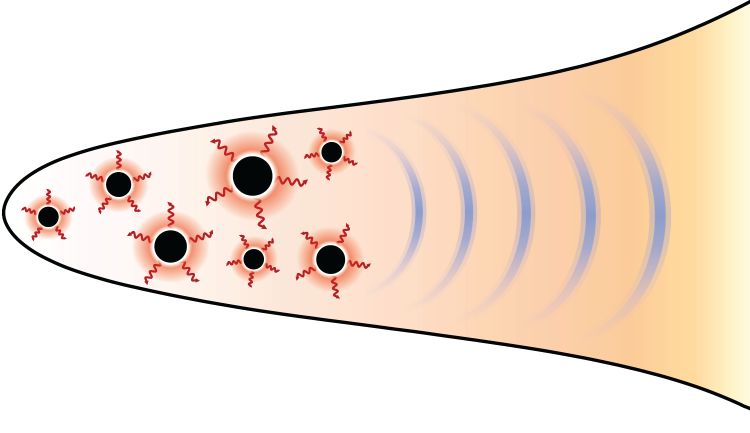
Эрдэмтэд эртний орчлон ертөнцийн тэлэлт болон бодисын бүрэлдэхүүнд бичил хар нүхнүүд хэрхэн нөлөөлсөн болохыг компьютерын загварчлалаар судалжээ.
Германы PRISMA++ Cluster of Excellence болон Mainz Institute for Theoretical Physics-ийн судлаачид эртний орчлон ертөнцөд оршин байсан анхдагч хар нүхнүүд Их тэсрэлтийн дараах үед ертөнцийг халаах үүрэг гүйцэтгэсэн байж болзошгүй гэсэн таамаглалыг дэвшүүллээ. Физикийн уламжлалт онолоор бол Их тэсрэлтийн дараа ертөнц хурдацтай тэлж, хөрөөд, улмаар дахин халах үйл явц явагдсан гэж үздэг. Энэхүү судалгаагаар анхдагч хар нүхнүүд уг халаалтын процесст хэрхэн оролцсоныг тодруулахыг зорьсон байна.
Судлаачид компьютерын загварчлал ашиглахдаа анхдагч хар нүхнүүдийг ижил хэмжээтэй гэж үздэг уламжлалт онолыг өөрчилж, янз бүрийн хэмжээтэй байх хувилбарыг авч үзжээ. Стивен Хокингийн 1970-аад оны судалгаагаар анхдагч хар нүхний дээд хязгаарыг 1,000 тонн буюу 109 грамм гэж тодорхойлсон байдаг. Хэрэв бүх хар нүх нэгэн зэрэг ижил хэмжээтэй байсан бол тэдгээрийн дэлбэрэлтээс үүсэх таталцлын долгион нь шинээр үүсэж буй атомуудыг устгах аюултай байв.
Судалгааны багийн гишүүн Николас Лэйстэрийн тайлбарласнаар, эдгээр хэт хөнгөн бичил хар нүхнүүд нь атомаас ч жижиг байж болох ч ертөнцийн энергийн дийлэнх хэсгийг агуулж байсан байж магадгүй юм. Тэдгээрийн дэлбэрэлт нь ертөнцийг халуун плазмаар дүүргэж, бодис үүсэх нөхцөлийг бүрдүүлсэн байна. Загварчлалын үр дүнд янз бүрийн хэмжээтэй хар нүхнүүд өөр өөр цаг хугацаанд дэлбэрснээр таталцлын долгионыг сулруулж, улмаар атомын бүтцийг гэмтээлгүйгээр ертөнцийн тэлэлтийг үргэлжлүүлэх боломжтой болгосон нь тогтоогджээ.
Дэлгэрэнгүйг эх сурвалжаас харах
Эх сурвалжийг нээх ↓
Understanding the origin and evolution of black holes is quite endeavor, including how they form, behave, what they’re made of, what happens when they collide, and even what happens if you fall into one. But now imagine trying to understand black holes of the early universe, known as primordial black holes, and how they behaved almost immediately after the Big Bang. How did they contribute to the formation and evolution of the early universe, specifically immediately after the Big Bang?
Now, a team of researchers from the PRISMA++ Cluster of Excellence and Mainz Institute for Theoretical Physics in Germany might be one step closer to solving this cosmic conundrum. As discussed in a recent study published in Physical Review Letters, the researchers propose that microscopic black holes were responsible for reheating the very young universe immediately after the latter’s post-Big Bang expansion. The longstanding theory is the universe expanded rapidly after the Big Bang, followed by a period of cooling then a period of reheating to continue the expansion. The primary motivation behind the study was to ascertain how primordial black holes played a role in this reheating.
To accomplish this, the researchers used a series of computer models to simulate the environment of the early universe, specifically focusing on the size of primordial black holes. This is because there has been a longstanding theory that primordial black holes were all the same size and produced the same amounts of gravitational waves at the end of their lifetimes, which occurs when they evaporate then explode. But this study challenges this theory by using primordial black holes of various sizes in their models.
In the 1970s, Stephen Hawking established 109 grams (1,000 metric tons, or the weight of a large container ship) as the upper limit for primordial black hole sizes, and lasting only 1 second of lifetime. This is because black holes larger than that would completely wipe out newly formed atoms from the black hole’s gravitational waves produced from exploding, along with exploding at the same time since they’re all the same sizes. By incorporating black holes of various sizes while still respecting this upper limit, the researchers wanted to ascertain whether their produced gravitational waves would still be small enough to not mess with cosmic chemistry. This study also comes as Universe Today recently reported on the relationship between primordial black holes the first stars.
In the end, the models revealed that black holes of different sizes while respecting this upper limit suppressed gravitational waves enough to maintain atom creation and not prevent further universe growth and expansion. This was primarily due to the primordial black holes exploding at various times due to their various sizes, as opposed to exploding at the same time from being the same size.
“We are really speaking of ultra-light black holes that could have dominated the very early universe,” said Nicolas Leister, who is a PhD student at the PRISMA++ Cluster of Excellence and a co-author on the study. “The smallest primordial black holes may have been smaller than an atom. But since they would have held almost all of the universe’s energy, their explosions could have filled the entire cosmos with the hot plasma from which matter formed.”
Understanding the early universe is one of the cornerstones of cosmology. This is because this could not only help scientists better understand how we came to be, but also how life on other worlds throughout the universe could form and evolve, too. A key driver of the early universe were black holes. While they were much smaller than they are today, their brief lifetimes and subsequent gravitational waves provided the early universe with the necessary heat to keep expanding and evolving to what we see today.
What new insights into the primordial black holes and how they contributed to the early universe will researchers make in the coming years and decades? Only time will tell, and this is why we science!
As always, keep doing science & keep looking up!

