
Тайваний Да-ань голын хөндийгөөс 84.1 метр өндөр “Тэнгэрийн сэлэм” хэмээх аварга модыг эрдэмтэд албан ёсоор бүртгэж, тус бүс нутгийн хамгийн өндөр модоор тодрууллаа.
“Тайванийн мод хайгчид” нэртэй судлаачдын баг есөн жилийн турш үргэлжилсэн судалгааныхаа үр дүнд энэхүү модыг олж илрүүлсэн байна. Тайванийн уулархаг, бартаа ихтэй газар зүйн байрлал нь түүхийн туршид олон зууны настай аварга модыг мод бэлтгэлийн ажиллагаанаас хамгаалж үлджээ. Нутгийн уугуул Рукай иргэд эдгээр аварга модыг “сар шүргэдэг мод” хэмээн нэрлэж ирсэн нь эрдэмтдийн судалгаанд чухал чиг баримжаа болсон байна.
Судлаачид 2014 оны наймдугаар сараас эхлэн судалгааны ажлаа эрчимжүүлж, LiDAR буюу лазерын тусгал ашиглан газрын зураглал хийх технологийг ашиглажээ. Газрын гадаргын өндөршил болон налуу газрын нөлөөнөөс үүдэлтэй хэмжилтийн алдааг засахын тулд 2020 оноос эхлэн олон зуун иргэн-эрдэмтэн LiDAR-ын өгөгдлийг нягтлан шалгахад оролцсон байна. Энэхүү хамтын ажиллагааны үр дүнд 65 метрээс дээш өндөртэй 941 мод бүхий “Тайванийн аварга моддын газрын зураг”-ийг бүтээжээ.
2023 оны нэгдүгээр сард тус газрын зураглалыг ашиглан зохион байгуулсан экспедицийн үеэр “Тэнгэрийн сэлэм” модыг хэмжиж, албан ёсны өндрийг баталгаажуулсан байна. Мөн 2026 оны эхэн үеийн байдлаар 70 метрээс дээш өндөртэй арван Taiwania төрлийн мод олж илрүүлснээ судлаачид мэдээлжээ. Энэхүү ойн бүс нь нүүрстөрөгчийн агууламж маш өндөртэй буюу дэлхийн хамгийн баялаг ойн сан бүхий орчинтой дүйцэхүйц болох нь тогтоогдсон нь судалгааны ач холбогдлыг улам бүр нэмэгдүүлж байна.
Дэлгэрэнгүйг эх сурвалжаас харах
↓Эх сурвалжийг нээх ↓
When climbers reached the crown of a massive Taiwania cryptomerioides fir deep in Taiwan’s Da’an River valley and dropped a measuring tape to the ground below, the number that came back settled a decade-long question: 84.1 meters. The tree, now named the “Heaven Sword of the Da’an River,” is the tallest confirmed tree in East Asia.
The group who found it called themselves the “Taiwan tree seekers,” and by the time they reached that crown, they had spent nine years pushing deeper into forests that most people never knew existed. Their findings are documented in a study published in Frontiers in Forests and Global Change.
Taiwan’s Mountains Hid What Loggers Could Not Reach
To understand how a tree this tall could remain unconfirmed for so long, the geography of Taiwan matters. The island covers roughly 36,000 square kilometers, about the size of Switzerland, but packs 258 peaks exceeding 3,000 meters into that space, creating dramatic elevation gradients within short distances. That vertical range generates extraordinary ecological diversity, with an estimated 5,000 plant species growing across habitats that span tropical rainforest at sea level and alpine tundra near the summits, and approximately 60 percent of the island remains forested, sheltering around 950 million trees.
Industrial logging between 1912 and 1991 stripped large portions of Taiwan’s original primary forest, but the steepest and most remote valleys proved physically unreachable for logging operations. It is in exactly those places that ancient Taiwania fir stands survived intact for centuries.
To the Indigenous Rukai people, these towering trees have long carried a name that translates as “the tree that hits the moon,” an acknowledgment passed down through generations of just how far above the surrounding canopy the largest specimens grow. That cultural knowledge long predated any scientific documentation and pointed researchers toward forests that official records had never fully captured.
Nine Years of Searching a Forest of 950 Million Trees
The formal scientific search began in August 2014, when researchers from the Taiwan Forestry Research Institute launched an expedition into the Cilan conservation area, targeting a cluster known locally as the “Chilan Three Sisters.” These three giant Taiwania firs had been known to people in the region for years but had never been scientifically measured. The tallest reached 69.3 meters, with a trunk diameter of nearly three meters, and the find attracted international attention in 2017 when professional climbers from the Australian organization The Tree Projects traveled to Taiwan to photograph the grove.
The team’s next major target was a region near Mt. Benya, close to Great Ghost Lake, a site considered sacred by Indigenous peoples, where local accounts described the densest concentration of giant Taiwania firs on the island. The approach required four days of heavy hiking, and the team climbed a 71.7-meter tree once they arrived.
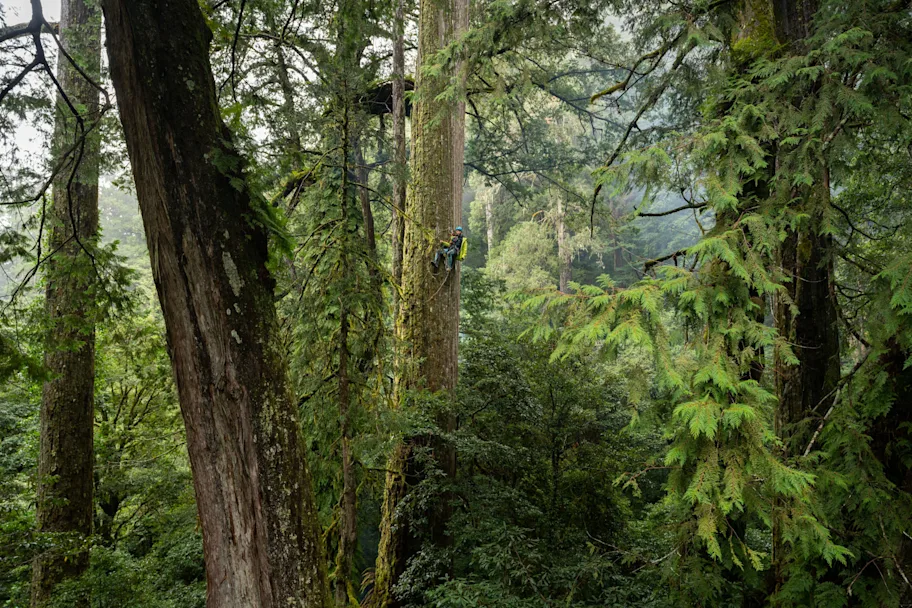
The expedition also exposed a fundamental problem: inside a dense, multi-layered old-growth canopy, the human eye consistently misjudges height. With 950 million trees spread across valleys that could take days to reach on foot, a ground-level search across the entire island was simply not viable. The researchers needed a method that could assess the forest from above.
How LiDAR Built Taiwan’s First Giant Tree Map
The team partnered with remote sensing specialists at National Cheng Kung University and turned to LiDAR, or Light Detection and Ranging, a technology that fires laser pulses from aircraft toward the ground and calculates precise height measurements based on how long each pulse takes to return. Applied across Taiwan’s forests, it produced a detailed three-dimensional map of the landscape and offered the first aerial view of where the true giants might be located.
Taiwan’s extreme topography introduced an immediate complication. The island’s vertical relief caused the automated detection algorithm to flag trees growing near cliff edges as far taller than they actually were, because the software measured height against the valley floor rather than the actual base of the tree. According to the researchers, 93 percent of candidate trees had been mismeasured as a result, making the raw LiDAR output unreliable without additional filtering.
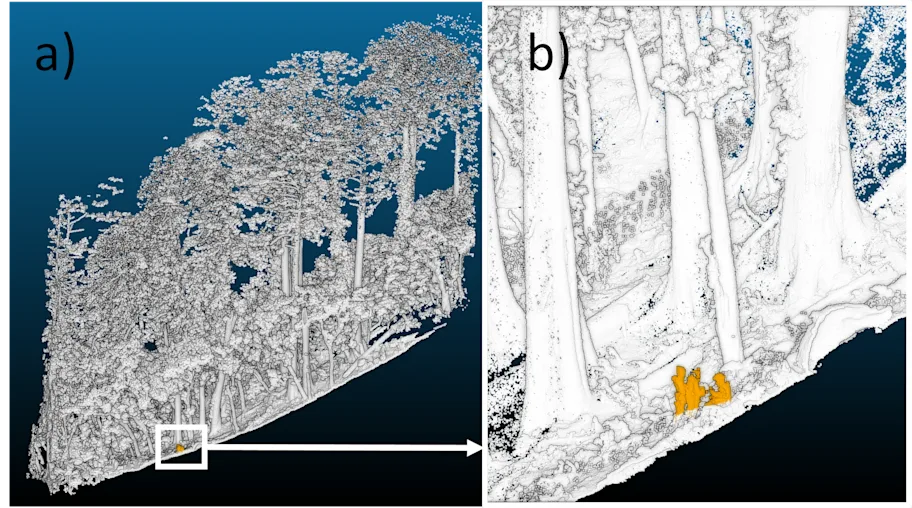
Correcting that required human judgment at a scale the research team could not manage alone. In 2020, hundreds of Taiwanese citizen scientists began reviewing LiDAR profile images, manually identifying which candidates were genuine tall trees and which were distortions caused by terrain.
The process filtered out tens of thousands of false leads, and by the end of 2022 that collective effort produced the Taiwan Giant Tree Map, a verified registry of 941 individual trees confirmed to exceed 65 meters in height. The map became the direct planning tool for the expedition that followed.
The Expedition That Confirmed the Record
Using the completed map, the team organized a new expedition during the Lunar New Year holiday in January 2023, targeting the single most promising candidate. Reaching it required a 20-kilometer river trace followed by two days of steep uphill hiking through trailless terrain. When climbers reached the crown and dropped a measuring tape to the forest floor, the confirmed height was 84.1 meters, and the tree was formally named the “Heaven Sword of the Da’an River.”
The team has continued its fieldwork since. By early 2026, the authors reported having located and climbed ten separate Taiwania trees exceeding 70 meters, two of which have cleared the 80-meter threshold. Near Mt. Benya, the Giant Tree Map also led the team to a single hectare containing 11 trees each taller than 65 meters, and to a cluster of approximately 30 ancient Taiwania firs growing together near Great Ghost Lake.
A 2024 carbon density survey of the “Tao Tree” valley, conducted alongside 15 citizen scientists, measured the forest’s total carbon storage at 1,384.5 megagrams per hectare, calculated without counting underground root systems. The authors reported that this figure places Taiwan’s giant Taiwania forests among the most carbon-dense environments on Earth, comparable to the most celebrated old-growth forests globally. For a forest that survived largely because loggers could not physically reach it, that finding adds a global dimension to what began as a search for the tallest tree in East Asia.
Enjoyed this article? Subscribe to our free newsletter for engaging stories, exclusive content, and the latest news.



