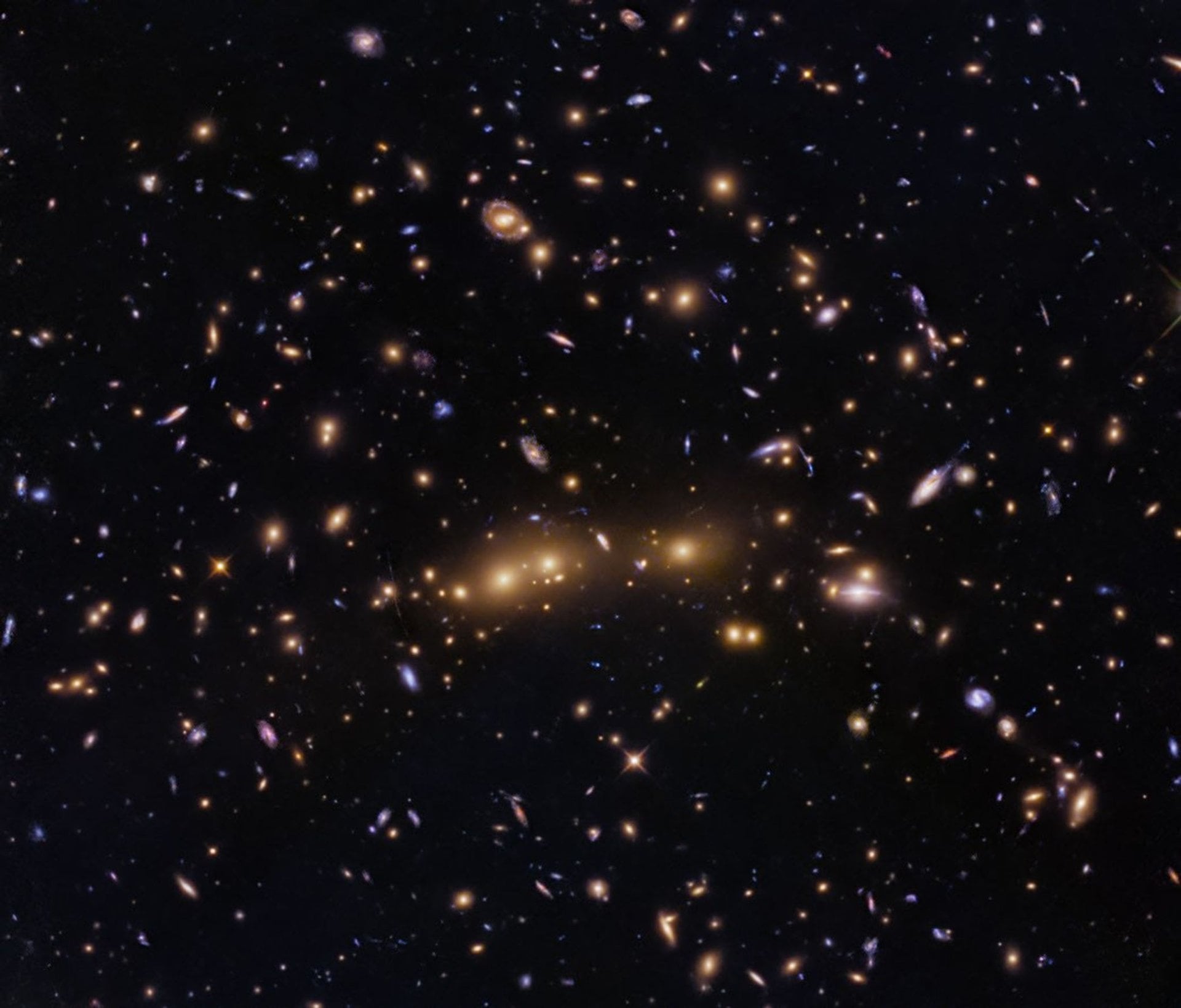
Хаббл сансрын дуран CL0016+1609 нэртэй галактикийн бөөгнөрөл нь хоёр тусдаа бүтэц нэгдэж буй үйл явц болохыг тогтоов.
Хаббл сансрын дурангийн оптик ажиглалтыг Chandra рентген дурангийн мэдээлэлтэй нэгтгэснээр CL0016+1609 (MACS J0018.5+1626) галактикийн бөөгнөрөл нь үнэндээ бидний харах өнцгийн дагуу нэгдэж буй хоёр бүтэц болохыг одон орон судлаачид илрүүлжээ. Рентген туяаны мужид маш тод ялгардаг энэхүү бөөгнөрөл нь сансар судлалын салбарт өргөнөөр судлагдсан объект юм.
Судлаачид Хаббл дурангийн “Advanced Camera for Surveys” (ACS) төхөөрөмжийг ашиглан бөөгнөрөл дэх харанхуй материйн тархалтыг хэмжихээр зорьсон байна. Энэхүү нэгдэл нь орчлон ертөнцийн том хэмжээний бүтцийг бүрдүүлэхэд хэрхэн нөлөөлж байгааг ойлгох нь судалгааны гол зорилго байв.
Хаббл нь харанхуй материйг шууд дүрслэх боломжгүй ч, түүний үзэгдэх материд үзүүлж буй таталцлын линзлэх нөлөөгөөр дамжуулан илрүүлдэг. Мөн RELICS хөтөлбөрийн хүрээнд хийгдсэн хэт улаан туяаны ажиглалтууд нь 46 галактикийн бөөгнөрлийг хамарсан бөгөөд уг таталцлын линзлэх үзэгдлийн ачаар 300 орчим алс холын галактикийг судлах боломж бүрджээ.
Эдгээр линзлэх үзэгдлийн үр дүнд төв хэсгийн том эллиптик галактикуудын зүүн талд илүү алс холын галактикийн бүдэг нуман дүрс, түүнчлэн баруун дээд хэсэгт илүү тод, богино нуман дүрс тодрон харагддаг. Энэхүү судалгаа нь сансар огторгуйн бүтцийн хувьслыг ойлгоход чухал ач холбогдолтой юм.
https://science.nasa.gov/missions/hubble/hubble-glimpses-merging-galaxy-clusters/
Дэлгэрэнгүйг эх сурвалжаас харах
Эх сурвалжийг нээх ↓
The venerable Hubble Space Telescope continues to survey the cosmos and capture images of amazing astronomical events. One of its latest finds features a galaxy cluster known as CL0016+1609 (MACS J0018.5+1626) that is very bright at X-ray wavelengths. By combining Hubble’s optical observations with data from the Chandra X-ray telescope, astronomers discovered that this cluster is actually two clusters that are merging along our line of sight.
CL0016+1609 is one of the most extensively studied galaxy clusters in X-ray and radio wavelengths. The research team responsible for the image requested observation time using Hubble’s Advanced Camera for Surveys (ACS) to measure the distribution of dark matter in the cluster. Their goal was to improve our understanding of how the merger of CL0016+1609 contributes to the large-scale structure of the Universe.
While Hubble cannot directly image Dark Matter, this mysterious mass is discernible by Hubble’s optical and infrared instruments through the gravitational lensing it exerts on visible matter in the cluster. Data from Hubble’s Wide Field Camera 3, taken as part of the ongoing Reionization Lensing Cluster Survey (RELICS), is also included in the image. Hubble’s first infrared images were taken as part of this program, which included 46 galaxy clusters.
The gravitational lenses formed by these clusters also allowed astronomers to view another 300 high-redshift candidate galaxies. In this image, a faint vertical arc of a more distant galaxy is visible to the left of the large elliptical galaxies in the center. A brighter and shorter arc is also visible just above and to the right of the same elliptical galaxies.
Further Reading: NASA

