Айовагийн их сургуулийн судлаачид сансрын нислэгийн үеэр хүний булчингийн эсэд гарах өөрчлөлтийг судалж, үүнийг эмчлэх арга замыг хайж байна.
Сансрын нисгэгчид удаан хугацааны турш жингүйдлийн орчинд байх үед булчингийн тогтолцоонд ноцтой өөрчлөлт гардаг. Айовагийн их сургуулийн эрдэмтэн доктор Халед Камал сансрын нислэгийн үеэр булчингийн эсүүд биеийн ачааллыг хэрхэн мэдэрч, хариу үйлдэл үзүүлдэг болохыг молекулын түвшинд судалж байна. Энэхүү судалгаа нь Сар болон Ангараг гараг руу хийх ирээдүйн урт хугацааны нислэгүүдэд нэн чухал ач холбогдолтой юм.
Судлаачид Дэлхий дээр жингүйдлийн нөхцөлийг дуурайлган үзүүлэх зорилгоор мэрэгч амьтдын арын мөчнүүдэд ачаалал өгөхгүй байх туршилтын загварыг бүтээжээ. Энэ нь булчин болон таталцлын хүчний хоорондох харилцааг хэрхэн тасалддаг болохыг бодит цаг хугацаанд ажиглах боломжийг олгосон байна. Доктор Камалын үзэж буйгаар, булчингийн хатингаршлын механизмыг бүрэн ойлгосноор нисгэгчдийн булчингийн эрүүл мэндийг хамгаалах үр дүнтэй арга хэмжээг боловсруулах боломжтой болно.
Энэхүү судалгааны үр дүн нь сансар судлалаас гадна Дэлхий дээрх хүмүүст ч өргөн ач холбогдолтой юм. Жингүйдлийн үед булчинд гардаг молекулын өөрчлөлтүүд нь хөгшрөлттэй холбоотой булчингийн сулрал болон булчингийн дистрофи зэрэг удамшлын өвчний явцтай ижил төстэй байдаг. Иймд олдсон шинэ биомаркерууд болон дохио дамжуулах системүүд нь ирээдүйд олон төрлийн өвчнийг оношлох, эмчлэх шинэ арга хэрэгсэл болох боломжтой.
Тус лаборатори нь амьтан судлал, машин сургалт, инженерчлэл зэрэг олон салбарын мэргэжилтнүүдийг нэгтгэсэн хамтын ажиллагааны төв болон өргөжиж байна. Доктор Камал NASA-д инженерүүдээс гадна биологич, физиологичид нэн шаардлагатай байгааг онцлоод, залуу судлаачдыг энэ салбарт татан оролцуулах нь чухал болохыг тэмдэглэжээ.
https://www.universetoday.com/article_images/1280px-The_station_pictured_from_the_SpaceX_Crew_Dragon_5_20260701_094803.jpg
https://www.universetoday.com/article_images/1280px-Skeletal_striated_muscle_20260701_095648.jpg
Дэлгэрэнгүйг эх сурвалжаас харах
Эх сурвалжийг нээх ↓
Imagine a muscle as something that has spent your entire life in conversation with gravity, constantly sensing your body’s weight, constantly adjusting, constantly being told it is needed. Now imagine cutting that conversation off entirely. That is in some ways what happens to an astronaut’s body in orbit, and it is the problem at the heart of new research at Iowa State University, supported by Iowa NASA EPSCoR, into how spaceflight reshapes human physiology from the cellular level upward.
The International Space Station, where the muscle wasting studied by Dr Kamal’s team plays out in orbit, a challenge that grows as missions push on towards the Moon and Mars (Credit: NASA)
The work belongs to Dr Khaled Kamal, who joined Iowa State in 2024 after more than a decade working on projects connected to the European Space Agency and NASA. Kamal studies how microgravity disrupts the signalling pathways that keep muscle healthy, processes with names like mechanotransduction, the way cells sense and respond to physical force, alongside redox biology and intercellular communication within the musculoskeletal system. His central focus is muscle atrophy, the wasting that astronauts experience on long duration missions to the International Space Station and that will only become a greater concern as crews venture further, towards the Moon and eventually Mars.
“We try to understand how spaceflight induces this muscle atrophy at the molecular and cellular level, the payoff is practical as much as scientific, understand the mechanism, and a countermeasure becomes possible,” – Dr Khaled Kamal from Iowa State University
Recreating weightlessness on Earth is, naturally, rather difficult, so Kamal’s lab built something rather clever! Iowa State’s first hindlimb unloading rodent model that mimics some of the physical conditions of microgravity without leaving the ground. Suspending an animal so its hind limbs bear no load effectively silences that same conversation between muscle and gravity, letting researchers watch in real time how muscle tissue senses the change and begins to respond, and giving them a testbed for therapies designed to preserve muscle health when that gravitational signal disappears.
What makes the research valuable well beyond the space programme is that the body does not particularly care why gravity’s signal has gone quiet. The molecular pathways disrupted in microgravity overlap substantially with those involved in age related sarcopenia and Duchenne muscular dystrophy, a genetic condition that breaks down muscle from childhood. Kamal is now hunting for new biomarkers, including extracellular vesicle signatures and mechanosensitive signalling systems, that could one day underpin monitoring tools and treatments for astronauts on long missions to the Moon and Mars, and equally for patients on Earth.
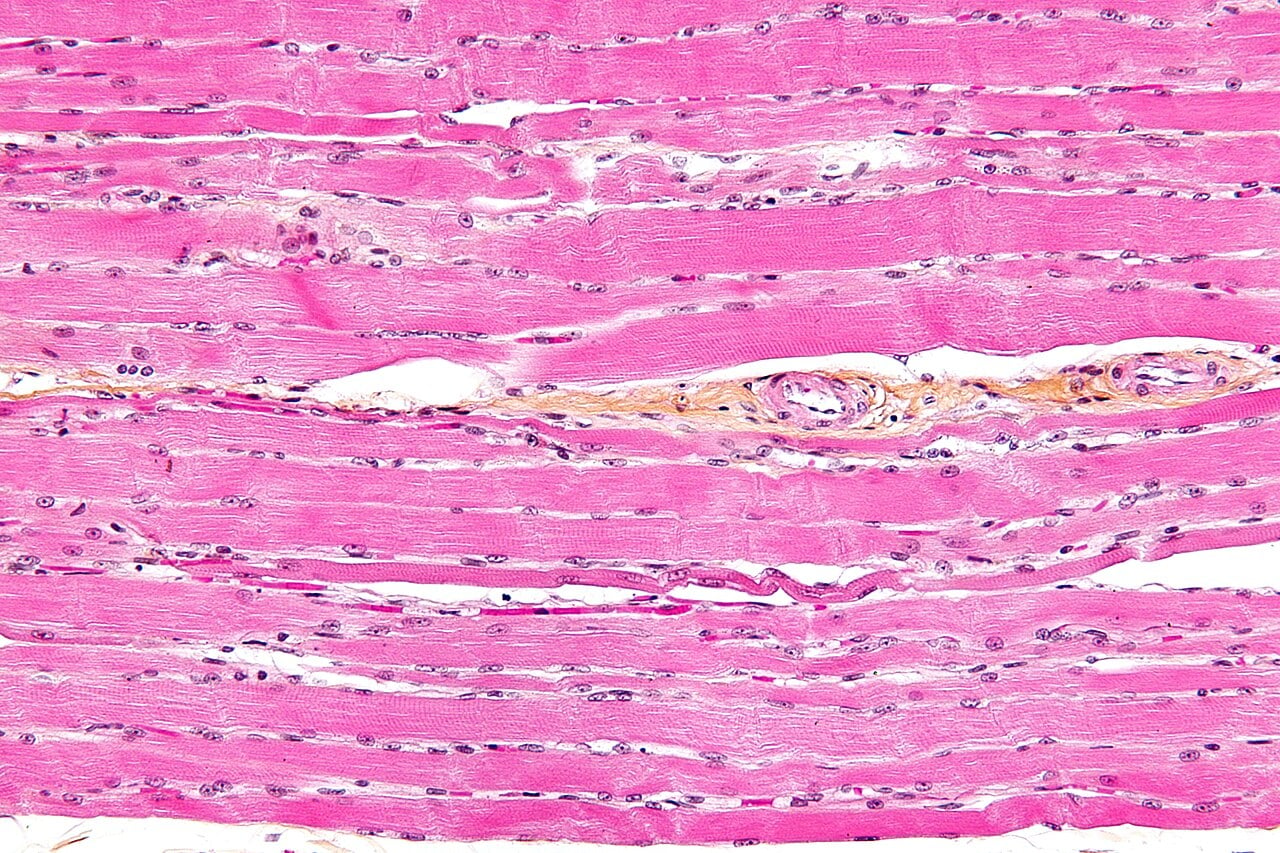
Microscopic view of striated skeletal muscle fibre, showing the banded pattern disrupted during muscle wastage (Credit : Nephron)
The lab itself has become something of a meeting point, drawing in collaborators from animal science, machine learning, engineering and cell biology, along with graduate and undergraduate researchers. Among them is PhD student Hassan, who joined in spring 2025 after being drawn in, he says, by the idea of recreating what astronauts experience under microgravity here on the ground. Kamal hopes the lab keeps expanding that pipeline. As he puts it, NASA needs biologists and physiologists every bit as much as it needs engineers, and Iowa’s growing space life science capacity is starting to produce both.
Source : Iowa NASA EPSCoR Supports Iowa State University Research Connecting Spaceflight and Human Health