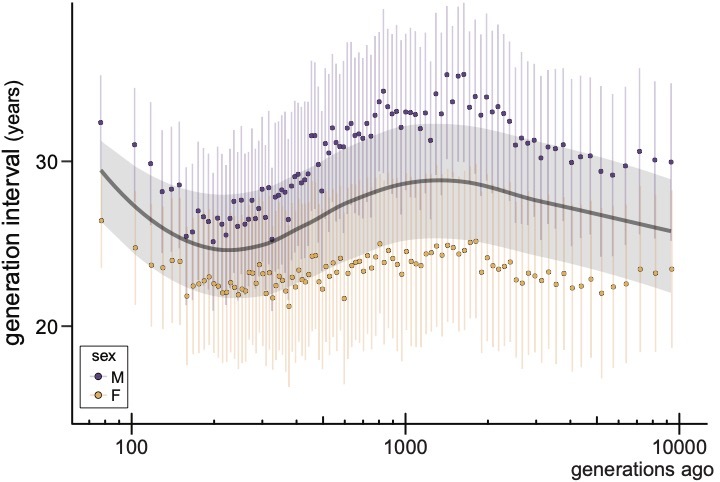
Эрдэмтэд хүний геном дахь мутацийг судлах замаар Homo sapiens зүйлийн үүсэл цагаас хойшхи үе удмын дундаж хугацааг тогтоожээ.
Индианагийн их сургуулийн хүн амын генетикч Мэттью Хан тэргүүтэй судлаачид сүүлийн 250,000 жилийн турших хүний үе удмын интервалыг сэргээн тогтоосон байна. Тэд эцэг эхийн нас ахих тусам үр хүүхдэдээ дамжуулдаг генетикийн мутацийн хэв шинж өөрчлөгддөг болохыг үндэслэн, орчин үеийн болон эртний мутацийн цуглуулгыг насны ангиллаар нь ялган шинжилжээ. Энэхүү судалгаагаар хүн төрөлхтний үе удмын дундаж интервал 26.9 жил гэж гарсан бөгөөд үүнд эрэгтэйчүүдийн дундаж нас 30.7, эмэгтэйчүүдийнх 23.2 жил байна.
Энэхүү тооцооллыг Homo sapiens зүйлийн оршин тогтносон 300,000 жилийн хугацаанд хэрэглэвэл хүн төрөлхтөн нийт 11,152 үеийг дамжин ирсэн гэсэн дүн гарч байна. Хэдийгээр үе удмын интервал нь цаг хугацаа, соёл, газар зүйн байршлаас хамааран хэлбэлзэж байсан ч генетикийн энэхүү загвар нь түүхэн баримт болон археологийн олдворуудаас илүү алс холын цаг хугацааг хамрах боломж олгож байгаа юм.
Барселона дахь Хувьслын биологийн хүрээлэнгийн судлаач Мойсес Колл Масиагийн үзэж буйгаар, үе удмын тоог нэг тоогоор хязгаарлах нь өрөөсгөл бөгөөд үүнийг тодорхой хүрээнд авч үзэх нь зүйтэй. Тухайлбал, шимпанзегийн үе удмын интервалыг (24.6 жил) доод хязгаар гэж үзвэл хүн төрөлхтөн 12,195 үеийг, харин Неандертал хүний ДНХ-д суурилсан 30 жилийн дээд хязгаарыг ашиглавал 10,000 орчим үеийг туулсан гэж тооцоолж болохоор байна.
Дэлгэрэнгүйг эх сурвалжаас харах
↓Эх сурвалжийг нээх ↓
The longest documented family tree in the world belongs to the Chinese philosopher Confucius, whose descendants can be traced across more than 80 generations, stretching nearly 3,000 years from his ancestors in the eighth century B.C. to people alive today. It is an extraordinary genealogical record, but it still covers only a tiny fraction of human history. Homo sapiens has existed for roughly 300,000 years, based on the oldest known fossils of our species, and that timeline raises a far bigger question: how many generations came before the ones we can actually name.
Working out the answer takes two pieces of information, according to Matthew Hahn, a population geneticist at Indiana University Bloomington. One is how long Homo sapiens has been around. The other is the length of a generation interval, the average span of time between a parent’s birth and their child’s birth. Divide the age of the species by that interval, and a rough generation count starts to emerge, though the exact number depends heavily on which interval is used.
What Counts as One Human Generation
A generation interval is not a fixed length like a calendar year. It reflects how old people tend to be when they have children, and that age shifts across time, place, and culture. Men typically father children later in life than women give birth, which pulls the overall average higher whenever both sexes are factored in together.
Historical records offer some of the clearest estimates. A 2003 study of Icelandic genealogies, drawn from centuries of church and civil documentation collected by researchers at deCODE Genetics, calculated that the average generation interval in Iceland over the past 300 years was 30.3 years.
A separate 2005 study of European women who had children between 1960 and 2000 arrived at a slightly shorter average of 29.1 years. Both figures work well for recent centuries, but neither can reach back far enough to cover the full span of Homo sapiens, since written and church records simply do not go that deep into the past.
DNA Mutations Trace Generation Length Across 250,000 Years
To look further back, researchers turned to a source that does stretch across hundreds of thousands of years: the human genome itself. A study published in Science Advances in 2023, led by Hahn, reconstructed generation intervals across the past 250,000 years by tracking how the mix of genetic mutations passed from parent to child shifts as parents age. Older parents leave behind a different blend of mutation types than younger parents do, which means a mutation’s pattern can hint at roughly how old the parent was at conception.
“If you know the types of mutations that individuals leave to their children according to their age, if you have a collection of mutations, you can try to estimate how old the mixture of individuals was,” Hahn explained. His team built that model using a 2017 study of Icelandic parents and a 2020 study that dated millions of mutations found in people today, then sorted those mutations by age to calculate the generation interval for each stretch of time.
The result: an average generation interval of 26.9 years across the full 250,000-year span, with fathers averaging 30.7 years and mothers averaging 23.2 years. That interval rose and fell along the way rather than staying constant, but applied to the roughly 300,000-year history of Homo sapiens, it works out to an estimated 11,152 generations of humans, one following another since our species first appeared.
Why the Total Isn’t a Single Fixed Number
Not every researcher lands on one number. Moisès Coll Macià, an evolutionary biologist and population geneticist at the Institute of Evolutionary Biology in Barcelona, told Live Science that a 26.9-year average is “not unimaginable,” but he prefers to describe the answer as a range rather than a single figure.
For the lower end of that range, Coll Macià points to chimpanzees, one of humanity’s closest living relatives, which have an estimated generation interval of about 24.6 years according to a 2012 paper in PNAS. Because humans and chimps share a common ancestor from the Miocene epoch, somewhere between 23 million and 5 million years ago, it stands to reason that past human generations likely fell somewhere between the pace of modern chimpanzees and the pace of modern humans.
For the upper end, he suggests 26 to 30 years, based on a 2016 PNAS study that used Neanderthal DNA preserved in ancient and modern human genomes to estimate the generation interval across the past 45,000 years.
Running the math across that fuller range changes the total only modestly. The upper-bound interval of about 30 years produces at least 10,000 generations. The lower-bound interval of 24.6 years pushes the count as high as 12,195 generations.
Enjoyed this article? Subscribe to our free newsletter for engaging stories, exclusive content, and the latest news.

