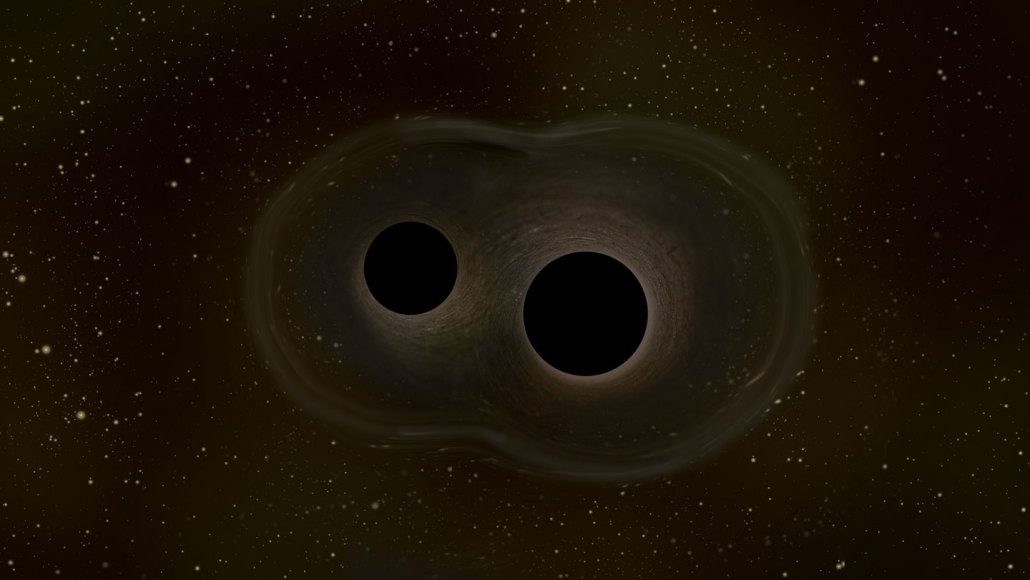
Одон орон судлаачид 4.4 тэрбум гэрлийн жилийн зайд орших аварга том эллипс хэлбэрийн галактикийн төвд одгүй хоосон орон зайг илрүүлжээ.
2018 онд анх бүртгэгдсэн, 3200 гэрлийн жилийн өргөнтэй энэхүү хоосон зайг олон жил сансрын тоосны үүл гэж таамаглаж байсан ч Жэймс Вэбб болон “Very Large Telescope” дурангийн шинэ ажиглалт энэхүү онолыг үгүйсгэв. Массачусетсийн технологийн их сургуулийн (MIT) одон орон судлаач Майкл Макдоналдаар удирдуулсан баг 2026 оны дөрөвдүгээр сарын 23-нд “The Astrophysical Journal Letters” сэтгүүлд нийтэлсэн судалгаагаар, энэхүү хоосон орон зай нь оддын дутагдлаас үүдэлтэй болохыг баталжээ. Тодруулбал, уг бүс нутгаас 2 тэрбум нартай тэнцэхүйц масстай од алга болсон нь тогтоогдсон байна.
Судалгаагаар тус галактикийн төвд нийт 60 тэрбум нартай тэнцэхүйц масстай, хоёр хар нүх хоорондоо спираль хэлбэрээр ойртон мөргөлдөх гэж буйг илрүүлжээ. Эдгээр хар нүх нь секундэд 370 км-ийн харьцангуй хурдтайгаар эргэлдэж байгаа бөгөөд тэдний хүчтэй таталцал нь орчны одуудыг гадагш шидэж, ийнхүү одгүй хоосон бүсийг үүсгэж байгаа аж.
Энэхүү нээлт нь сансар огторгуйн хэмжээнд маш ховор тохиолдох үзэгдэл бөгөөд ийм том хэмжээний хар нүхнүүд мөргөлдөх шатандаа байгааг ажигласан нь анхны тохиолдлуудын нэг юм. Эрдэмтэд уг мэдээллийг ашиглан галактикуудын мөргөлдөөн хэрхэн явагддаг болон тэдгээр нь галактикийн бүтцийг хэрхэн өөрчилдөг талаарх загваруудаа илүү нарийвчлах төлөвлөгөөтэй байна.
Дэлгэрэнгүйг эх сурвалжаас харах
↓Эх сурвалжийг нээх ↓
At the center of a distant galaxy called Abell 402-BCG, astronomers have identified a starless void stretching 3,200 light years across, a gap first spotted in 2018 and long assumed to be the work of obscuring cosmic dust. New observations now point to a different explanation: a pair of colliding ultramassive black holes carving the region empty as they spiral toward each other.
The galaxy sits inside the cluster Abell 402, roughly 4 billion light years from Earth, according to Sky & Telescope, with Futura-Sciences placing the distance at an estimated 4.4 billion light years. Together, the two suspected black holes carry an estimated combined mass of 60 billion times that of the sun, which would make the system at least twice as heavy as the next largest known black hole duo.
Space Telescopes Rule Out a Dust Cloud
When astronomers first noticed the dark patch at the galaxy’s core in 2018, the leading explanation was a cloud of dust blocking starlight from the region. Dust clouds are common in galaxy centers, and at the time there was no way to test the idea against an alternative. The gap sat unexplained for years, a quiet anomaly in an otherwise ordinary-looking giant elliptical galaxy.
A team led by MIT astronomer Michael McDonald revisited the mystery using the James Webb Space Telescope alongside the Very Large Telescope at the European Southern Observatory. The results were published April 23, 2026, in The Astrophysical Journal Letters, and they were designed specifically to test whether dust could still explain what Hubble had captured years earlier.
The test relied on how dust behaves at different wavelengths. A dust cloud should dim starlight less in the near-infrared light captured by JWST than in the optical light recorded by Hubble, since dust is more transparent to infrared. Instead, Sky & Telescope reports that the cavity looked equally dark in both, a result that does not match how dust normally behaves.
That consistency across wavelengths let the team rule out dust and conclude the void was genuinely empty of stars, not merely obscured. The researchers estimate that about 2 billion solar masses of stars are missing from the region, roughly 1% of the galaxy’s total stellar mass. For a region so small compared to the galaxy as a whole, that is a substantial and unusual deficit.
A Binary of Black Holes, Not a Single Void
With dust ruled out, the team looked for what could have physically removed that many stars. On one edge of the cavity, JWST picked up an infrared-bright point source with the spectral signature of an actively feeding black hole, the kind of glow produced when gas and dust fall inward and heat up before crossing the event horizon.
Follow-up spectroscopy strengthened the case. Observations with the MUSE spectrograph on the Very Large Telescope turned up a second, separate source of ionized gas on the opposite side of the void, consistent with a second active black hole rather than just one. That gave the team two candidate black holes bracketing the empty region rather than a single object at its center.
According to Sky & Telescope’s account of the study, the two sources show a relative velocity of about 370 kilometers per second, an indication that they are orbiting one another rather than sitting still. The researchers separately estimate that the wider core structure, some 6,500 light years across, was hollowed out earlier by a roughly 50 billion solar mass black hole formed in an even earlier merger.

Galaxy mergers set this kind of process in motion. When two galaxies collide, their central black holes get pulled toward each other by mutual gravity. As the black holes close the distance, their combined gravitational pull flings nearby stars outward, carving out a starless gap like the one observed in Abell 402-BCG, Futura-Sciences reports.
McDonald’s team concludes that Abell 402-BCG previously collided with another galaxy, and estimates the current black hole pair has orbited a common center of gravity for only a few tens of millions of years, a brief span by astronomical standards. In galactic terms, that makes this a recently formed pairing still in the early stages of its slow collapse toward one another.
What Happens When the Black Holes Merge
The two black holes are on a path to eventually merge into a single object of record-breaking scale. Individual black holes exceeding 60 billion solar masses have been identified only a handful of times before, according to Futura-Sciences, which makes both the current pairing and its eventual combined mass unusual even by the standards of the largest known black holes.
Science News notes that merging supermassive black holes have long been predicted but rarely observed in this advanced, close-orbit stage. Both the sheer mass of the two black holes and the fact that they were caught mid-merger, rather than before or long after, make the Abell 402-BCG sighting especially rare among the systems astronomers have studied so far.
Sky & Telescope reports that simulations suggest only about 0.5% of massive galaxies are caught in this particular phase of evolution at any given time. That low probability is part of why the discovery stands out: catching a galaxy in the act of hosting a close, spiraling black hole binary is a narrow window, and Abell 402-BCG appears to fall inside it.
Researchers plan to use the data to calculate how often large-scale galactic collisions like this occur across the universe, and to refine models of how such mergers reshape the galaxies that host them. The case also gives astronomers a template for spotting similar star-free cavities in other galaxies going forward.
Enjoyed this article? Subscribe to our free newsletter for engaging stories, exclusive content, and the latest news.

