Өмнөд Уэльсийн Гоуэр хойгийн шохойн чулуун агуйгаас олдсон улаан өнгийн зурааснууд нь 17,000 жилийн тэртээх, Их Британийн нутаг дэвсгэр дэх хамгийн эртний хадны зураг болохыг эрдэмтэд тогтоолоо.
Уг зургийг 1912 онд геологич Уильям Соллас, судлаач Анри Брёй нарын баг анх бүртгэж авсан ч хожим нь бусад судлаачид үүнийг хүний гараар бүтээгдээгүй, байгалийн жамаар тогтсон төмрийн исэл хэмээн үгүйсгэж байв. 2022 оны есдүгээр сард олон улсын судлаачдын баг уг зургийг дахин олж илрүүлэн, орчин үеийн дүрслэлийн арга болон лабораторийн шинжилгээгээр судалжээ.
“Quaternary” сэтгүүлд нийтлэгдсэн судалгаагаар, зурааснуудыг гематит буюу төмрийн ислээр гараар зурсан болохыг тогтоосон байна. Судлаачид зураасны дээр тогтсон кальцийн давхаргыг уран-торийн аргаар шинжилж, ойролцоогоор 17,000 жилийн настай гэсэн дүгнэлтэд хүрсэн нь тус бүс нутаг дахь дээд палеолитын үеийн урлагийн анхны баримт болж байна.
Ливерпүүлийн их сургуулийн археологич Жорж Нэш уг зураас нь агуйн гүн, харанхуй хэсэгт байрлаж байгаа нь тухайн үеийн хүмүүсийн зан үйл, эсвэл соёлын өвөрмөц туршлагатай холбоотой байж болохыг тэмдэглэжээ. “Bacon Hole” хэмээх энэхүү агуйгаас Ромын болон дундад зууны үеийн олдворууд ч олдсон нь хүн төрөлхтөн олон мянганы турш уг газрыг ашиглаж ирснийг гэрчилж байна.
Дэлгэрэнгүйг эх сурвалжаас харах
↓Эх сурвалжийг нээх ↓
Eleven horizontal red lines painted deep inside a limestone cave on the Gower Peninsula in south Wales have been dated to roughly 17,000 years ago, an age that would make them the oldest known rock art in the United Kingdom. The panel sits inside Bacon Hole, a cave in the cliffs above the Bristol Channel, and it was first noticed more than a century ago.
A new study in Quaternary has used pigment analysis and dating of the mineral crust covering the lines to argue the marks were made by hand rather than formed by nature. The claim revives a debate that dates back to the early 20th century, when the same panel was first recorded and then dismissed.
A Forgotten Find Rediscovered After a Century
Bacon Hole lies within the parish of Pennard, set into the limestone cliffs of south Gower and overlooking the Bristol Channel. The painted panel itself sits inside a side chamber east of the cave’s main gallery, in an area that receives no natural light. Reaching the cave requires a steep footpath along the cliff top.
The panel was first recorded in 1912 by geologist William Sollas and prehistorian Henri Breuil, who described the eleven horizontal lines as the first known example of Upper Palaeolithic cave art in Britain. Their identification drew international attention at the time.

That claim did not hold. By 1928, other researchers had concluded the red lines were mineral staining rather than human handiwork, attributing them to iron-oxide deposits seeping naturally through the rock. The debate faded, and the exact location of the panel inside the cave was eventually forgotten for decades.
It took until September 2022 for an international team of researchers to relocate the panel. Fieldwork continued over the following two years, combining new imaging methods with laboratory testing to reassess whether the lines were natural or man-made.
Pigment Analysis Points to Hematite Applied by Hand
Once the panel was relocated, researchers began with high-resolution photography of the wall. The images were processed using D-Stretch, a digital enhancement tool commonly used in archaeology to bring out faint patterns that are difficult to see with the naked eye.
In April 2023, a team from the First Art project collected pigment samples from the painted surface to test for organic residues. The goal was to determine whether the red coloring matched a known painting material or a natural mineral stain, a distinction central to the entire study.
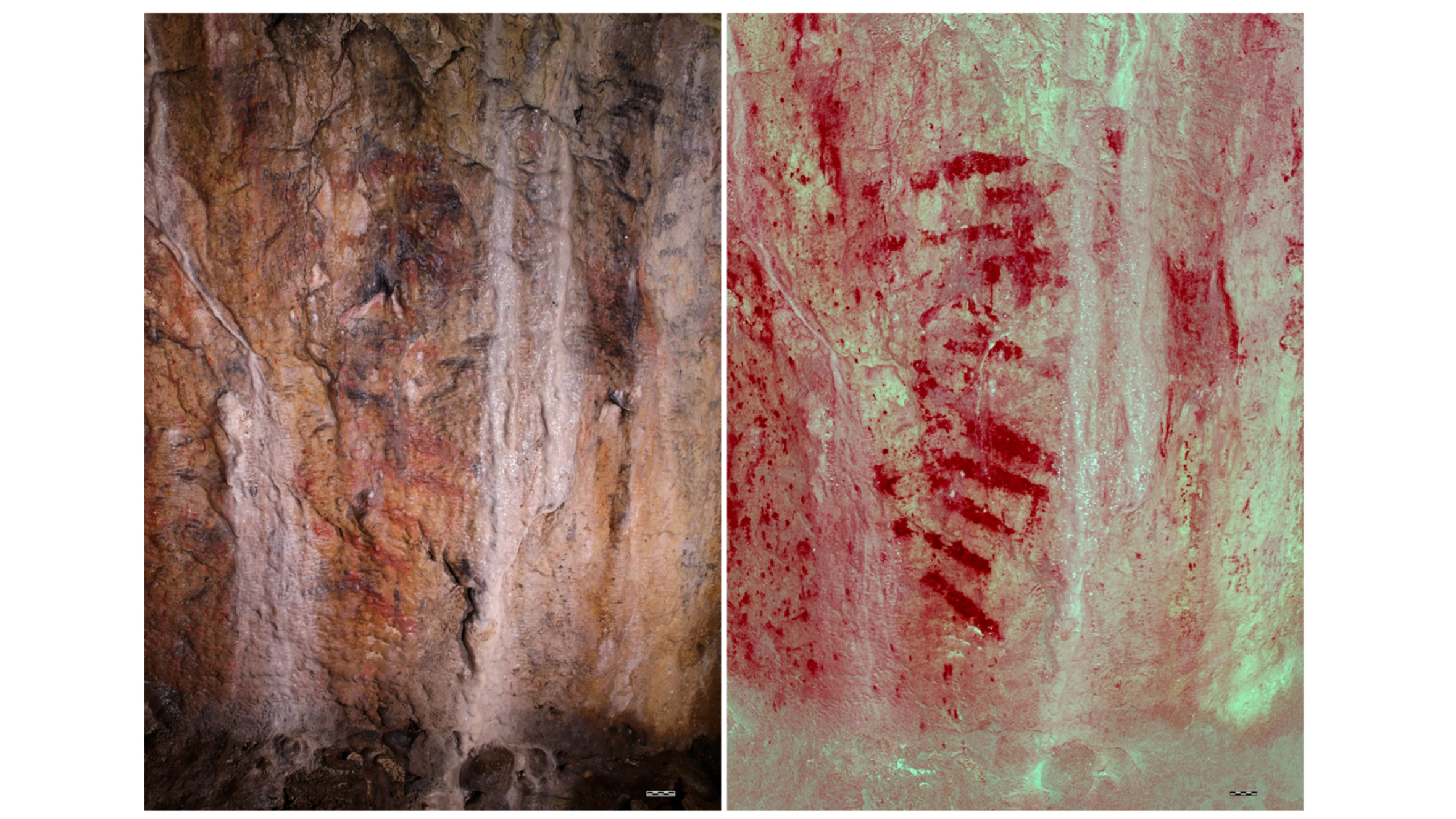
Spectroscopic testing on the samples identified the pigment as hematite, an iron-oxide compound widely used for painting by prehistoric groups. Hematite does occur naturally in parts of the cave, which is part of why the 1928 skeptics were able to argue the lines were geological in origin.
The researchers also found hematite elsewhere on the wall in the form of finger dots and small splashes, patterns that are hard to explain as a natural process. The eleven lines are spaced at regular, equal intervals, a detail the study’s authors cite as further evidence of deliberate, structured application.
Uranium-Thorium Dating Suggests an Age of About 17,000 Years
To estimate when the lines were painted, researchers from the University of Southampton collected samples in April 2023 from the thin white calcite crust that has formed over the panel. Uranium-thorium dating measures the radioactive decay of uranium trapped in calcite as it forms, giving a minimum age for the layer above the paint.
One sample placed the calcite’s formation at around 17,000 years ago, consistent with the end of the Upper Palaeolithic period in Britain. As a scientific control, the First Art team worked with researchers at Nanjing Normal University to run a second, independent dating analysis.

Not every sample agreed with the first result. Other calcite readings came back much younger, which the study attributes to groundwater seeping into the cave and forming new calcite layers on top of older ones over thousands of years, complicating any single reading.
The study’s authors have been careful not to overstate the finding. As reported by Live Science, the team cautioned that its age estimate rests on a single analysis and that further testing of the cave walls is needed. Live Science also notes that uranium-thorium dating can sometimes overestimate age, since groundwater passing through calcite can leach out uranium and make a sample appear older than it is.
A Cave Revisited Across Thousands of Years
Bacon Hole’s history extends well beyond the Upper Palaeolithic. Archaeologists working there have recovered pre-Roman pottery fragments, a Roman-era bone pin, a seventh-century Irish brooch, Saxon-era beads, and a medieval cooking pot, evidence that people returned to the cave across many different periods.
In 1894, a local fisherman added his own graffiti to the walls, layering modern marks on top of a site that already carried thousands of years of visits. The cave’s easy access from the shoreline below likely made it a convenient stop across many centuries.
Study first author George Nash, an archaeologist at the University of Liverpool, told Live Science that the location of the red-lined panel, deep in the darkest part of the cave, may be significant. “The darkness itself may have been an essential part of the ritual experience,” Nash said. He added that practical explanations alone, such as access to food resources on the plain and coastline below, may not fully account for why people kept returning to this particular chamber.
Bacon Hole is not currently a Scheduled Monument, but it sits within an Area of Outstanding Natural Beauty and is designated a Site of Special Scientific Interest. The cave remains under the custodianship of the National Trust.
Enjoyed this article? Subscribe to our free newsletter for engaging stories, exclusive content, and the latest news.