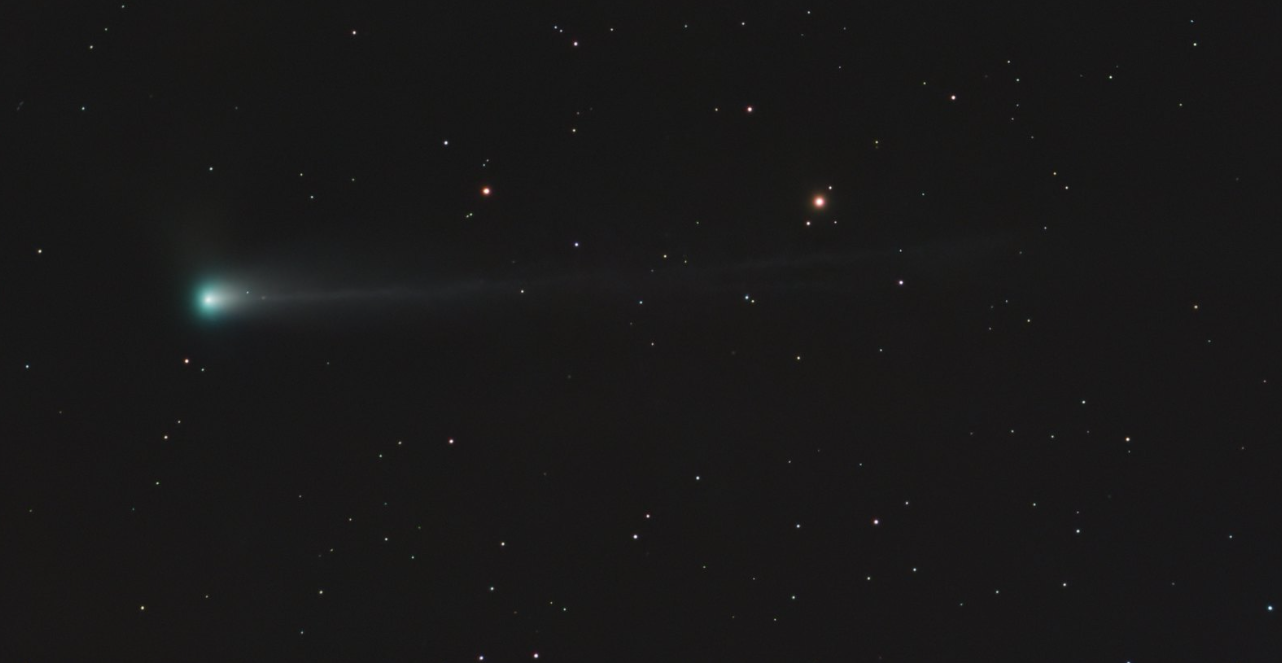
HD 7977 од манай нарны аймгийн ойролцоо өнгөрөхдөө таталцлын хүчээрээ дамжуулан сүүлт оддын урсгалыг манай зүг чиглүүлсэн байж болзошгүйг шинэ судалгаагаар тогтоожээ.
ESA-гийн Gaia сансрын дурангийн мэдээлэлд үндэслэн хийсэн уг судалгаагаар, 2.5 сая жилийн өмнө HD 7977 од манай нарны аймгийн гаднах бүрхүүл буюу Оортын үүлэн дундуур өнгөрсөн болохыг тогтоожээ. Урьдчилсан тооцоогоор уг од нарнаас 6,000–10,000 одон орны нэгжийн (AU) зайд зөрсөн байна. Энэхүү ойрын дайралт нь тухайн үед нарны аймгийн таталцлын тэнцвэрт байдлыг алдагдуулж, өнөөг хүртэл үргэлжилж буй сүүлт оддын цувааг үүсгэсэн байх магадлалтай гэж Planetary Science Institute-ийн эрдэмтэн Нэйтан Каиб тайлбарлав.
Судлаачид 1989 оноос хойш ажиглагдсан, нэг сая гаруй жилийн орбитын хугацаатай 112 хэт урт хугацаат сүүлт одны замд дүн шинжилгээ хийжээ. Үр дүнгээс харахад эдгээр сүүлт оддын байршил нь Сүүн зам галактикийн ерөнхий таталцлаас илүүтэйгээр HD 7977 одны нөлөөгөөр үүссэн байх шинжтэй байна. Энэхүү үзэгдэл нь манай нарны аймаг ховор бөгөөд хүчтэй сүүлт оддын борооны сүүлийн шатанд байгааг илтгэж байж болох юм.
https://www.psi.edu/blog/long-period-comets-orbits-reflect-close-passage-by-star-hd-7977/
HD 7977 нь нартай ойролцоо масстай, G-төрлийн од бөгөөд тухайн үед дэлхийгээс харахад Сугар гарагаас 40 дахин тод буюу өдрийн цагаар ч харагдахуйц гэрэлтэж байжээ. Эрдэмтэд Gaia дурангийн цуглуулсан асар их мэдээлэл болон Pan-STARRS, ATLAS зэрэг тэнгэрийн ажиглалтын хөтөлбөрүүдийн тусламжтайгаар сүүлт оддын гарал үүслийн талаарх нарийвчилсан мэдээллийг ирэх жилүүдэд илүү тодруулах боломжтой гэж үзэж байна.
https://www.esa.int/Science_Exploration/Space_Science/Gaia_overview
https://www.youtube.com/embed/wEZBNsU4dMU
Дэлгэрэнгүйг эх сурвалжаас харах
Эх сурвалжийг нээх ↓
A star’s passage near our solar system may have sent a hail of comets our way.
It’s strange to think. Though the stars and the constellations you see tonight may seem eternal, their positions and configurations do change slowly over time. Our Sun and the stars near us are like pedestrians on a long looping sidewalk, moving at varying speeds and directions on a roughly quarter of a billion year journey around the core of our Milky Way galaxy.
Now, a recent study out of the Planetary Science Institute notes that the close passage of the star HD 7977 may have triggered a cascade, sending long-period comets sunward. What’s more, the same uptick in long-period comets may still be underway today. The study was recently presented at the American Astronomical Society Division on Dynamical Astronomy.
The European Space Agency’s Gaia mission first identified the close passage of HD 7977 near our solar system. A successor to ESA’s Hipparcos mission, Gaia’s role was to make precise measurements in the brightness, position and motion of over a billion stars, in an effort to accurately map a local portion of our home galaxy. Gaia’s mission came to an end in early 2025, but the researchers will continue to pour over the enormous volume of data created by the mission through the remainder of the decade.
ESA’s Gaia spacecraft in the clean room ahead of launch. Credit: ESA.
The passage occurred 2.5 million years ago, when the early Pleistocene was just getting underway. Our early ancestors Australopithecus africanus (the descendants of Lucy, who lived a million years prior) dominated the scene at the time.
HD 7977 is a G-type, star, 1.07 times the mass of our Sun. Now located in the constellation of Cassiopeia the Queen, early estimates placed the passage of HD 7977 at 4,000 to 25,000 Astronomical Units (AUs) from the Sun. The recent study refines this value down to 6,000 to 10,000 AU. One AU is the distance from Earth to the Sun. For context, 10,000 AU is just under 16% of a light-year. Voyager 1, most distant human-built object ever sent into space, is now just over 171 AU from the Sun. Voyager 1 is expected to pass one light-day distant later this year.
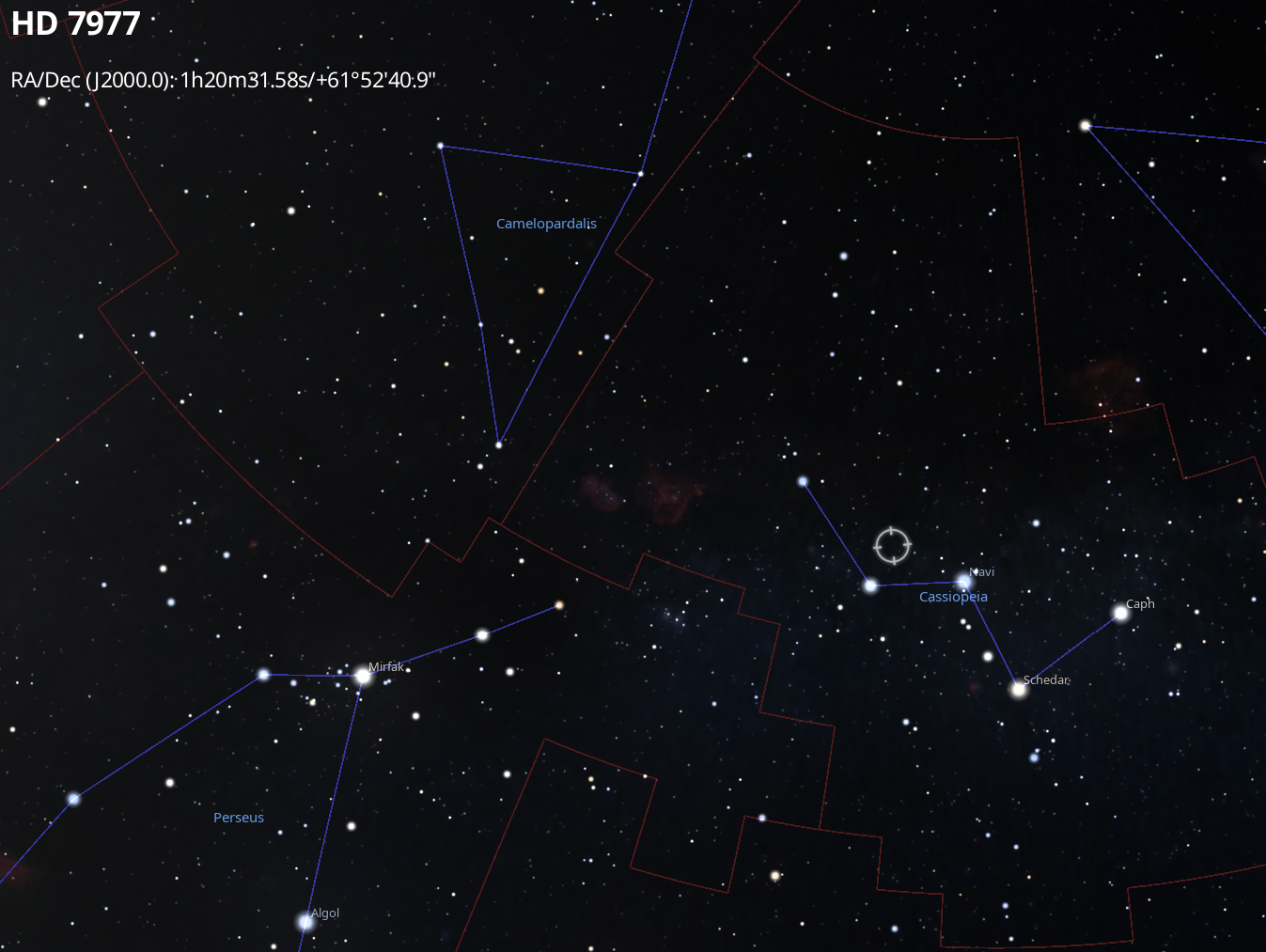 The current location of HD 7977 in the sky. Credit: Stellarium.
The study notes that HD 7977 may have passed close enough, that its gravitational influence may have dominated the sphere of our solar system, versus the average background pull of the Milky Way galaxy itself.
One tantalizing result shows that ultra-long period comets seen today are a good fit for the passage of HD 7977 through the outer solar system, while shorter period comets on repeat passages suggest the pull of the galactic disk was a bigger part of their origin story.
The estimate would have put the passage of HD 7977 within the distant Oort Cloud, the realm of the comets. This vast reservoir located 2,000 to 200,000 AU from the Sun is the source of long-period comets, which are occasionally jostled and sent sunward.
The study looked at the orbits of 112 ultra long-period comets seen since 1989. In astronomy, ‘periodic’ comets have an orbital period of less than 200 years, while long-period comets have longer periods of thousands of years or more. For the purposes of this study, however, researchers looked at comets with orbits longer than a million years, suggesting they are new, first-time visitors to the inner solar system.
“The distribution of comet orbits suggests we are living through an unusual time where HD 7977 has dominated the generation of new comets and not the larger gravitational field of the Milky Way, as it usually would,” says Planetary Senior Scientist Nathan Kaib (Universite de Bordeaux) in the recent Planetary Science Institute press release. “This would mean we’re living through the late stages of a pretty rare and powerful comet shower.”
Two long-period alumni in recent memory were comets C/2023 A3 Tsuchinshan-ATLAS, and C/2024 E1 Wierzchoś.
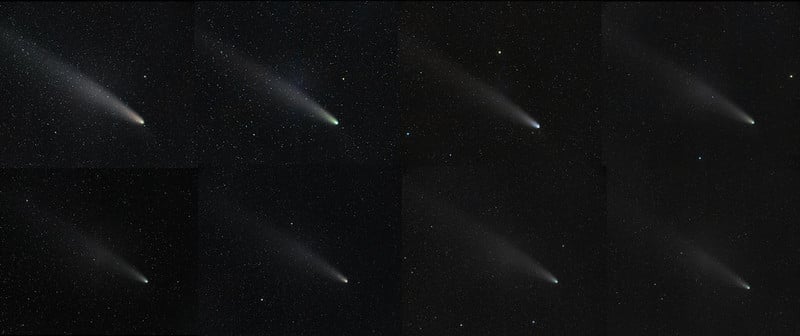 Long period comet C/2023 A3 Tsuchinshan-ATLAS from 2024. Credit: Eliot Herman.
As is often in the case in astronomy, a deeper look at the results is needed. Researchers in the study note that the orbital sizes of the comets involved aren’t always a good distribution match. It’s often tough to refine influences on orbits measured in the millions of years. Plus, more subtle dynamics such as jets, light pressure and more may be at play.
More insight could exist within Gaia’s unpublished datasets. We’re also nabbing fainter and more distant long period comets than ever before, thanks to sky surveys such as Pan-STARRS and ATLAS. We may soon get even more information as the decade-long Vera Rubin Observatory Legacy of Space and Time survey gets underway.
What would the passage of HD 7977 have looked like from Earth, millions of years ago? Well, a sun-like star as seen from 10,000 AU distant would shine at about -7th magnitude, 40 times brighter than Venus and easily visible in the daytime. You can bet our ancestors would have seen HD 7977 in their sky. To date, no exoplanets have been found orbiting HD 7977.
Other known close passages include Scholz’s Star (52,000 AU, about 70,000 years ago) and Gliese 710 (10,500 AU, 1.3 million years from now) though unlike HD 7977, both of those are smaller and fainter M-type red dwarfs.
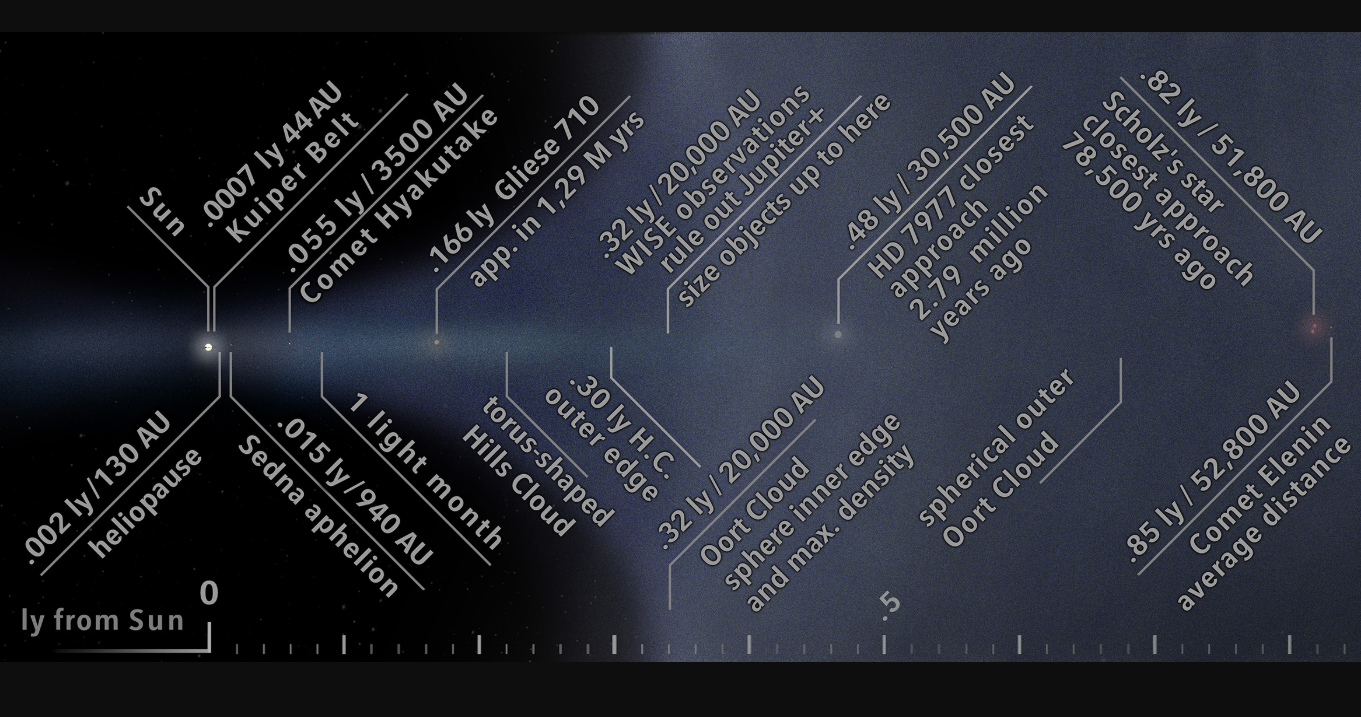 Past and future close passages to the Sun, to include HD 7977. Credit: Wikimedia Commons/Pablo Carlos Budassi/Under a CC BY-SA 4.0 license; see the full strip here.
It’s amazing to think: next time we see an ultra-long period comet entering the inner solar system, we’re still seeing the effects of a stellar passage near our us, long ago.

